
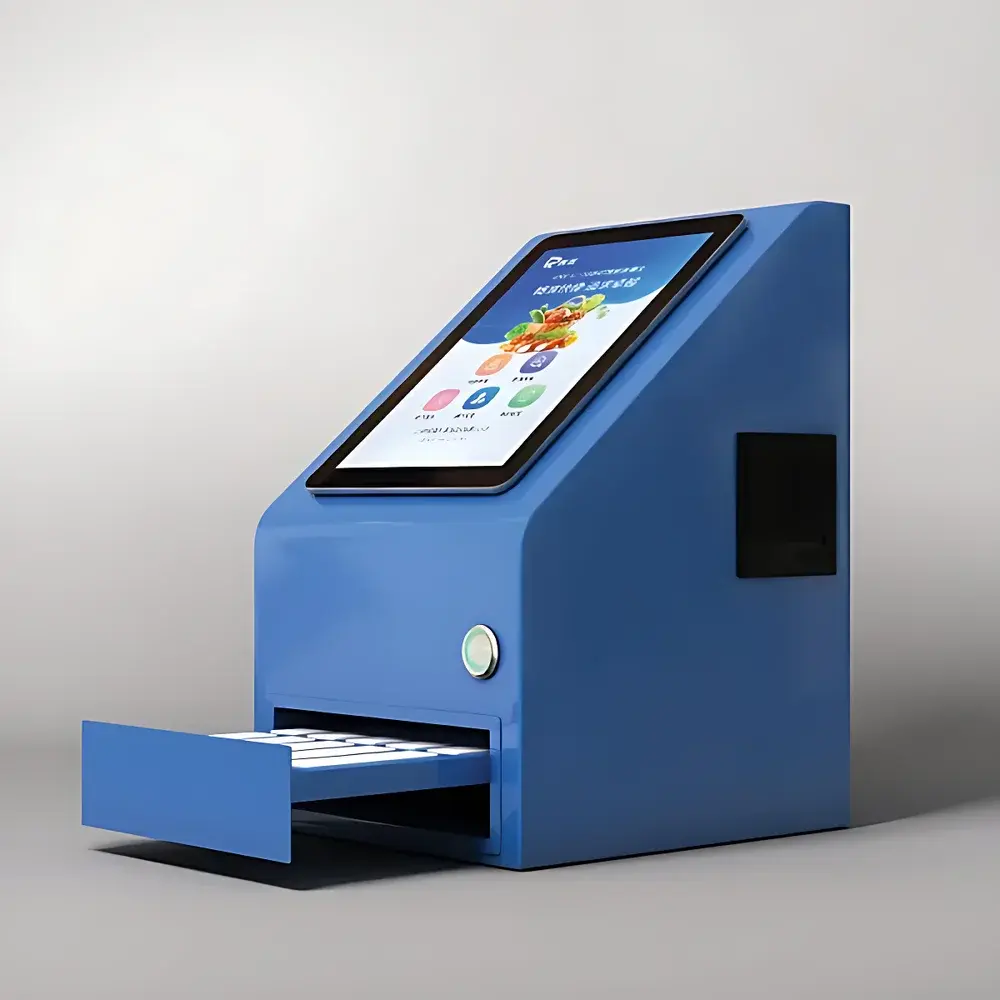
Ruixin JT-108SR Immuno-Colloidal Gold-Based Rapid Multi-Residue Analyzer for β-Agonists in Meat
| Brand | Ruixin |
|---|---|
| Origin | Shanghai, China |
| Manufacturer Type | Authorized Distributor |
| Regional Category | Domestic (PRC) |
| Model | JT-108SR |
| Price | USD 5,300 (approx.) |
| Function Type | Multi-analyte Screening Platform |
| Sample Compatibility | Universal for Porcine, Bovine & Ovine Tissues |
| Wavelength Range | 380–680 nm |
| Detection Time | ≤180 s per assay |
| Repeatability (CV) | ≤0.3% |
| Detection Channels | 8 parallel optical readout units |
| Measurement Speed | <1 s per test strip |
| Precision | CV <1% (intra-assay, certified control strips) |
| Sensitivity | LODs ranging from 0.5 ppb (clenbuterol, salbutamol, ractopamine) to 100 ppb (ribavirin) |
| Output Modes | Chromaticity analysis, C/T ratio quantification, T-line intensity, C-line validation |
| Interface | USB 2.0 |
| Network | Wi-Fi (802.11 b/g/n), RJ45 Ethernet, optional 4G LTE module |
| Power Supply | AC 220 V ±10%, 50 Hz |
| Operating System | Android-based embedded UI |
| Display | 10.1-inch capacitive touchscreen |
| Data Storage | Internal eMMC + microSD expansion (≥1 million records) |
| Connectivity | Cloud API support, QR-code–enabled traceability, GPS/AGPS geotagging |
Overview
The Ruixin JT-108SR is a CE-compliant, laboratory-grade immuno-colloidal gold rapid analyzer engineered for quantitative interpretation of lateral flow immunochromatographic assays (LFIA) targeting β-adrenergic agonists—commonly referred to as “lean meat agents”—in raw and processed meat matrices. Unlike conventional visual interpretation, the JT-108SR employs high-resolution CCD imaging coupled with algorithm-driven optical density mapping across the full visible spectrum (380–680 nm) to convert qualitative strip signals into reproducible, traceable numerical outputs. Its core architecture follows the principles of reflectance photometry and dual-line ratio analysis (C/T), enabling objective, operator-independent quantification without calibration curves for semi-quantitative screening or with reference standards for confirmatory-tier reporting. Designed for use in slaughterhouse QC labs, agricultural cooperatives, food safety supervision centers, and third-party testing facilities, the system meets functional requirements aligned with GB/T 22286–2008 (Chinese national standard for β-agonist detection in animal tissues) and supports audit-ready workflows compatible with GLP documentation practices.
Key Features
- Eight independent optical detection channels enable simultaneous processing of up to eight lateral flow strips—maximizing throughput without cross-channel interference.
- Automated strip recognition identifies valid assay cards in real time; invalid or improperly inserted strips are flagged prior to analysis, eliminating false-negative risk from mechanical misalignment.
- Android-based embedded OS with intuitive 10.1-inch touchscreen interface ensures low-training deployment across multilingual field teams.
- Integrated data management suite stores full-resolution strip images, C/T ratios, chromaticity profiles, and geotagged metadata—retained locally on eMMC and expandable microSD card (supporting >1 million records).
- Open firmware architecture enables remote OTA updates, modular app deployment, and integration with regional food traceability platforms via RESTful API.
- Multi-format printing capability includes thermal roll paper (for immediate labelling), adhesive label stock (with GS1-compliant traceability QR codes), and A4 output for regulatory submission packages.
- Dual-network redundancy: Built-in Wi-Fi (802.11 b/g/n) and Gigabit Ethernet (RJ45) ensure uninterrupted cloud synchronization; optional 4G LTE module supports offline-to-online data reconciliation in remote abattoirs.
Sample Compatibility & Compliance
The JT-108SR is validated for homogenized tissue extracts from porcine, bovine, and ovine muscle samples prepared according to standard AOAC 2007.01–derived extraction protocols. It accommodates commercially available colloidal gold test kits certified under CNAS-accredited manufacturing (e.g., kits meeting ISO/IEC 17025:2017 criteria). While not a primary confirmatory instrument, its quantitative output satisfies pre-screening thresholds stipulated in China’s Ministry of Agriculture and Rural Affairs Notice No. 229 [2020] and provides evidentiary support for follow-up LC-MS/MS verification. All software logs—including timestamped image capture, user ID, GPS coordinates, and result classification—are structured to comply with basic 21 CFR Part 11 data integrity expectations for electronic records.
Software & Data Management
The embedded analytical engine performs pixel-level grayscale normalization, background subtraction, and spatial filtering to suppress ambient light variance and strip batch heterogeneity. Each assay generates a standardized JSON payload containing raw optical intensities, calculated C/T ratios, pass/fail status per analyte, and digital signatures for tamper-evident archiving. Data export options include CSV (for Excel-based statistical review), PDF reports (with embedded QR codes linking to cloud-hosted raw data), and direct push to Ruixin’s RuixinTrace™ cloud platform—supporting role-based access control, automated dashboard generation, and API-based interoperability with provincial food safety monitoring systems (e.g., Guangdong Food Safety Supervision Platform).
Applications
- Routine surveillance at meat processing plants: daily batch screening of carcass samples prior to chilling or packaging.
- Regulatory field inspections: mobile deployment by municipal food safety enforcement officers using integrated GPS tagging and real-time upload.
- Cooperative quality assurance: enabling farmer groups to issue digitally signed, scannable certificates of analysis (CoA) for premium market access.
- Contract laboratory triage: high-volume pre-sorting of samples prior to confirmatory LC-MS/MS analysis, reducing instrument queue time by >60%.
- Educational use: standardized training platform for veterinary public health curricula focusing on rapid diagnostic methodology and data integrity fundamentals.
FAQ
Does the JT-108SR require external calibration standards for routine operation?
No—its optical engine is factory-calibrated against NIST-traceable reflectance standards. Daily verification uses built-in reference strips; quantitative reporting relies on kit-specific calibration curves provided by the test strip manufacturer.
Can the instrument be integrated into an existing LIMS environment?
Yes—via configurable HTTP POST endpoints and CSV batch import. Pre-built connectors are available for major Chinese provincial LIMS deployments (e.g., Zhejiang, Sichuan, and Shandong provincial platforms).
Is the software compliant with FDA 21 CFR Part 11 requirements?
The system supports audit trail logging, electronic signatures, and role-based permissions—meeting foundational elements of Part 11. Full compliance requires site-specific validation protocols and documented SOPs, which Ruixin provides as part of its GxP Implementation Package.
What is the expected service life of the CCD sensor under continuous operation?
Rated for ≥50,000 measurement cycles with no degradation in signal-to-noise ratio, assuming ambient operating temperatures between 10–35°C and relative humidity <80% non-condensing.
Are consumables (e.g., test strips) included with the instrument?
No—test strips must be sourced separately from Ruixin-certified suppliers. The JT-108SR supports all major domestic LFIA brands compliant with GB/T 22286–2008, but performance validation is required for each new lot prior to routine use.





