
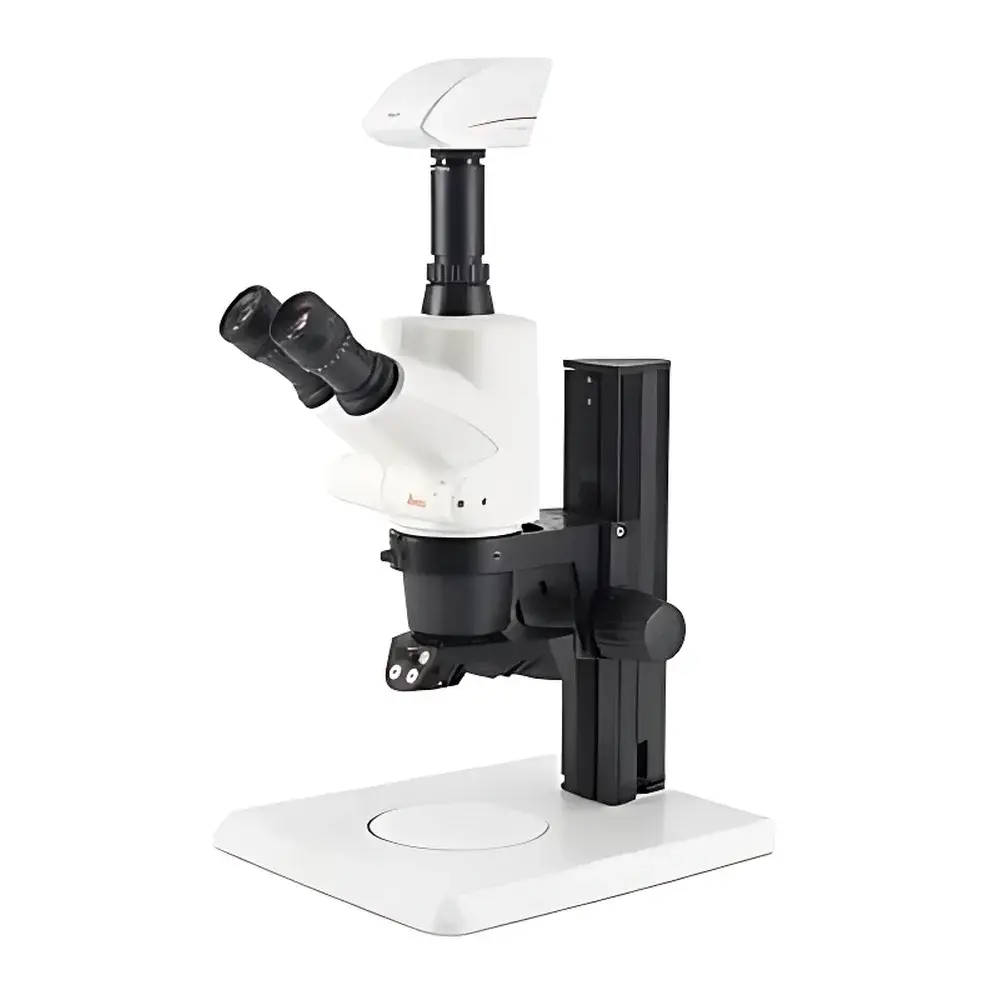
Leica LED3000 NVI Vertical Illumination System for Stereo Microscopes
| Brand | Leica |
|---|---|
| Origin | Germany |
| Model | LED3000 NVI |
| Light Source | Dual high-CRI white LEDs |
| Illumination Geometry | Near-vertical (±15° from optical axis) |
| Rated Lifetime | ≥50,000 hours at full output |
| Color Rendering Index (CRI) | ≥95 |
| Correlated Color Temperature (CCT) | 5600 K ± 200 K |
| Compatibility | Leica M-series and Z-series stereo microscopes with NVI port |
| Software Integration | Fully supported in Leica LAS X v3.7+ with illumination parameter logging and recall |
| Compliance | CE, RoHS, IEC 61000-6-3 (EMC), IEC 62471 (Photobiological Safety Class 1) |
Overview
The Leica LED3000 NVI is a purpose-engineered near-vertical illumination system designed exclusively for Leica stereo microscopes equipped with the NVI (Near-Vertical Illumination) interface—primarily the M125, M165 C/FC, M205 A/C, and Z6/Z16 series. Unlike conventional coaxial or oblique ring lights, the LED3000 NVI employs two precisely aligned, high-luminance white LEDs positioned within ±15° of the optical axis, delivering collimated, shadow-minimized illumination directly along the viewing path. This geometry enables high-fidelity surface inspection of topographically complex specimens—including deep cavities, threaded features, recessed solder joints, and micro-machined channels—where traditional angled lighting induces masking shadows or specular glare. The system operates on the principle of quasi-coaxial illumination: light enters the optical path just prior to the objective, reflects diffusely off the specimen surface, and returns through the same path, maximizing signal-to-noise ratio for digital image capture without requiring post-acquisition color correction.
Key Features
- Dual high-CRI (≥95) white LED array calibrated to 5600 K CCT, replicating natural daylight spectral distribution for accurate color fidelity across biological, metallurgical, and electronic samples.
- Near-vertical illumination architecture eliminates parallax-induced shadowing, enabling consistent visualization of vertical sidewalls, blind holes, and undercut geometries without manual repositioning.
- Integrated thermal management ensures stable luminous flux over time; no perceptible intensity drift during extended operation (>8 h continuous use).
- Direct hardware-level synchronization with Leica LAS X software: illumination state (intensity, on/off), exposure time, and camera gain are stored as metadata within each acquired image file.
- Zero-latency dimming control via LAS X interface or optional footswitch (sold separately); intensity resolution of 0.1% across 0–100% range.
- Class 1 photobiological safety certified per IEC 62471—no UV or IR emission, safe for prolonged operator use under ISO 8596 visual ergonomics guidelines.
Sample Compatibility & Compliance
The LED3000 NVI is validated for routine use with non-fluorescent, non-autofluorescent specimens across industrial QA/QC, failure analysis, and academic morphology studies. It supports reflective, translucent, and low-contrast matte surfaces—including PCB assemblies, ceramic substrates, polymer injection-molded parts, and histological tissue sections mounted on glass slides. The system complies with EU regulatory frameworks including CE marking under the Machinery Directive 2006/42/EC and EMC Directive 2014/30/EU. For regulated environments, LAS X software operation with LED3000 NVI parameters satisfies audit requirements under FDA 21 CFR Part 11 when configured with electronic signatures and immutable audit trails. All firmware and driver updates adhere to Leica’s GLP-aligned change control process.
Software & Data Management
Leica LAS X v3.7 and later provide native support for LED3000 NVI configuration, enabling full parametric reproducibility. Users can define and save illumination presets—each linked to specific magnification, camera binning, and exposure settings—within experiment templates. During acquisition, real-time LED intensity values are embedded into TIFF and JPEG metadata (EXIF and custom Leica tags). Batch processing workflows allow retrospective adjustment of illumination profiles across datasets, while the LAS X “Light History” panel logs timestamped changes for traceability. Exported reports include illumination metadata compliant with ISO/IEC 17025 documentation standards for accredited laboratories.
Applications
- Electronics manufacturing: Inspection of solder paste volume, void detection in BGA packages, and coplanarity verification of fine-pitch QFN leads.
- Precision machining: Assessment of burr formation, tool wear marks, and surface finish consistency on stainless steel and titanium components.
- Medical device assembly: Visual validation of laser-weld seam integrity, catheter lumen alignment, and adhesive bond coverage on polymer housings.
- Academic morphology: Documentation of insect exoskeleton microstructures, plant trichome orientation, and fungal hyphal branching patterns without color shift artifacts.
- Forensic evidence examination: Non-destructive analysis of bullet striations, toolmark impressions, and fiber surface texture under spectrally neutral illumination.
FAQ
Is the LED3000 NVI compatible with non-Leica stereo microscopes?
No. The system requires the proprietary NVI mechanical and electrical interface found only on designated Leica M- and Z-series stands. Adapters or third-party couplers are not supported and may compromise optical alignment or safety certification.
Does the system support automated focus stacking with illumination synchronization?
Yes. When used with Leica DMC6200 or DFC9000 GT cameras and LAS X AutoStack module, LED intensity remains constant across focal planes, and illumination metadata is preserved for each slice in the Z-stack.
Can illumination parameters be controlled programmatically via API?
Yes. Leica provides a documented COM-based automation interface (LAS X Automation SDK) enabling remote control of LED intensity, on/off state, and preset recall from Python, MATLAB, or LabVIEW environments.
What maintenance is required over its 50,000-hour lifetime?
None beyond periodic lens cleaning using optics-grade isopropanol and lint-free wipes. The LED modules are sealed and non-user-serviceable; end-of-life replacement is performed by authorized Leica service centers.
Is calibration required before first use or after firmware updates?
No. The system ships with factory-calibrated photometric output and does not require user calibration. Firmware updates preserve all illumination characterization data and do not affect radiometric accuracy.




