
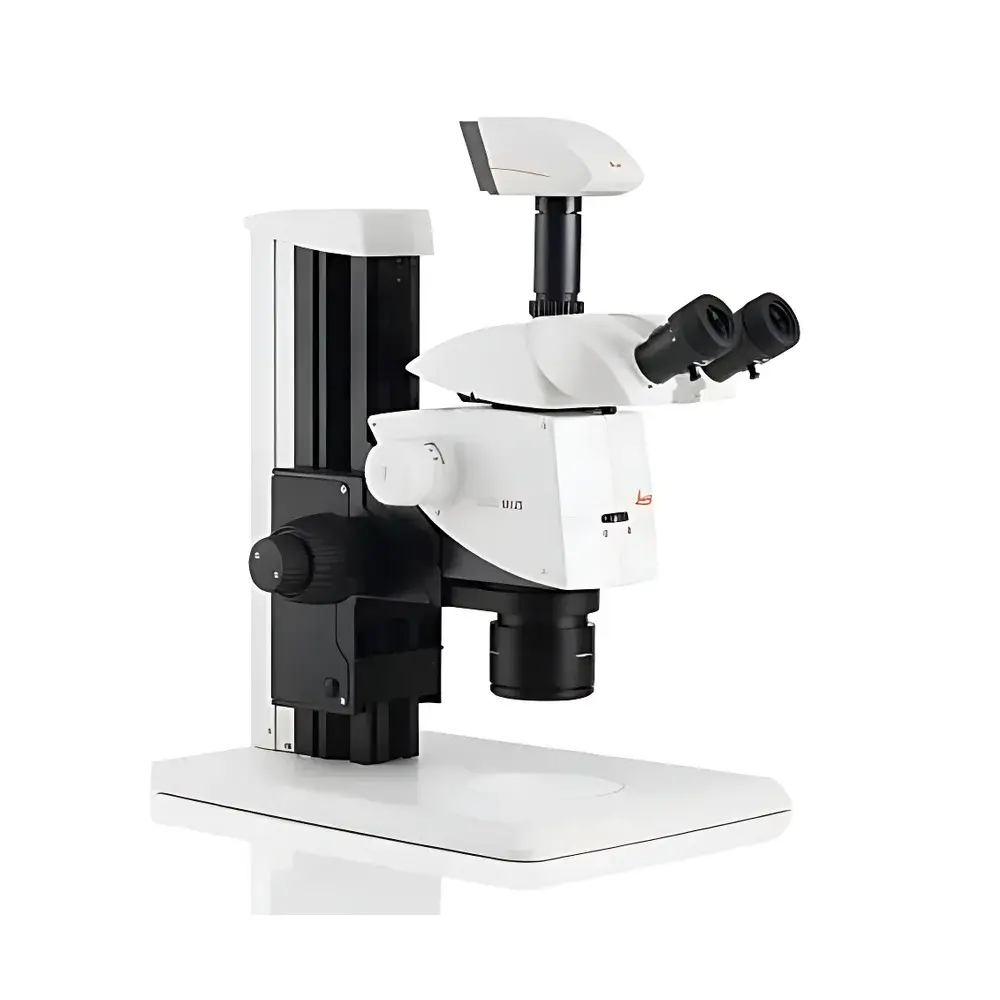
Leica M125 Stereo Microscope
| Brand | Leica |
|---|---|
| Origin | Germany |
| Model | M125 |
| Total Magnification Range | 8×–100× |
| Zoom Ratio | 12.5 : 1 |
| Field Diameter | 28.8 mm (at 8×) to 2.3 mm (at 100×) |
| Working Distance | 61.5 mm (with 1× Plan Apo Chromat objective) |
| Objective Type | 1× Plan Apo Chromat (standard) |
| Numerical Aperture | 0.288 |
| Depth of Field Control | Dual adjustable aperture |
| Viewing Angle | 30° trinocular tube |
| Resolution | Up to 864 lp/mm (with optimal optical configuration) |
| Eyepiece Options | 10×/23 mm, 16×/15 mm, 25×/9.5 mm, 40×/6 mm wide-field eyepieces |
| Diopter Adjustment | ±5° per eyepiece |
| Compatible Objectives | 0.5×, 0.63×, 0.8×, 1×, 1.6×, 2× Plan Apo Chromat and Plan Achromat objectives |
| Illumination | LED or cold-light sources (optional) |
| Imaging Interface | C-mount compatible for CCD/camera systems |
| Software Compatibility | Supports Leica Application Suite (LAS), LAS X, and third-party image analysis platforms compliant with TWAIN/DirectShow |
Overview
The Leica M125 Stereo Microscope is a high-performance, modular CMO (Common Main Objective) stereo imaging system engineered for precision visual inspection, documentation, and analytical tasks across life sciences, materials science, electronics, and industrial quality control laboratories. Introduced in 2008, it implements an advanced optical architecture featuring fully corrected infinite-conjugate optics with dual-axis (axial and radial) apochromatic correction—ensuring minimal chromatic and spherical aberration across the entire zoom range. Its CMO design employs a single shared objective lens for both observation paths, eliminating parallax and delivering superior co-axiality, depth fidelity, and image consistency compared to traditional Greenough-type stereomicroscopes. The system achieves maximum theoretical resolution of 864 line pairs per millimeter under optimal configuration (e.g., 2× Plan Apo Chromat objective with 40× eyepieces), with practical resolution maintained at ≥432 lp/mm across standard operating conditions (1× objective / 10× eyepieces). The 30° inclined trinocular tube supports ergonomic viewing and simultaneous imaging, while the built-in dual variable aperture enables precise control over depth of field and contrast—critical for layered sample analysis and surface topography assessment.
Key Features
- CMO optical path with apochromatically corrected infinite-conjugate optics for zero parallax and high-fidelity stereoscopic imaging
- 12.5:1 continuous zoom ratio (8×–100× standard magnification; up to 800× with auxiliary lenses and high-magnification eyepieces)
- Modular platform supporting interchangeable objectives (0.5×–2×), wide-field eyepieces (10×–40×), and illumination modules
- Dual adjustable aperture system for independent control of illumination intensity and depth-of-field optimization
- Multi-coated, lead-free optical components meeting RoHS Directive 2011/65/EU compliance
- Surface resistivity >2×10¹¹ Ω/mm²; electrostatic discharge time <2 seconds (1000 V → 100 V), ensuring ESD-safe operation in microelectronics environments
- Trinocular port with C-mount interface (1× magnification factor) for seamless integration with digital cameras and machine vision systems
- Diopter adjustment (±5° per eyepiece) and optional reticle-ready eyepiece tubes for quantitative measurement workflows
Sample Compatibility & Compliance
The Leica M125 accommodates diverse specimen types—from live biological specimens in petri dishes and dissected tissue preparations to metallurgical cross-sections, solder joints, PCB assemblies, polymer composites, and geological thin sections. Its extended working distances (20.1 mm to 135 mm, depending on objective selection) enable manipulation under the objective using micromanipulators or fine-tipped tools. The microscope complies with ISO 10934-1:2004 (optical microscopy — terminology), DIN EN 61000-6-3:2019 (EMC emission requirements), and IEC 61000-6-2:2019 (immunity standards). When used with Leica-certified digital imaging hardware and LAS X software, the system supports audit trails, user access control, and electronic signature functionality aligned with FDA 21 CFR Part 11 and GLP/GMP documentation requirements.
Software & Data Management
The M125 integrates natively with Leica Application Suite (LAS) and LAS X software platforms, enabling automated acquisition, multi-channel fluorescence overlay (when equipped with filter cubes), Z-stack reconstruction, extended depth-of-field (EDF) rendering, and calibrated morphometric analysis. Image metadata—including magnification, objective ID, illumination settings, and timestamp—is embedded in TIFF and JPEG files per EXIF 2.31 specification. Third-party compatibility includes TWAIN and DirectShow drivers for integration into custom LIMS or MES environments. Optional hardware modules support motorized zoom memory recall (13 preset positions), programmable focus tracking, and synchronized illumination ramping—facilitating repeatable SOP-driven workflows in regulated QA/QC labs.
Applications
- Life sciences: Embryology, dissection, histology slide screening, and developmental biology imaging
- Materials science: Fracture surface analysis, grain boundary evaluation, coating uniformity inspection
- Electronics manufacturing: SMT solder joint verification, wire bonding assessment, counterfeit component identification
- Forensics: Toolmark comparison, fiber and trace evidence examination
- Pharmaceutical QA: Tablet coating integrity, capsule fill inspection, excipient particle morphology
- Educational labs: Modular teaching platform supporting progressive skill development from basic observation to quantitative metrology
FAQ
What is the difference between CMO and Greenough optical designs in stereo microscopes?
The CMO (Common Main Objective) design uses a single objective lens shared by both eyepieces, ensuring perfect co-axiality, zero parallax, and consistent magnification across both eyes—ideal for photomicrography and measurement accuracy. Greenough systems employ two separate objective paths, introducing inherent parallax and limiting high-magnification stability.
Can the M125 be validated for GxP-compliant environments?
Yes—when paired with Leica’s validated LAS X software version 3.7+ and configured with audit trail logging, electronic signatures, and role-based access control, the system meets core requirements of FDA 21 CFR Part 11, EU Annex 11, and ISO/IEC 17025 for accredited testing laboratories.
Is motorized zoom or focus available as an upgrade?
Motorized zoom (M-Zoom) and motorized focus (M-Focus) modules are available as factory-installed options or field-upgradable accessories, supporting programmable protocol execution and remote operation via Ethernet or USB.
What is the maximum usable resolution with standard configurations?
At 100× total magnification (1× objective + 10× eyepieces), the system delivers ≥432 lp/mm resolution. With 2× Plan Apo Chromat objective and 40× eyepieces (800×), theoretical resolution reaches 864 lp/mm—limited only by diffraction and illumination coherence.
Does the M125 support fluorescence imaging?
Yes—via optional filter cube insertions in the epi-illumination port and compatibility with Leica’s EL6000 or LED-based fluorescence light sources, enabling reflected-light fluorescence applications such as GFP-tagged tissue screening or fluorescent particle detection.





