
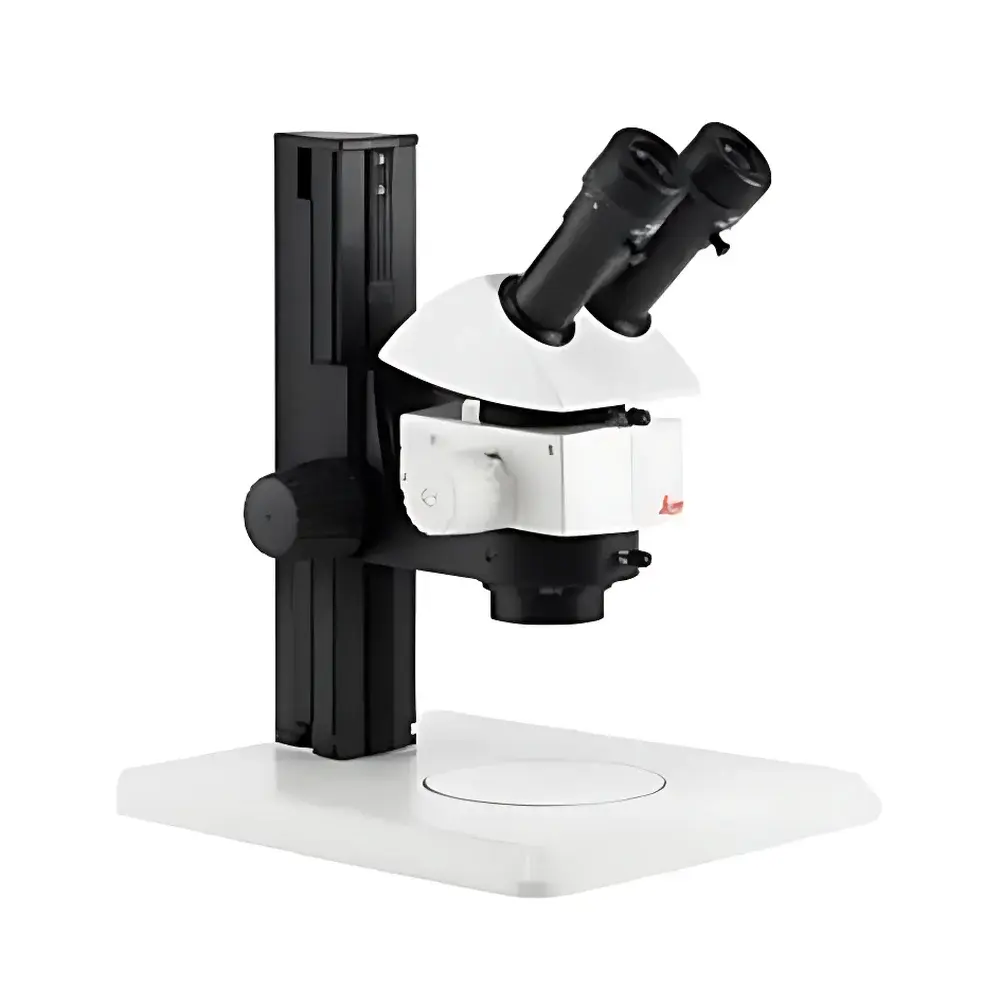
Leica M50 Stereo Microscope
| Brand | Leica |
|---|---|
| Origin | Germany |
| Model | M50 |
| Zoom Ratio | 5:1 |
| Magnification Range (with standard optics) | 6.3×–40× |
| Max. Total Magnification | 320× |
| Objective Types | Achromatic (0.32×–2.0×), Plan Achromatic (0.8×–1.6×) |
| Working Distance Range | 27.4 mm – 303 mm |
| Field of View Diameter | 5.75 mm – 116.8 mm |
| Resolution (at 40×) | 225 lp/mm |
| Numerical Aperture (1× objective) | 0.15 |
| Ergonomic Viewing Angle | 10°–50° |
| ESD Compliance | Surface Resistivity 2×10¹¹ Ω/mm², Discharge Time <2 s (1000 V → 100 V) |
| Optical Design | Common Main Objective (CMO), Parallel Light Path |
| Coating | Multi-layer anti-reflective coatings |
| Eyepieces | Wide-field 10×, 16×, 25×, 40× with adjustable eyecups and click-stop positioning |
Overview
The Leica M50 Stereo Microscope is a high-precision, ergonomically engineered instrument designed for routine inspection, quality control, assembly, and documentation tasks in industrial, academic, and clinical laboratory environments. Built upon Leica Microsystems’ decades-long heritage in optical design, the M50 employs a Common Main Objective (CMO) architecture with parallel light paths—eliminating the optical distortion and visual fatigue associated with traditional Greenough-style (V-path) stereo microscopes. This CMO configuration ensures consistent image geometry, superior depth of field, and exceptional lateral resolution across the entire zoom range. With a fixed 5:1 zoom ratio and five discrete magnification steps (6.3×, 10×, 16×, 25×, 40×), the M50 delivers repeatable, calibration-stable magnification settings critical for comparative analysis, dimensional measurement, and standardized imaging workflows. Its modular design supports seamless integration with digital cameras, LED illumination systems, and ergonomic accessories compliant with ISO 9241-5 and EN 61326-1 standards.
Key Features
- Parallel-optics CMO system enabling true stereoscopic fidelity, reduced eye strain, and long-term operator comfort—validated per DIN EN ISO 10993-5 for occupational safety in extended-use applications.
- Five-step manual zoom turret with tactile click-stop positioning—ensures precise, repeatable magnification selection without refocusing or repositioning.
- Interchangeable achromatic and plan achromatic objectives (0.32× to 2.0×), supporting working distances from 27.4 mm to 303 mm and FOV diameters up to 116.8 mm—ideal for large specimens or fine-detail work.
- Wide-field eyepieces (10×, 16×, 25×, 40×) with adjustable eyecups and diopter compensation; binocular tube offers continuously variable inclination (10°–50°) for individualized posture alignment.
- ESD-safe construction: conductive housing with surface resistivity of 2×10¹¹ Ω/mm² and sub-2-second discharge time (1000 V → 100 V), meeting IEC 61340-5-1 requirements for electrostatic-sensitive device handling.
- Multi-layer broadband anti-reflective coatings on all optical surfaces—optimized for visible spectrum transmission (>92% per surface) and minimal chromatic aberration, even at maximum magnification.
Sample Compatibility & Compliance
The Leica M50 accommodates diverse sample geometries—from PCB assemblies and mechanical components to biological tissue sections and botanical specimens—without requiring stage reconfiguration. Its extended working distance range enables unobstructed access for tweezers, pipettes, or soldering tools under observation. All optical components are lead-free and RoHS-compliant. The system meets CE marking requirements under the EU Machinery Directive 2006/42/EC and Electromagnetic Compatibility Directive 2014/30/EU. For regulated environments, the M50’s stable optical calibration and mechanical repeatability support adherence to ASTM E29-23 (standard practice for using significant digits), ISO/IEC 17025:2017 (calibration traceability), and GLP documentation protocols when paired with Leica Application Suite (LAS) X software.
Software & Data Management
While the M50 operates as a standalone optical platform, it is fully compatible with Leica’s LAS X software suite for image acquisition, annotation, measurement (length, area, angle, particle count), and report generation. LAS X supports FDA 21 CFR Part 11 compliance through optional audit trail activation, electronic signatures, and user-access controls. Image metadata—including magnification, objective ID, illumination settings, and timestamp—is embedded automatically in TIFF and JPEG outputs. The microscope’s standardized camera port (C-mount) allows integration with third-party CMOS sensors (e.g., Basler ace, FLIR Blackfly) and supports live streaming via USB 3.0 or GigE Vision interfaces for remote collaboration or inline process monitoring.
Applications
- Electronics manufacturing: SMT component placement verification, solder joint inspection, and counterfeit IC detection.
- Life sciences: Dissection of model organisms, embryonic staging, and histological slide screening.
- Materials science: Fracture surface analysis, coating uniformity assessment, and fiber morphology evaluation.
- Forensics: Toolmark comparison, gunshot residue characterization, and document authenticity examination.
- Education: Student microscopy labs requiring robust, intuitive instrumentation with low maintenance overhead.
FAQ
Does the Leica M50 support motorized zoom or focus?
No—the M50 features manual zoom and coarse/fine focusing mechanisms. Motorization is available on higher-tier models (e.g., M125, M205) but intentionally omitted here to prioritize mechanical stability, cost efficiency, and service longevity.
Can I use third-party objectives or eyepieces?
Leica does not guarantee optical performance or mechanical compatibility with non-Leica accessories. Only Leica-certified objectives and ErgoModules® eyepiece systems maintain specified resolution, working distance, and ESD integrity.
Is the M50 suitable for photomicrography in regulated GxP environments?
Yes—when configured with LAS X software and validated camera modules, the system supports ALCOA+ data integrity principles and can be included in IQ/OQ/PQ validation protocols per Annex 11 and USP .
What illumination options are compatible?
The M50 accepts Leica LED3000 RL (ring light), LED5000 TL (transmitted light), and KL300 LED cold-light sources—all with intensity control, color temperature stability (<50 K drift), and flicker-free output.
How is calibration maintained over time?
The fixed-position zoom turret and hardened gear train ensure zero drift between magnification steps. Annual verification using NIST-traceable stage micrometers and resolution test targets is recommended per ISO 10993-5 guidance.




