
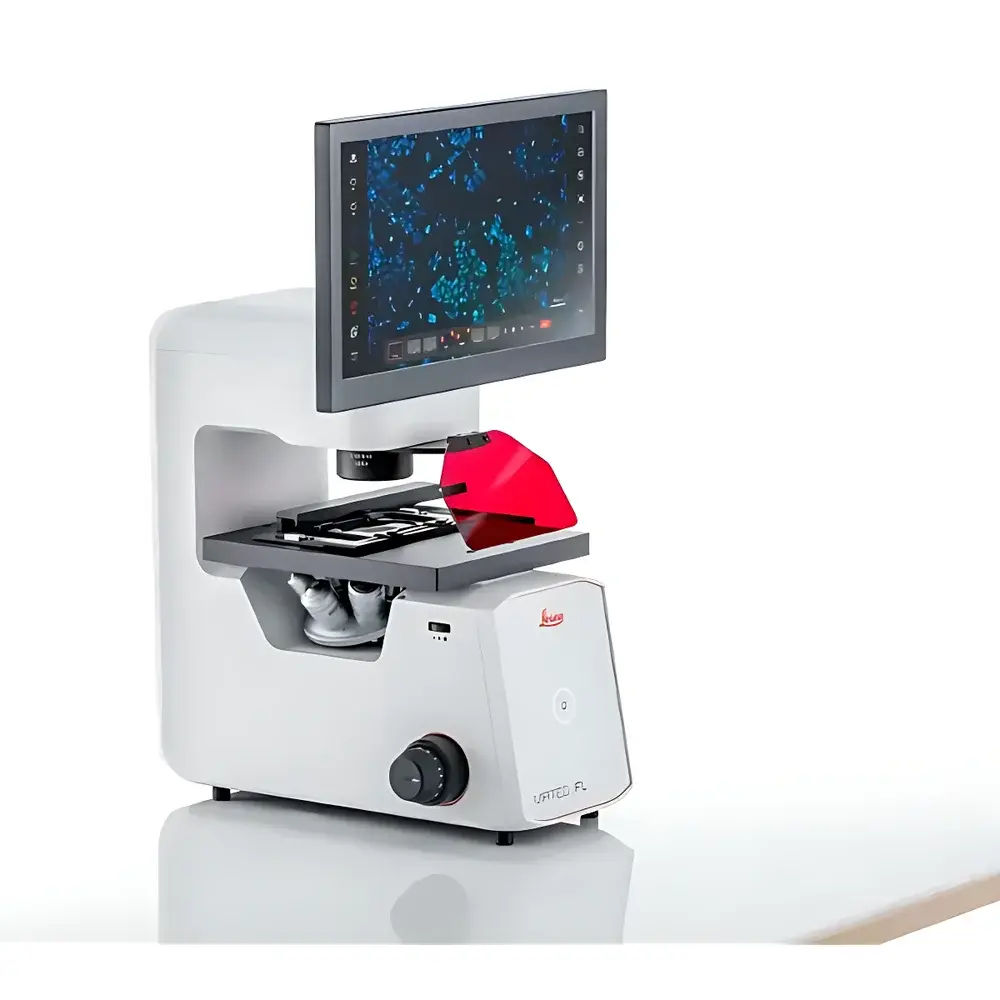
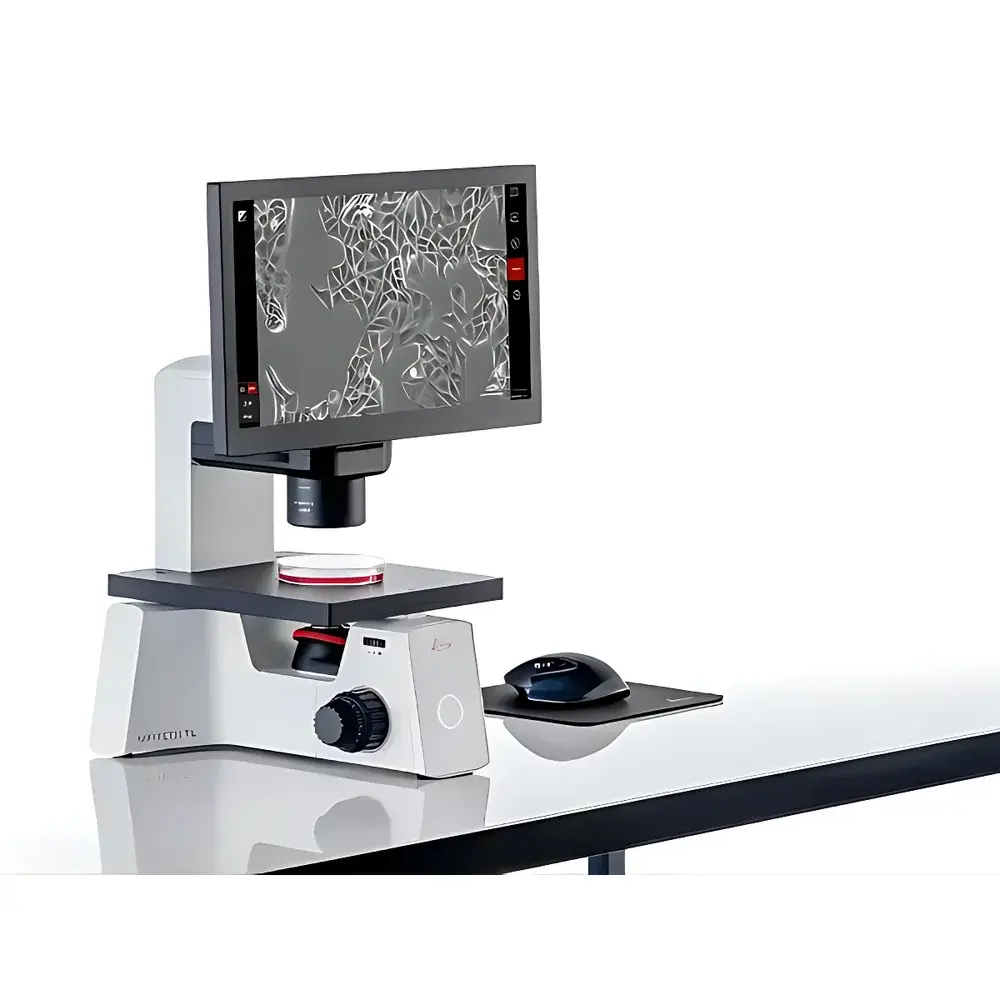
Leica Mateo FL Inverted Fluorescence Digital Microscope
| Brand | Leica |
|---|---|
| Origin | Shanghai, China |
| Manufacturer Type | Authorized Distributor |
| Product Category | Domestic (China-made) |
| Model | Mateo FL |
| Instrument Type | Inverted Fluorescence Microscope |
| Imaging Modes | Fluorescence + Brightfield (Transmitted Light) |
| Dual-Camera System | Integrated Monochrome + Color Cameras |
| AI-Powered Analysis | Confluence Detection, Cell Counting, Transfection Optimization |
| Compliance | FDA 21 CFR Part 11 (Audit Trail, User Management, Electronic Signatures) |
| Sterilization Compatibility | UV, 70% Ethanol, Hydrogen Peroxide (BSL-1/BSL-2 Certified) |
| Onboard Storage | 500 GB (≈3 million images) |
| Barcode & QR Code Integration | Sample Tracking & Mobile Data Transfer |
| Space-Saving Design | Compact Footprint for Laminar Flow Hood Integration |
Overview
The Leica Mateo FL is an inverted fluorescence digital microscope engineered for precision, reproducibility, and workflow integrity in advanced cell culture laboratories. It operates on a dual-modality optical platform combining high-sensitivity fluorescence imaging with quantitative brightfield (transmitted light) observation—enabling simultaneous or sequential acquisition of structural and functional cellular data without sample relocation. Its core optical architecture supports standard fluorophore excitation/emission sets (DAPI, FITC, TRITC, Cy5), while the integrated Köhler illumination system ensures uniform intensity across the field of view. Unlike conventional inverted microscopes requiring manual camera swaps or external alignment, the Mateo FL embeds two synchronized, calibrated cameras—one monochrome for high-dynamic-range fluorescence quantification and one color for contextual brightfield documentation—eliminating mechanical realignment and reducing photobleaching artifacts. Designed for GxP-aligned environments, the system adheres to foundational principles of GLP and GMP-compliant microscopy: traceable user actions, immutable audit logs, and role-based access control—all natively implemented per FDA 21 CFR Part 11 requirements.
Key Features
- Integrated dual-camera system: Monochrome sensor optimized for low-noise fluorescence signal capture; color sensor for real-time brightfield reference and morphological correlation.
- AI-assisted confluence analysis: Proprietary algorithm calculates cell-covered area percentage directly from phase contrast or brightfield images, removing inter-operator variability and enabling objective pass/fail criteria for subculturing decisions.
- Automated cell counting: Delivers statistically validated counts within 5 seconds per field of view, reducing manual hemocytometer-based workflows by ~15 minutes per assay—validated against ISO 21526:2020 for viability assessment consistency.
- Smart transfection optimization: Correlates fluorescence intensity kinetics (e.g., GFP expression onset) with confluence thresholds to recommend optimal seeding density and transfection timing.
- Auto-phase contrast: Real-time digital phase enhancement for label-free visualization of unstained, transparent, or low-contrast specimens—including primary neurons, organoids, and stem cell colonies—without hardware phase rings or alignment.
- BSL-1/BSL-2 compatible decontamination: Supports validated sterilization protocols using UV-C irradiation (254 nm), 70% ethanol wipe-down, or vaporized hydrogen peroxide (VHP), ensuring safe operation inside laminar flow hoods.
Sample Compatibility & Compliance
The Mateo FL accommodates standard tissue culture formats including 6–96-well plates, chamber slides, Petri dishes, and flask inserts—compatible with both adherent and suspension cultures. Its stage design permits unobstructed access for micropipette manipulation during live imaging. All optical components meet ISO 10934-1 (microscope performance standards) and are certified for use with Class I and II biological safety cabinets. Regulatory compliance extends beyond hardware: built-in electronic signatures, timestamped audit trails, and locked configuration files satisfy FDA 21 CFR Part 11 Annex 11 (EU) and ISO/IEC 17025 documentation requirements. Installation Qualification (IQ) and Operational Qualification (OQ) services are available through Leica-certified field engineers, providing documented evidence of system performance against factory specifications.
Software & Data Management
Leica Mateo Software v3.x provides a unified interface for acquisition, analysis, and archival—deployed as a Windows-based application with optional cloud synchronization. The software implements full ALCOA+ (Attributable, Legible, Contemporaneous, Original, Accurate, Complete, Consistent, Enduring, Available) data governance: every image contains embedded metadata (user ID, timestamp, exposure parameters, objective ID, calibration status), and all processing steps are logged in a non-erasable audit trail. Barcode scanning automates sample ID association; QR codes embedded in exported images link directly to raw data repositories. With 500 GB of internal SSD storage, the system retains up to three million 5-megapixel images locally—supporting offline operation in secure lab networks. Export formats include TIFF (uncompressed), OME-TIFF (multi-channel metadata), and PDF reports compliant with ISO/IEC 17025 reporting guidelines.
Applications
- High-throughput confluence monitoring in bioproduction workflows (e.g., mAb manufacturing, viral vector expansion)
- Long-term live-cell imaging of fluorescent biosensors (Ca²⁺, pH, membrane potential) under controlled CO₂/humidity conditions
- Quality control of iPSC-derived organoids and 3D co-cultures using multi-channel fluorescence registration
- Standardized passaging protocols across decentralized labs via centralized confluence threshold deployment
- FDA-regulated cell therapy release testing where objective morphology scoring replaces subjective grading
- Educational training modules with guided phase contrast setup and AI-assisted annotation tools
FAQ
Does the Mateo FL support oil immersion objectives?
No—the system is optimized for air and dry objectives (4× to 63×) used in routine cell culture monitoring; oil immersion is not required for typical adherent monolayer applications.
Can third-party analysis plugins be integrated into the software?
Only Leica-certified extensions are supported to maintain 21 CFR Part 11 compliance; custom Python or MATLAB scripts must run externally and import/export via OME-TIFF.
Is remote access possible for off-site review of acquired images?
Yes—via Leica’s secure WebShare portal (optional subscription), which enforces TLS 1.3 encryption and session timeout policies aligned with NIST SP 800-53 Rev. 5.
What validation documentation is provided with the system?
Factory-issued Certificate of Conformance, IQ/OQ protocol templates, and a traceable calibration certificate for camera gain, exposure linearity, and stage positioning accuracy.
How often does the system require recalibration?
Annual recalibration is recommended; however, daily automated self-checks verify LED intensity stability, focus repeatability, and camera sensor dark current—logs are retained for internal QA review.





