
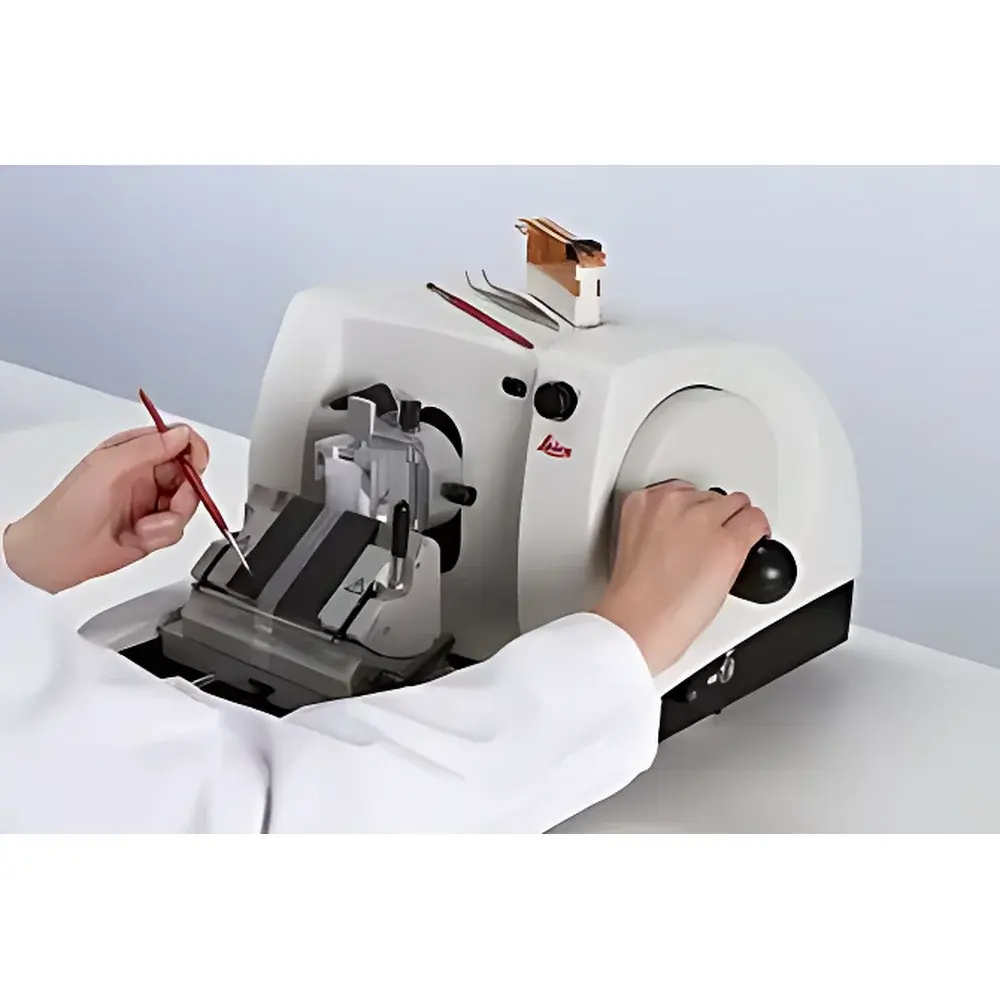
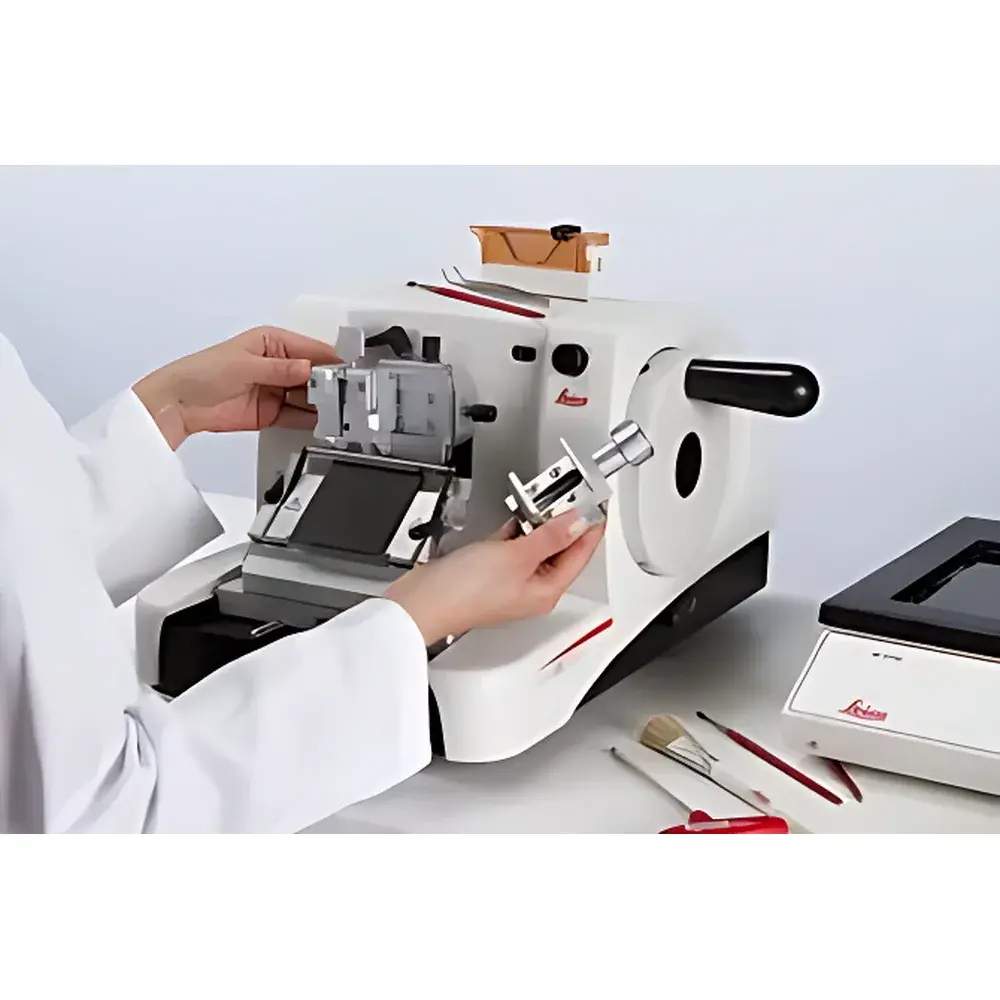
Leica RM2125 RTS Rotary Microtome
| Brand | Leica |
|---|---|
| Origin | Germany |
| Model | RM2125 RTS |
| Cutting Thickness Range | 0.5–100 µm |
| Sectioning Mode | Manual Rotary |
| Specimen Stage Travel | 24 mm (horizontal), 30 mm (vertical) |
| Knife Holder | Standard H-type (compatible with disposable and reusable steel knives) |
| Footswitch Optional | Yes |
| Safety Features | Blade guard, ergonomic handwheel lock, specimen clamp with dual-lock mechanism |
| Compliance | CE-marked, conforms to IEC 61010-1 for laboratory equipment safety |
Overview
The Leica RM2125 RTS Rotary Microtome is a precision-engineered manual microtome designed for routine histopathology laboratories requiring consistent, high-fidelity sectioning of formalin-fixed, paraffin-embedded (FFPE) tissue blocks. Based on Leica Biosystems’ decades-long heritage in microtomy, the RM2125 RTS implements core mechanical principles of rotary motion kinematics—where the specimen advances linearly while the knife remains stationary during each cutting stroke—to deliver reproducible sections across the full operational range of 0.5 to 100 µm. Its robust cast-aluminum base and precision-ground lead-screw advancement system minimize vibration and backlash, directly contributing to reduced chatter artifacts and improved ribbon formation. Engineered for diagnostic-grade reliability, the RM2125 RTS serves as a foundational instrument in clinical pathology labs where section integrity, morphological fidelity, and operator ergonomics are non-negotiable requirements under GLP-aligned workflows.
Key Features
- Precision thickness adjustment dial with vernier scale, enabling repeatable setting resolution of ±0.5 µm across the 0.5–100 µm range
- Ergonomic dual-handwheel design with integrated safety lock: prevents accidental movement during specimen trimming or knife adjustment
- Modular H-type knife holder accommodating both standard steel knives and disposable blades—optimized for compatibility with Leica’s proprietary blade systems and third-party alternatives
- Specimen stage with independent horizontal (24 mm) and vertical (30 mm) travel, facilitating precise block orientation and repositioning without remounting
- Integrated blade guard with automatic retraction during cutting stroke and full coverage at rest—certified per EN ISO 13857 safety clearance standards
- Tool-free specimen clamp featuring dual mechanical locking levers, ensuring zero drift during serial sectioning even with dense or brittle tissues
Sample Compatibility & Compliance
The RM2125 RTS supports a broad spectrum of routinely processed biological specimens, including FFPE tissue blocks (e.g., breast, prostate, lymph node), decalcified bone cores, and resin-embedded soft tissues. It is validated for use with standard microtome knives (e.g., Feather S35, Leica KNIFE 2000) and compatible with cryo-adapted accessories when used in ambient-temperature environments. As a CE-marked device, it complies with IEC 61010-1:2010 for electrical safety in laboratory equipment and meets essential health and safety requirements outlined in Directive 2014/30/EU (EMC) and 2014/35/EU (LVD). While not classified as an in vitro diagnostic (IVD) device under IVDR 2017/746, its output—histological sections—is subject to preanalytical quality control per ISO 15189:2022 clause 5.4.2, and its operational consistency supports adherence to CAP and CLIA preanalytical documentation standards.
Software & Data Management
As a manually operated mechanical microtome, the RM2125 RTS does not incorporate embedded electronics, firmware, or digital connectivity. Consequently, it requires no software installation, network configuration, or cybersecurity validation. All operational parameters—including section thickness, number of ribbons cut, and knife usage—are recorded manually in lab notebooks or LIMS-integrated log sheets. This analog architecture eliminates risks associated with software obsolescence, data corruption, or regulatory nonconformance related to FDA 21 CFR Part 11 electronic records—making it inherently suitable for regulated environments where auditability, traceability, and long-term maintenance predictability are prioritized over automation.
Applications
- Routine diagnostic histology in hospital pathology departments and reference laboratories
- Academic research involving morphometric analysis of tissue architecture (e.g., tumor grading, fibrosis quantification)
- Quality assurance testing of embedding protocols and fixation variables
- Training platforms for histotechnician certification programs (HTL, HT)
- Preparation of sections for immunohistochemistry (IHC), special stains (e.g., Masson’s trichrome), and in situ hybridization (ISH)
FAQ
Is the RM2125 RTS compatible with cryostat-mounted specimens?
No—the RM2125 RTS is designed exclusively for room-temperature sectioning of paraffin-embedded or resin-embedded blocks. For frozen sections, Leica recommends the CM1950 or CM3050 S cryostats.
Can the knife holder accept tungsten-carbide or diamond knives?
The standard H-type holder is engineered for steel and disposable blades only; tungsten-carbide or diamond knives require the optional Leica KNIFE ADVANCE system and are not supported on the RM2125 RTS platform.
Does Leica provide service documentation compliant with ISO/IEC 17025 calibration requirements?
Yes—Leica Biosystems offers certified technical service reports and mechanical verification protocols aligned with ISO/IEC 17025:2017 Annex A.2, covering lead-screw linearity, stage repeatability, and thickness accuracy verification using NIST-traceable micrometers.
What is the recommended maintenance interval for the RM2125 RTS?
Leica specifies biannual preventive maintenance by authorized service engineers, including lubrication of the advancement mechanism, torque verification of clamping components, and inspection of handwheel gear meshing—documented per GLP Annex 11 requirements for equipment qualification.



