
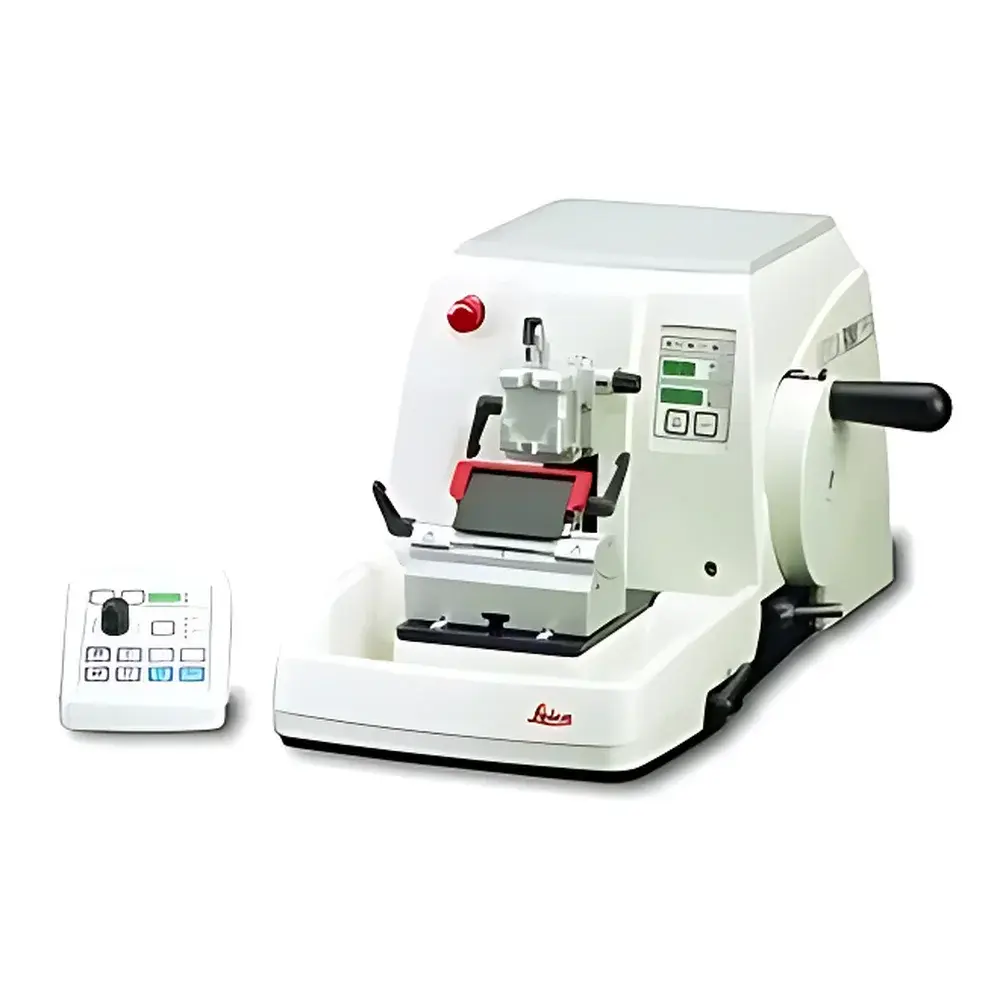
Leica RM2255 Fully Automatic Rotary Microtome
| Brand | Leica |
|---|---|
| Origin | Germany |
| Model | RM2255 |
| Maximum Sample Size | 50 × 60 × 40 mm |
| Section Thickness Range | 0.5–100 µm |
| Section Increment | 5 µm |
| Vertical Travel | 70 mm |
Overview
The Leica RM2255 Fully Automatic Rotary Microtome is an engineered precision instrument designed for high-throughput, reproducible sectioning of paraffin- and resin-embedded specimens in histology, materials science, and quality control laboratories. Operating on the principle of rotary microtomy—where a specimen block advances vertically toward a stationary knife during each cutting cycle—the RM2255 integrates electromechanical drive systems with mechanical stability to deliver consistent slice geometry, minimal compression artifacts, and reduced operator fatigue. Its fully automated cutting cycle eliminates manual handwheel rotation, thereby minimizing biomechanical strain associated with repetitive motion—a critical ergonomic consideration validated under ISO 11228-1 (Ergonomics of manual handling) and widely recognized in occupational health guidelines for pathology and industrial lab environments.
Key Features
- Fully automatic cutting cycle driven by a brushless DC motor, delivering constant cutting speed and force across the full thickness range (0.5–100 µm), ensuring uniform section integrity and inter-run reproducibility.
- Precision X/Y positioning system with calibrated fine-adjustment knobs and dual red reference markers at the zero-position origin, enabling rapid repositioning for recuts or serial sectioning without realignment drift.
- 70 mm vertical travel capacity accommodates oversized embedding cassettes (up to 50 × 60 × 40 mm) and increases clearance between specimen surface and knife edge—enhancing safety during block trimming and knife change procedures.
- Unobstructed working area achieved through elimination of traditional locking levers; specimen stage remains freely accessible from all sides for efficient workflow integration with cryostat or staining stations.
- Dual-mode operation: seamless transition between fully automatic sectioning and manual handwheel control—supporting both routine diagnostics and exploratory research protocols requiring tactile feedback.
Sample Compatibility & Compliance
The RM2255 is optimized for rigid, room-temperature specimens embedded in paraffin wax (e.g., formalin-fixed, paraffin-embedded human or animal tissues) and low-viscosity resins (e.g., LR White, Epon, or GMA-based formulations). It supports standard histological cassette formats (e.g., Leica HistoCore BIOCUT-compatible cassettes) and accepts custom blocks mounted on aluminum or stainless-steel stubs. The instrument complies with IEC 61010-1:2010 for laboratory equipment safety and meets electromagnetic compatibility requirements per EN 61326-1. Its mechanical design aligns with GLP/GMP documentation practices, supporting audit-ready traceability when integrated into validated laboratory workflows (e.g., ISO/IEC 17025-accredited histopathology labs).
Software & Data Management
While the RM2255 operates as a standalone electromechanical platform without embedded touchscreen or network connectivity, its mechanical repeatability and deterministic actuation enable robust integration into digital pathology pipelines. All sectioning parameters—including thickness setting, number of sections, and cut mode—are mechanically indexed and physically recorded via engraved dials and vernier scales—ensuring non-volatile, tamper-evident parameter logging compatible with FDA 21 CFR Part 11–aligned procedural documentation. Optional accessories include Leica’s HistoCore AUTOCUT module for synchronized tape-assisted section collection and third-party LIMS interfaces via RS-232 or analog trigger outputs for event-based data capture (e.g., section count timestamping).
Applications
- Routine histopathology: High-volume sectioning of FFPE tissue blocks for H&E and IHC staining in clinical diagnostic labs.
- Preclinical research: Serial sectioning of resin-embedded neural or bone samples for ultrastructural analysis by TEM or light microscopy.
- Industrial materials testing: Precision slicing of polymer composites, ceramics, or metallographic mounts for microstructural evaluation per ASTM E3-22 and ISO 643 standards.
- Quality assurance: Reproducible cross-sectional sampling of manufactured components (e.g., battery electrodes, semiconductor packaging) for dimensional verification and defect mapping.
FAQ
Is the RM2255 compatible with cryosectioning?
No—the RM2255 is strictly a room-temperature rotary microtome. For frozen sections, Leica recommends the CM1950 or CM3050 S cryostats.
Can it be used with diamond knives?
No—diamond knives are intended for ultramicrotomy (e.g., Leica EM UC7); the RM2255 uses disposable steel or tungsten-carbide blades optimized for paraffin and resin hardness profiles.
Does it support thickness increments smaller than 5 µm?
The minimum adjustable increment is 5 µm; however, the mechanical dial allows stable, repeatable settings down to 0.5 µm within that resolution constraint.
What maintenance is required for long-term calibration stability?
Annual mechanical recalibration of the X/Y positioning system and vertical feed mechanism is recommended per Leica Service Bulletin MB-RM2255-04; no firmware updates are applicable as the system contains no programmable logic.



