
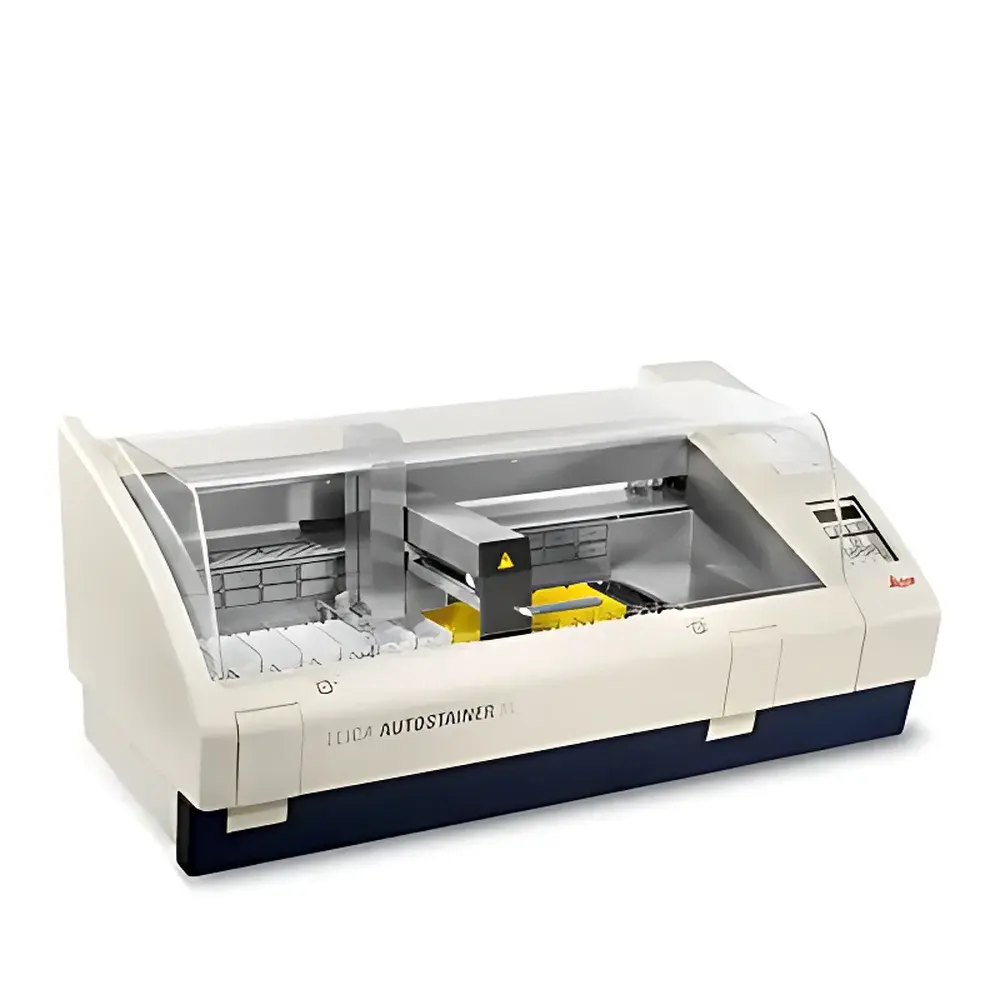
Leica ST5010-CV5030 Fully Automated Coverslipper
| Brand | Leica |
|---|---|
| Origin | Germany |
| Model | ST5010-CV5030 |
| Automation Level | Fully Automatic |
| Instrument Type | Rotary (Carousel-Based) |
| Throughput Capacity | 3 Slide Racks per Load |
| Design Integration | Seamless Interface with Leica Autostainer XL |
Overview
The Leica ST5010-CV5030 Fully Automated Coverslipper is an integrated, carousel-based tissue processing module engineered for high-throughput histopathology laboratories requiring reproducible, contamination-controlled coverslipping following routine H&E and cytological staining. Designed as a dedicated post-staining endpoint in Leica’s automated pathology workflow, the system operates on a precision rotary architecture that synchronizes mechanical transport, adhesive application, coverslip placement, and pressure-controlled bonding—all without manual intervention. Its core function is to deliver uniform, bubble-free, edge-aligned coverslips across glass microscope slides pre-processed by compatible stainers (e.g., Leica Autostainer XL), thereby eliminating variability introduced by manual mounting and supporting diagnostic consistency under ISO 15189 and CAP-accredited laboratory protocols.
Key Features
- Rotary (carousel) platform architecture enabling continuous, non-stop operation across three slide racks—each holding up to 40 standard 26 × 76 mm slides—without interrupting the staining-to-mounting sequence.
- Direct robotic interface with Leica Autostainer XL: fully automated slide rack transfer via standardized carrier docking, eliminating manual handling and reducing cross-contamination risk.
- Optically transparent polycarbonate lid with integrated LED illumination allows real-time visual verification of rack positioning, adhesive dispensing, and coverslip alignment during operation—critical for troubleshooting and GLP-compliant process monitoring.
- Programmable adhesive dispensing system calibrated for consistent droplet volume and placement (optimized for aqueous and resin-based mounting media), minimizing waste and ensuring uniform refractive index across mounted specimens.
- Adjustable clamping force and dwell time control for coverslip adhesion, accommodating variations in slide thickness, coverslip dimensions (22 × 22 mm to 24 × 50 mm), and ambient humidity conditions.
- Embedded diagnostics and event logging compliant with FDA 21 CFR Part 11 requirements—including user authentication, audit trail generation, and electronic signature support for critical parameter changes.
Sample Compatibility & Compliance
The ST5010-CV5030 accommodates standard histology slides (75 × 25 mm, 76 × 26 mm) and common cytology slides (including ThinPrep® and SurePath® formats) with or without pre-applied barcodes. Coverslip compatibility spans standard No. 1½ (0.17 mm thick) and specialty low-fluorescence variants. The system meets IEC 61000-6-2/6-4 electromagnetic compatibility standards and is CE-marked under the EU In Vitro Diagnostic Regulation (IVDR) 2017/746. It supports laboratory compliance with ISO 15189:2022 (clause 5.3.2 on equipment validation) and CLSI EP25-A guidelines for automated instrumentation verification.
Software & Data Management
Controlled via Leica Application Suite (LAS X) Pathology Edition v4.13+, the ST5010-CV5030 integrates into enterprise-wide LIS/PACS environments through ASTM E1384-compliant HL7 messaging. All run logs—including rack ID, timestamp, adhesive lot number, operator ID, and environmental sensor readings (temperature/humidity)—are stored in encrypted SQLite databases with daily automated backup to network-attached storage. Audit trails are immutable and exportable in CSV or PDF format for internal QA review or regulatory inspection. Software updates are delivered via secure HTTPS channels with SHA-256 signature verification.
Applications
- Routine H&E-stained surgical pathology specimens requiring rapid, standardized coverslipping prior to microscopic review.
- Cytology preparations—including gynecological, non-gyn, and fine-needle aspiration samples—where optical clarity and long-term archival stability are essential.
- Immunohistochemistry (IHC)- and special stain–processed slides where mounting medium compatibility must preserve antigen integrity and fluorescence signal retention.
- High-volume reference labs performing batch processing under CAP, COLA, or UK NEQAS proficiency testing frameworks.
- Research core facilities implementing digital pathology pipelines requiring consistent slide flatness and refractive homogeneity for whole-slide imaging (WSI) acquisition.
FAQ
Is the ST5010-CV5030 compatible with non-Leica stainers?
Yes—via optional third-party interface kits supporting RS-232 or Modbus TCP communication; however, full rack auto-transfer functionality is validated only with Leica Autostainer XL and Bond RX systems.
What mounting media types are supported?
Aqueous media (e.g., glycerol gelatin, Faramount), resin-based media (e.g., DPX, Permount), and xylene-free alternatives (e.g., EcoMount); viscosity range: 10–1,200 mPa·s.
Does the system require external exhaust or fume hood integration?
No—adhesive dispensing is fully enclosed and equipped with activated carbon filtration; ambient VOC emissions remain below OSHA PEL thresholds for laboratory spaces.
Can custom protocols be saved and recalled?
Yes—up to 99 user-defined protocols, each storing adhesive type, dispense volume, clamp pressure, dwell time, and rack orientation parameters.
What is the mean time between failures (MTBF) under typical clinical load?
Based on Leica’s Field Reliability Report Q3 2023: ≥12,500 operational hours (equivalent to ~5 years at 8 h/day, 5 days/week).




