
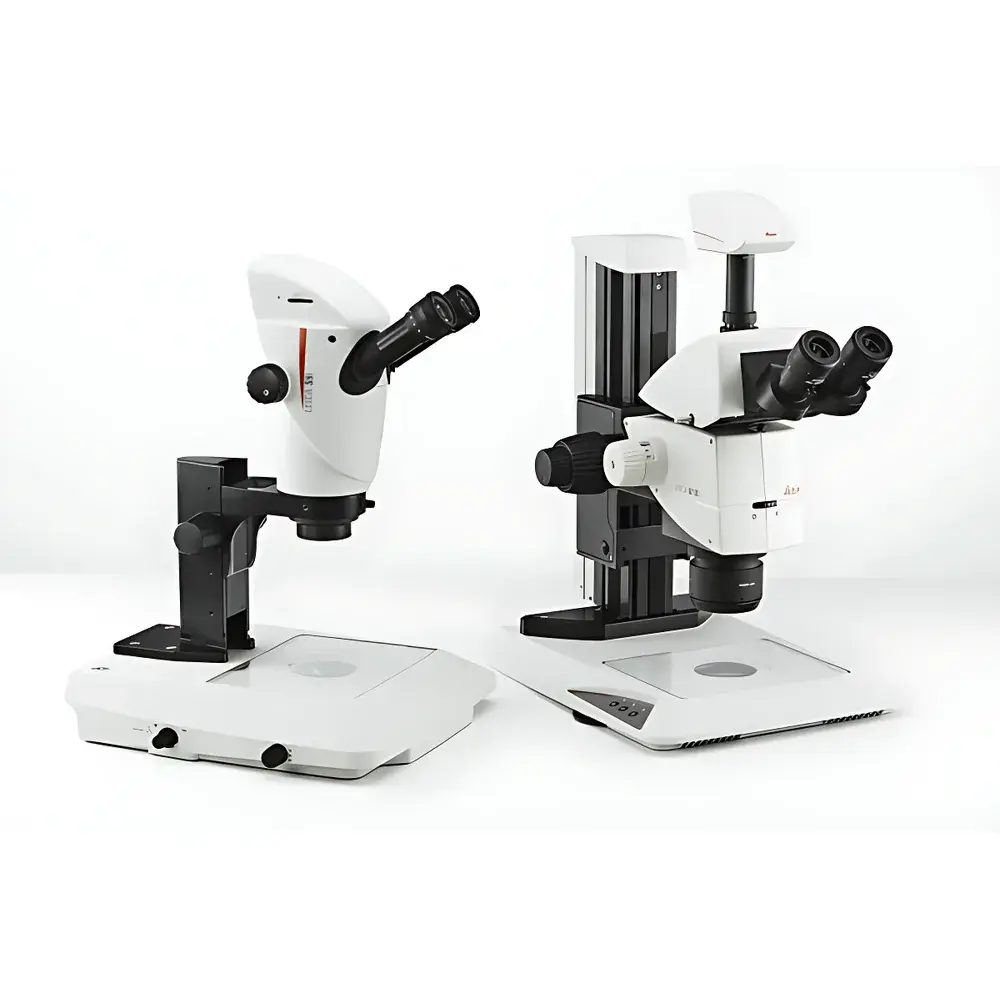
Leica TL3000 Ergo and TL5000 Ergo Transmitted Light Stands
| Brand | Leica |
|---|---|
| Origin | Germany |
| Model | TL3000 Ergo and TL5000 Ergo |
| Numerical Aperture (NA) | 0.73 (TL3000 Ergo), 0.9 (TL5000 Ergo) |
| Illumination | High-stability white LED |
| Contrast Modes | Brightfield, Rottermann Contrast, Unilateral or Bilateral Darkfield |
| Field Diameter | 65 mm |
| Cooling | Passive (max. +6°C above ambient) |
| Software Integration | Fully encoded |
| Compliance | Designed for GLP/GMP-aligned workflows |
Overview
The Leica TL3000 Ergo and TL5000 Ergo are precision-engineered transmitted light stands designed for high-fidelity optical contrast generation in upright and stereomicroscopy applications. Built on Leica’s proprietary Ergo optical architecture, both models deliver simultaneous high numerical aperture (NA) illumination and optimized contrast—without compromising resolution or color fidelity. Unlike conventional Köhler-based systems that force trade-offs between NA, uniformity, and contrast control, the TL3000 and TL5000 employ a collimated, telecentric LED illumination path coupled with motorized or manually actuated contrast diaphragms to ensure diffraction-limited performance across all contrast modalities. The TL3000 Ergo serves as a fully manual, ergonomically optimized platform for routine high-magnification inspection, while the TL5000 Ergo extends functionality with full motorization, software-driven parameter synchronization, and automated stray-light suppression—making it suitable for reproducible, auditable imaging workflows in regulated environments.
Key Features
- Optimized NA delivery: TL3000 Ergo supports up to NA 0.73; TL5000 Ergo achieves NA 0.9—enabling high-resolution phase-sensitive observation without loss of depth-of-field or lateral resolution.
- Dual-contrast architecture: Integrated Rottermann Contrast mode provides edge-enhanced visualization of internal structures in unstained or weakly birefringent specimens—distinct from standard DIC or phase contrast—and is fully compatible with long-working-distance objectives.
- Stray-light management: TL5000 Ergo features an electrically actuated contrast shutter with precise positional encoding, dynamically aligning the aperture stop relative to the LED source to minimize flare and maximize signal-to-noise ratio.
- Passive thermal design: No active cooling fans; thermally stable LED module maintains <±0.5°C color temperature stability across intensity ranges (20–100%), ensuring consistent chromatic reproduction for quantitative brightfield and colorimetric analysis.
- Ergonomic field geometry: 65 mm illuminated field diameter accommodates full zoom range of Leica M-series and Z-series stereomicroscopes—even at lowest magnifications—while preserving peripheral illumination uniformity (>92% across field).
- Fully encoded hardware: All mechanical adjustments (intensity, contrast position, filter selection) generate digital logs synchronized with image acquisition in LAS X, supporting traceable metadata per frame per experiment.
Sample Compatibility & Compliance
These stands support diverse specimen categories requiring non-invasive, label-free contrast: live zebrafish embryos, C. elegans, oocytes, polymer microstructures, geological thin sections, forensic fibers, and IVF-grade gametes. The Rottermann mode enables visualization of cytoplasmic streaming, nuclear envelope dynamics, and subcellular organelle boundaries without fixation or staining—critical for developmental biology and toxicology screening. For industrial QA/QC, the bilateral darkfield mode reveals gas inclusions in silicone elastomers and crystalline defects in optical-grade plastics. Both models meet ISO 10934-1 (microscope illumination standards) and are validated for use in GLP-compliant laboratories; metadata embedding in LAS X supports FDA 21 CFR Part 11 compliance when paired with appropriate access controls and electronic signature protocols.
Software & Data Management
Leica LAS X software fully integrates with both stands via USB 3.0 and Leica’s proprietary HCA protocol. Users can store and recall complete illumination configurations—including LED intensity, contrast diaphragm position, filter state, and exposure time—as named presets. Each acquired image embeds EXIF-compatible metadata referencing the exact optical state at acquisition time. Audit trails log all parameter changes with timestamps and operator IDs. For automated workflows, the TL5000 Ergo supports script-driven contrast sequencing (e.g., brightfield → Rottermann → darkfield) synchronized with stage movement and focus stacking—enabling unattended multi-condition imaging for longitudinal studies.
Applications
- Developmental Biology: Time-lapse imaging of zebrafish embryogenesis with simultaneous cardiac cell tracking and blood flow visualization under Rottermann contrast.
- Materials Science: Detection of micron-scale voids and interfacial delamination in injection-molded thermoplastics using unilateral darkfield illumination.
- Forensic Microscopy: Discrimination of textile fiber morphology and dye distribution patterns without polarized light, leveraging high-NA brightfield and spectral neutrality.
- Reproductive Medicine: Non-invasive assessment of oocyte maturity and embryo cleavage kinetics in IVF labs—enabled by green-filter-optimized contrast and passive thermal stability.
- Geosciences: Rapid identification of mineral birefringence and crystal twinning in thin sections using integrated polarizing glass inserts.
FAQ
Can the TL3000 Ergo be upgraded to TL5000-level automation?
No—the TL5000 Ergo incorporates dedicated motorized actuators, position encoders, and firmware not present in the TL3000 Ergo. Hardware upgrade paths are not supported.
Is the Rottermann Contrast mode compatible with third-party microscopes?
Rottermann Contrast requires precise alignment of the condenser aperture relative to the objective’s back focal plane and is only calibrated for Leica M-series, Z-series, and DM-series upright microscopes.
What is the maximum working distance supported with full NA utilization?
With Leica 1.0× PlanApo objectives (WD = 60 mm), the TL5000 Ergo maintains >95% NA transmission up to 50 mm working distance; performance degrades linearly beyond that due to vignetting.
Do the glass filter inserts affect color temperature or intensity linearity?
All inserts are interference-coated to preserve LED spectral output within ±3% CIE Δu’v’ deviation; intensity attenuation is pre-characterized and compensated automatically in LAS X during preset recall.
How is thermal drift managed during extended acquisitions?
The passive thermal mass of the aluminum chassis, combined with low-power LED drive electronics, limits temperature rise to ≤6°C above ambient over 8-hour operation—verified per IEC 61000-4-2 thermal stability testing.



