
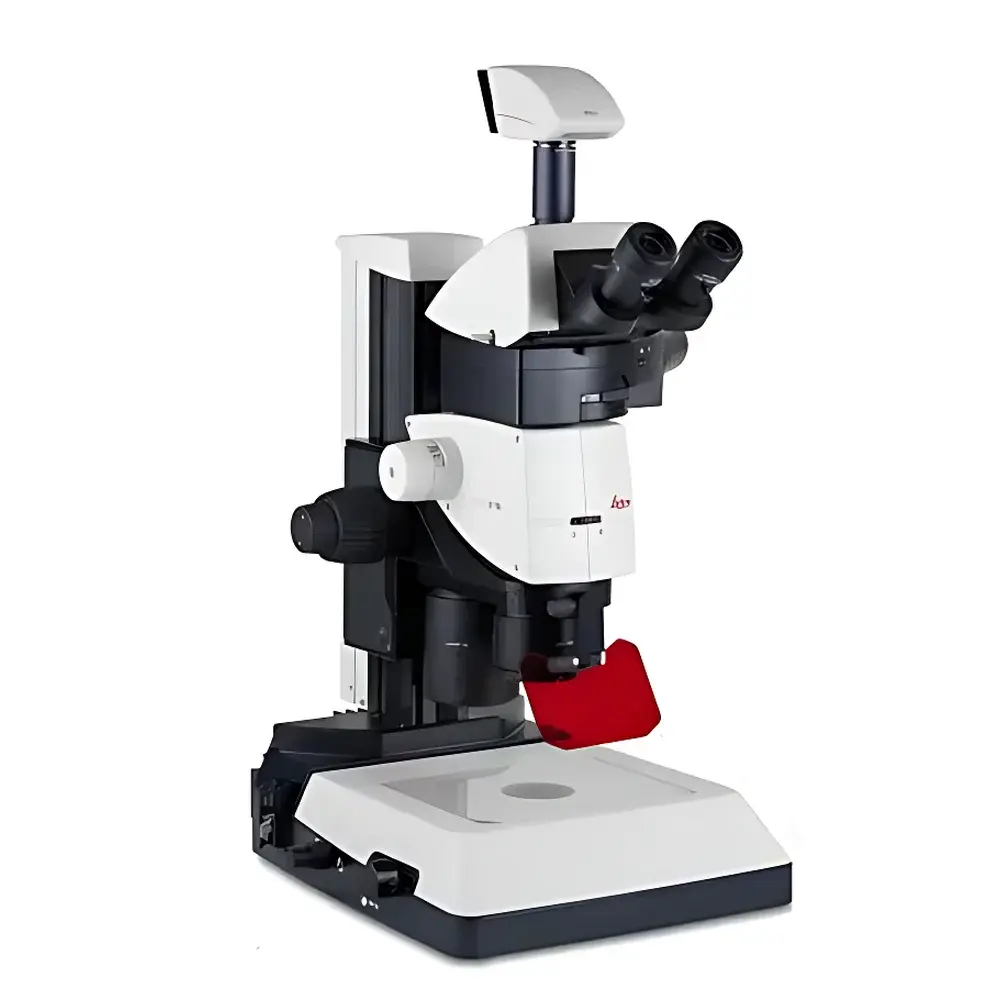
Leica TL4000 RC Transmitted Light Base for Stereo Microscopy
| Brand | Leica |
|---|---|
| Origin | Germany |
| Model | TL4000 RC |
| Illumination Technology | Rottermann Contrast (RC) |
| Optical Compatibility | Designed for Leica M-series and Z-series stereo microscopes |
| Mechanical Stage Integration | Slide-on XY mechanical stage with focus-synchronized movement |
| Vibration Damping | Integrated high-performance anti-vibration pads |
| Regulatory Compliance | CE-marked, compliant with IEC 61000-6-3 (EMC) and IEC 61000-6-2 (immunity) |
Overview
The Leica TL4000 RC is a precision-engineered transmitted light base designed exclusively for high-resolution stereo microscopy applications requiring enhanced optical contrast without staining or labeling. It implements Rottermann Contrast (RC), a proprietary oblique illumination technique developed by Leica Microsystems that exploits differential refraction at phase boundaries to generate topographic-like contrast—effectively rendering optically transparent, unstained specimens with apparent relief. Unlike conventional brightfield or darkfield transmission, RC does not rely on absorption or scattering alone; instead, it modulates the angular distribution of incident light across the specimen plane using a dynamically adjustable mirror system, enabling real-time inversion of contrast polarity (positive vs. negative relief). This principle is particularly valuable in developmental biology, embryology, histology of cleared tissues, and quality inspection of polymer-based microstructures where refractive index gradients—not pigment or fluorescence—define structural relevance.
Key Features
- Rottermann Contrast (RC) Illumination: Delivers label-free, non-invasive contrast enhancement based on refractive index gradients—ideal for live, hydrated, or delicate biological samples.
- Dual-Mirror Toggle Mechanism: A manually actuated slide-on mirror assembly offers rapid, repeatable switching between convex (positive relief) and concave (negative relief) illumination geometries—enabling immediate visual differentiation of morphologically similar structures.
- Focus-Synchronized Slide-on XY Mechanical Stage: Engineered to maintain precise focal alignment during lateral specimen translation under transmitted light—eliminating parallax-induced focus drift during extended imaging sessions.
- Integrated Anti-Vibration Damping System: High-density elastomeric pads decouple the base from ambient floor vibrations (e.g., HVAC systems, footfall), ensuring stability for high-magnification observation (>100× effective magnification with compatible objectives) and time-lapse digital capture.
- Modular Optical Interface: Compatible with Leica M125, M165 FC, M205 FA/FC, and Z6/Z16 stereo microscope stands via standardized dovetail coupling—supporting both coaxial and angled illumination paths.
- CE-Compliant Electrical Design: Low-noise DC-powered LED illumination module (5,000 K color temperature, CRI >90) meets IEC 61000 electromagnetic compatibility standards for laboratory environments.
Sample Compatibility & Compliance
The TL4000 RC supports a broad range of transmission-compatible specimens including whole-mount zebrafish embryos, Drosophila larvae, plant meristems, hydrogel-embedded organoids, thin-sectioned paraffin or resin blocks (≤20 µm), and industrial components such as semiconductor wafers, microfluidic chips, and injection-molded polymer optics. Its RC contrast mechanism is insensitive to specimen thickness variations within ±15% of nominal working distance, making it robust for routine QC workflows. The system conforms to ISO 10934-1 (microscopy terminology), EN 61326-1 (electrical safety for lab equipment), and supports GLP-compliant documentation when paired with Leica Application Suite X (LAS X) software with audit trail and electronic signature modules (21 CFR Part 11 ready).
Software & Data Management
While the TL4000 RC operates as a hardware-only illumination platform, it is fully interoperable with Leica’s LAS X software suite for synchronized image acquisition, contrast parameter logging, and metadata embedding (including RC mirror position, exposure time, objective magnification, and stage coordinates). All illumination states are timestamped and exportable in TIFF/FITS format with embedded EXIF tags. For regulated environments, LAS X v3.7+ enables user-access control, change history tracking, and PDF report generation compliant with ISO/IEC 17025 requirements for calibration traceability.
Applications
- Time-lapse imaging of gastrulation and neurulation in vertebrate embryos
- Label-free assessment of cell migration dynamics in 3D collagen matrices
- In-process inspection of micro-optical elements (lens arrays, diffractive surfaces)
- Non-destructive evaluation of delamination or void formation in multilayer polymer films
- Teaching laboratories: Visualizing cytoplasmic streaming, vacuole dynamics, or stomatal aperture in live plant tissue
- Forensic fiber analysis—distinguishing synthetic fiber subtypes based on birefringence and surface topography
FAQ
What is the working distance requirement for optimal Rottermann Contrast performance?
The TL4000 RC achieves maximum contrast fidelity at working distances between 45 mm and 85 mm—compatible with Leica’s long-working-distance (LWD) stereo objectives (e.g., PlanApo 1.0×–2.0×).
Can the RC mirror position be motorized or automated?
No—the mirror toggle is manual and tactile-optimized for ergonomic, glove-compatible operation; however, position state can be logged via LAS X when using a connected camera.
Is the TL4000 RC compatible with third-party stereo microscopes?
It is mechanically and optically engineered for Leica stereo platforms only; mounting interfaces and illumination geometry are not standardized for non-Leica systems.
Does RC illumination generate heat that could affect live samples?
The LED light source operates at ≤35°C surface temperature under continuous use, and thermal output is below 0.5 W/cm² at the specimen plane—validated for >4-hour exposure of thermosensitive zebrafish embryos.
How does Rottermann Contrast compare to Differential Interference Contrast (DIC)?
Unlike DIC—which requires polarized light and Wollaston prisms—RC uses unpolarized white light and a single adjustable mirror, offering simpler alignment, broader spectral compatibility, and no polarization-induced artifacts in birefringent samples.



