
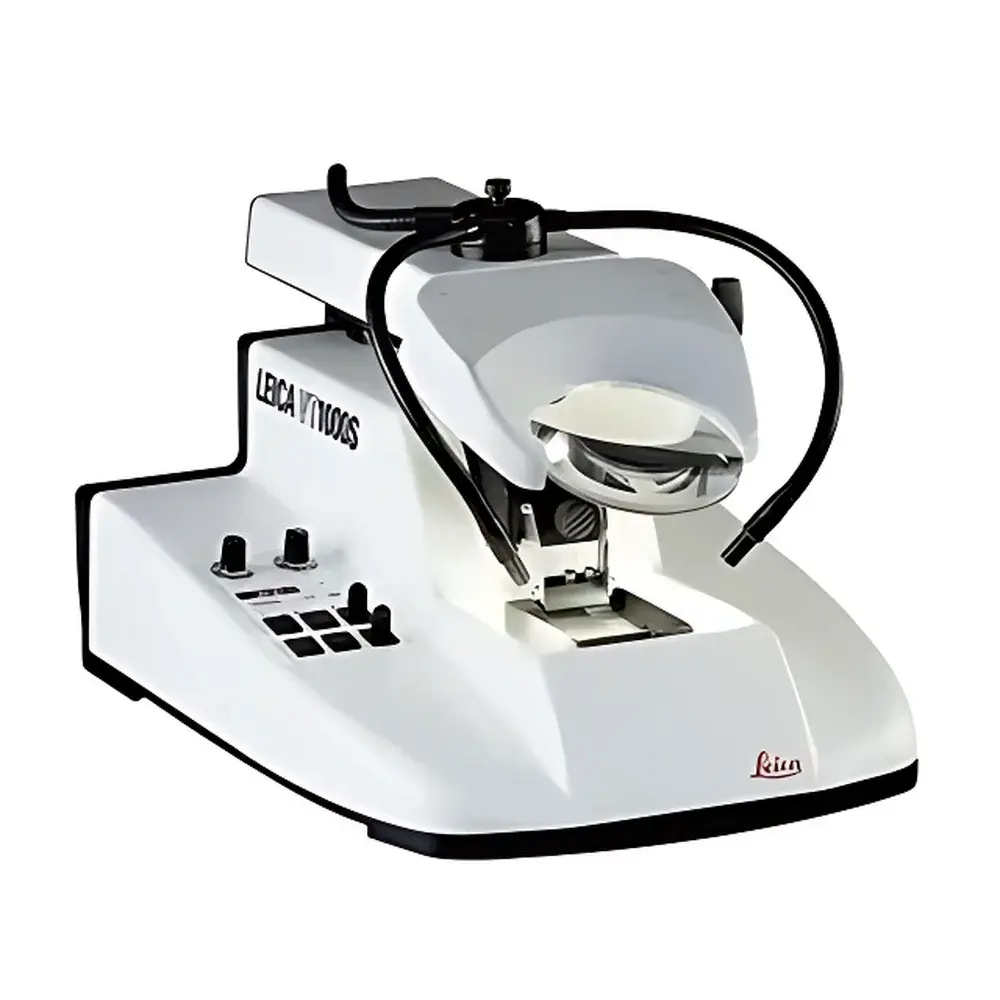
Leica VT1000 S Vibrating Microtome
| Origin | Germany |
|---|---|
| Manufacturer Type | Authorized Distributor |
| Origin Category | Imported Instrument |
| Model | VT1000 S |
| Pricing | Upon Request |
Overview
The Leica VT1000 S is a precision-engineered vibrating microtome designed for the preparation of thick, viable, and undamaged sections from soft, unfixed, or lightly fixed biological and non-biological specimens. Unlike rotary or cryo-microtomes that rely on compression and shearing forces, the VT1000 S operates on the principle of high-frequency oscillation—employing a vibrating blade moving in a vertical sinusoidal motion to achieve clean, low-stress sectioning. This mechanism minimizes mechanical distortion and cellular disruption, making it especially suitable for electrophysiological applications such as patch-clamp recording, live-tissue imaging, and functional neuroanatomy studies. Its robust optical-grade construction, combined with thermal stability and vibration-damped base design, ensures consistent performance across extended operational cycles in core facilities and academic laboratories.
Key Features
- Adjustable Oscillation Frequency: Programmable frequency range from 0 to 100 Hz, enabling precise optimization for specimen elasticity, hydration state, and required section integrity—e.g., lower frequencies (10–30 Hz) for dense fixed neural tissue; higher frequencies (60–90 Hz) for soft, hydrated plant root or foam polymer samples.
- Five-Step Amplitude Selection: Discrete amplitude settings of 0.2, 0.4, 0.6, 0.8, and 1.0 mm allow fine-tuned control over blade displacement, directly influencing cut smoothness and minimizing chatter artifacts in delicate specimens.
- Variable Advance Speed: Linear specimen advancement adjustable from 0.025 to 2.5 mm/s with 0.001 mm/s resolution, supporting both ultra-slow acquisition for high-resolution serial sectioning and rapid profiling for screening workflows.
- Programmable Cutting Window & Sample Retraction: Users define active cutting zones and enable automatic retraction (up to 1.5 mm) during blade return stroke—preventing surface smearing, edge curling, or compression damage common in non-rigid samples.
- High-Speed Blade Return: Optimized 5 mm/s blade retraction velocity reduces cycle time without compromising positional repeatability or motor longevity, critical for high-throughput tissue banking or multi-region sampling protocols.
Sample Compatibility & Compliance
The VT1000 S accommodates specimens ranging from 1 mm³ to 25 × 25 × 15 mm (W × D × H), including but not limited to: fresh brain slices (hippocampal, cortical), perfusion-fixed spinal cord blocks, intact plant roots and stems, hydrogel-embedded organoids, and low-density polymeric foams used in material science. All wet-stage components are corrosion-resistant stainless steel or anodized aluminum; no lubricants contact sample pathways. The instrument complies with IEC 61000-6-2 (EMC immunity) and IEC 61000-6-3 (EMC emission) standards. While not classified as a medical device under FDA 21 CFR Part 820, its operational parameters align with GLP-compliant histology SOPs when integrated into validated laboratory workflows per ISO/IEC 17025 requirements.
Software & Data Management
The VT1000 S operates via front-panel membrane keypad with real-time parameter feedback (frequency, amplitude, advance speed, cut count). No proprietary software is required for basic operation; however, optional RS-232 or USB-to-serial interface enables integration with LabVIEW™ or Python-based automation scripts for synchronized data logging (e.g., correlating slice number with electrophysiology acquisition timestamps). All user-defined protocols—including frequency/amplitude combinations, advance speed ramps, and retraction profiles—are stored in non-volatile memory (up to 20 presets) and retain calibration upon power cycling. Audit trail functionality is available through external logging systems compliant with 21 CFR Part 11 when paired with validated electronic lab notebooks (ELNs).
Applications
- Preparation of 30–500 µm acute brain slices for ex vivo patch-clamp, field potential, and calcium imaging experiments.
- Sectioning of formalin-fixed, paraffin-embedding–resistant tissues (e.g., calcified cartilage, fibrotic lung) where conventional microtomy fails.
- High-fidelity longitudinal sectioning of intact Arabidopsis roots and maize coleoptiles for developmental phenotyping.
- Controlled slicing of polyurethane and melamine foams for pore structure analysis via SEM or micro-CT.
- Serial sectioning of hydrogel-encapsulated iPSC-derived neural spheroids for 3D reconstruction and spatial transcriptomics alignment.
FAQ
What types of specimens require vibration-based sectioning instead of standard microtomy?
Soft, hydrated, or elastic tissues—such as live brain slices, embryonic organs, or hydrogel matrices—lack sufficient rigidity for conventional knife-edge compression. Vibration microtomy avoids lateral shear stress, preserving ultrastructural integrity and physiological viability.
Can the VT1000 S be used with cryoprotected but unfrozen samples?
Yes. It is routinely employed for sectioning sucrose- or glycerol-perfused brain tissue maintained at 4°C in oxygenated artificial cerebrospinal fluid (aCSF), eliminating ice-crystal artifacts associated with freezing.
Is blade compatibility limited to Leica-specific consumables?
The instrument accepts standard Leica 818/819 series vibrating blades and third-party stainless-steel alternatives conforming to DIN 58272 geometry specifications, provided they are mounted with ≤0.02 mm runout tolerance.
How does sample retraction improve section quality?
Retraction decouples the specimen from blade contact during return stroke, preventing drag-induced folding, chatter lines, or surface abrasion—particularly critical for fragile membranes or layered composite materials.
What maintenance intervals are recommended for long-term reliability?
Daily cleaning of the specimen stage and blade holder with ethanol; biannual inspection of drive motor coupling and linear guide rails by certified service engineers; no routine calibration required due to factory-trimmed encoder-based position feedback.



