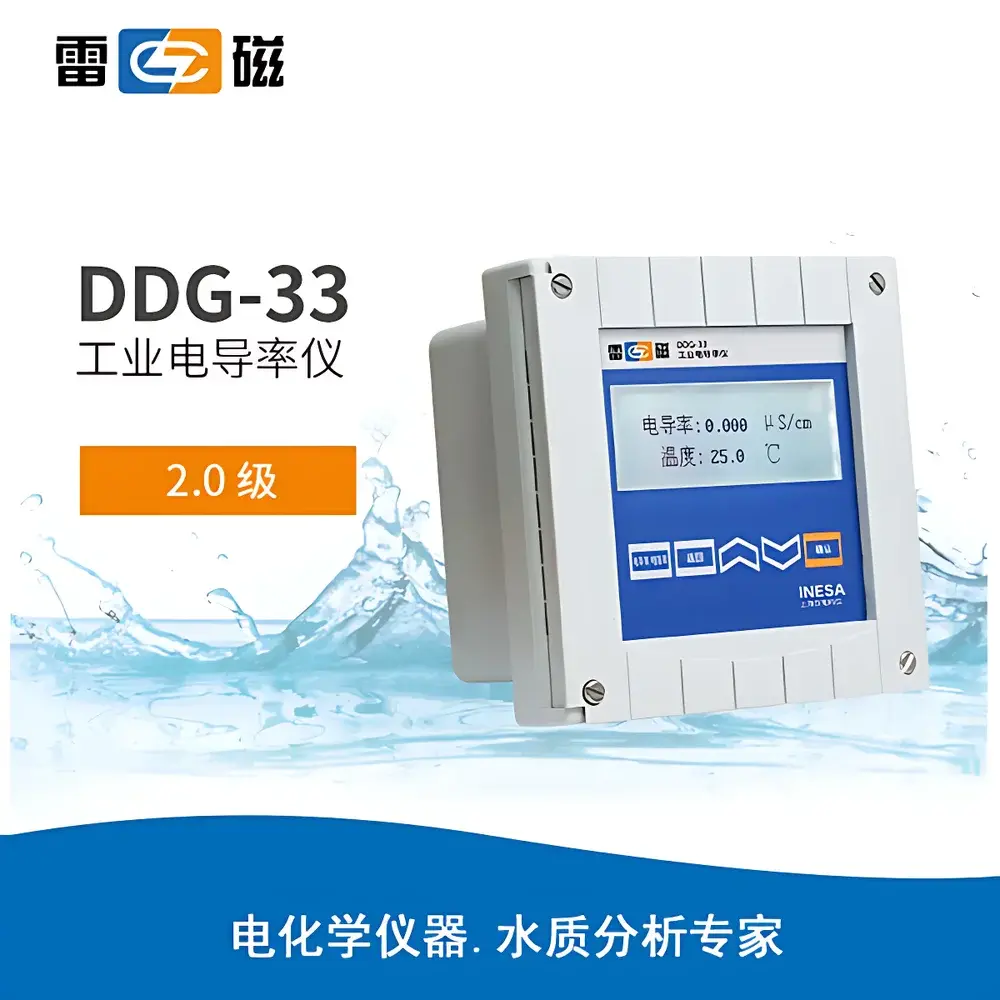
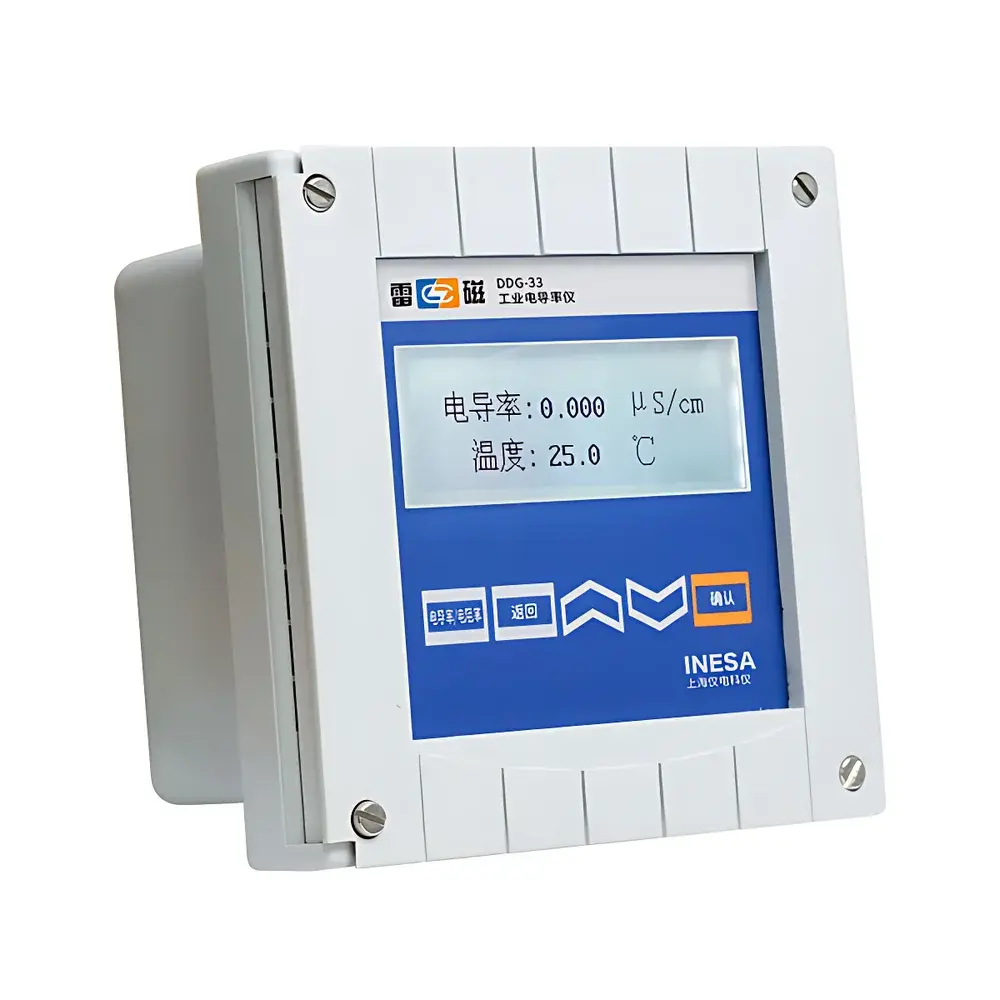
Leichi DDG-33 Online Conductivity Analyzer
| Brand | Leichi |
|---|---|
| Origin | Shanghai, China |
| Model | DDG-33 |
| Conductivity Range | K=0.01 cm⁻¹: 0–20 µS/cm |
| K=0.1 cm⁻¹ | 1–200 µS/cm |
| K=1.0 cm⁻¹ | 10–10,000 µS/cm |
| Temperature Range | −10.0 to 120.0 °C |
| Basic Instrument Error | ±2.0% FS (conductivity), ±0.5 °C (0.0–60.0 °C), ±1.0 °C (other) |
| Resolution | 0.001/0.01/0.1 µS/cm |
| Temperature Compensation Range | 5.0–60.0 °C (reference 25.0 °C) |
| Repeatability | 1.0% FS |
| Electronic Unit Accuracy | ±1.0% FS (conductivity), ±0.3 °C (temperature) |
| Stability | ±0.5% FS/24 h |
| Enclosure Rating | IP65 |
| Power Supply | AC 220 V ±10%, 50 Hz or DC 24 V |
| Dimensions | 166 × 166 × 110 mm |
| Weight | 2 kg |
Overview
The Leichi DDG-33 Online Conductivity Analyzer is an industrial-grade, panel-mount conductivity monitoring system engineered for continuous, real-time measurement of aqueous solution conductivity in demanding process environments. It operates on the principle of two-electrode (or four-electrode, depending on cell configuration) conductometric measurement, where electrical conductance between electrodes immersed in the sample is converted into a calibrated conductivity value (µS/cm or mS/cm), corrected for temperature via built-in Pt1000 or thermistor-based sensing. Designed for long-term stability and minimal drift, the DDG-33 integrates microprocessor-controlled signal conditioning, automatic range switching, and linearized temperature compensation referenced to 25.0 °C — conforming to standard industry practices defined in ASTM D1125 and ISO 7888. Its robust architecture supports unattended operation in water treatment, power plant feedwater/condensate monitoring, pharmaceutical purified water loops, and semiconductor ultrapure water (UPW) distribution systems.
Key Features
- High-contrast dot-matrix LCD display showing simultaneous conductivity and temperature readings with intuitive unit labeling
- Automatic electrode constant recognition and range selection based on connected sensor (K = 0.01, 0.1, or 1.0 cm⁻¹)
- Programmable temperature compensation (5.0–60.0 °C) using the nonlinear NIST-derived algorithm compliant with IEC 60746-3
- Dual independent alarm outputs (relay contacts) configurable for upper/lower conductivity limits with adjustable hysteresis
- Isolated 4–20 mA analog output with user-defined zero/span mapping, supporting HART-compatible loop-powered configurations
- Non-volatile memory retains calibration coefficients, alarm thresholds, and system settings during power interruption
- IP65-rated polycarbonate enclosure suitable for indoor panel mounting in humid or splash-prone environments (e.g., pump rooms, skid-mounted systems)
Sample Compatibility & Compliance
The DDG-33 is validated for use with low-to-medium conductivity aqueous streams including softened water, boiler feedwater, steam condensate, reverse osmosis permeate, deionized water (DI), and distilled water. It is not intended for high-salinity brines (>100 mS/cm), aggressive oxidizing media (e.g., concentrated chlorine solutions), or viscous or particulate-laden slurries without appropriate flow-cell integration and filtration. The analyzer meets electromagnetic compatibility requirements per EN 61326-1 (industrial environment) and safety standards per EN 61010-1. While not certified for SIL or ATEX zones, its design supports integration into larger control systems compliant with ISA-84 or IEC 61511 when used with external safety barriers.
Software & Data Management
The DDG-33 operates as a standalone field instrument with no embedded PC software or USB interface. Configuration, calibration, and alarm setup are performed locally via front-panel membrane keys with password-protected access levels (operator vs. technician). All critical parameters — including calibration date, electrode constant, temperature coefficient (β), and span verification points — are stored with timestamped audit trails. When integrated into a DCS or SCADA system via 4–20 mA output, data logging and trending comply with basic GLP/GMP documentation requirements. For regulatory environments requiring electronic record integrity (e.g., FDA 21 CFR Part 11), third-party data acquisition software must provide user authentication, change tracking, and electronic signature functionality — the DDG-33 itself does not implement cryptographic signing or role-based access control.
Applications
- Continuous monitoring of condensate return lines in thermal power plants to detect cooling water leakage (e.g., tube rupture in condensers)
- Real-time verification of ion exchange resin exhaustion in softening and demineralization skids
- Quality assurance of purified water (PW) and water for injection (WFI) distribution loops per USP and EU GMP Annex 1
- Monitoring of RO reject and permeate streams to optimize membrane cleaning cycles and recovery ratios
- Process validation support for clean-in-place (CIP) rinse endpoint detection in biopharmaceutical manufacturing
- Environmental compliance reporting for effluent discharge conductivity limits under local wastewater regulations
FAQ
What electrode constants are supported by the DDG-33?
The analyzer is compatible with three standardized conductivity cells: 2043-205B (K = 0.01 cm⁻¹), 2043-405B (K = 0.1 cm⁻¹), and 2043-605B (K = 1.0 cm⁻¹). Each cell must be manually selected in the setup menu to ensure correct scaling.
Does the DDG-33 support automatic temperature compensation for non-aqueous solvents?
No. Temperature compensation is optimized for aqueous electrolyte solutions per the DIN/ISO standard polynomial model. It is not validated for organic solvents, glycols, or mixed-phase systems.
Can the 4–20 mA output be configured for temperature-only transmission?
No. The analog output is fixed to represent conductivity only. Temperature is available solely on the local display and cannot be transmitted externally without additional hardware.
Is calibration traceable to national standards?
Yes — when calibrated using NIST-traceable KCl standard solutions (e.g., 1413 µS/cm at 25 °C), the DDG-33 achieves measurement uncertainty consistent with its ±2.0% FS specification. Calibration certificates from accredited labs may be issued upon request.
What maintenance intervals are recommended for long-term reliability?
Electrode cleaning and verification against reference standards are advised every 3–6 months in clean water applications; monthly in high-fouling or high-CO₂ environments. The electronics require no routine servicing beyond visual inspection and environmental seal integrity checks.
Related Products