
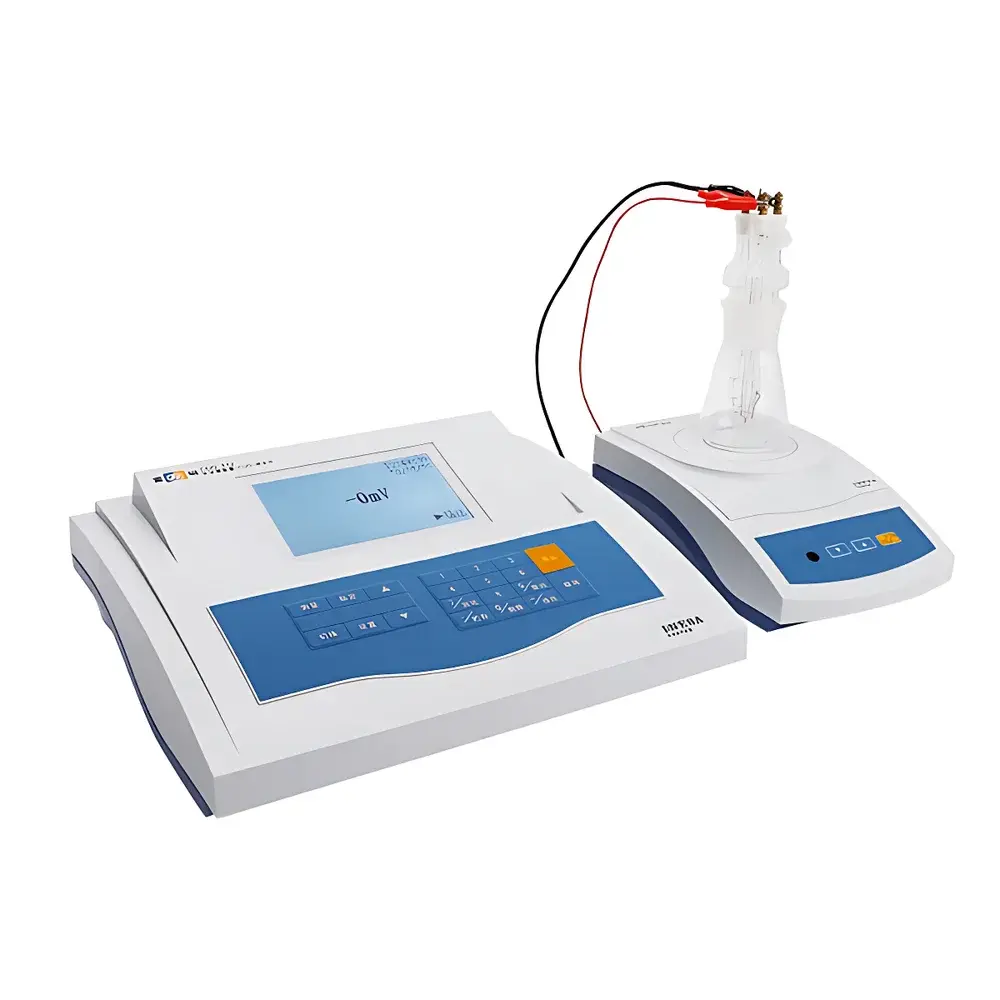
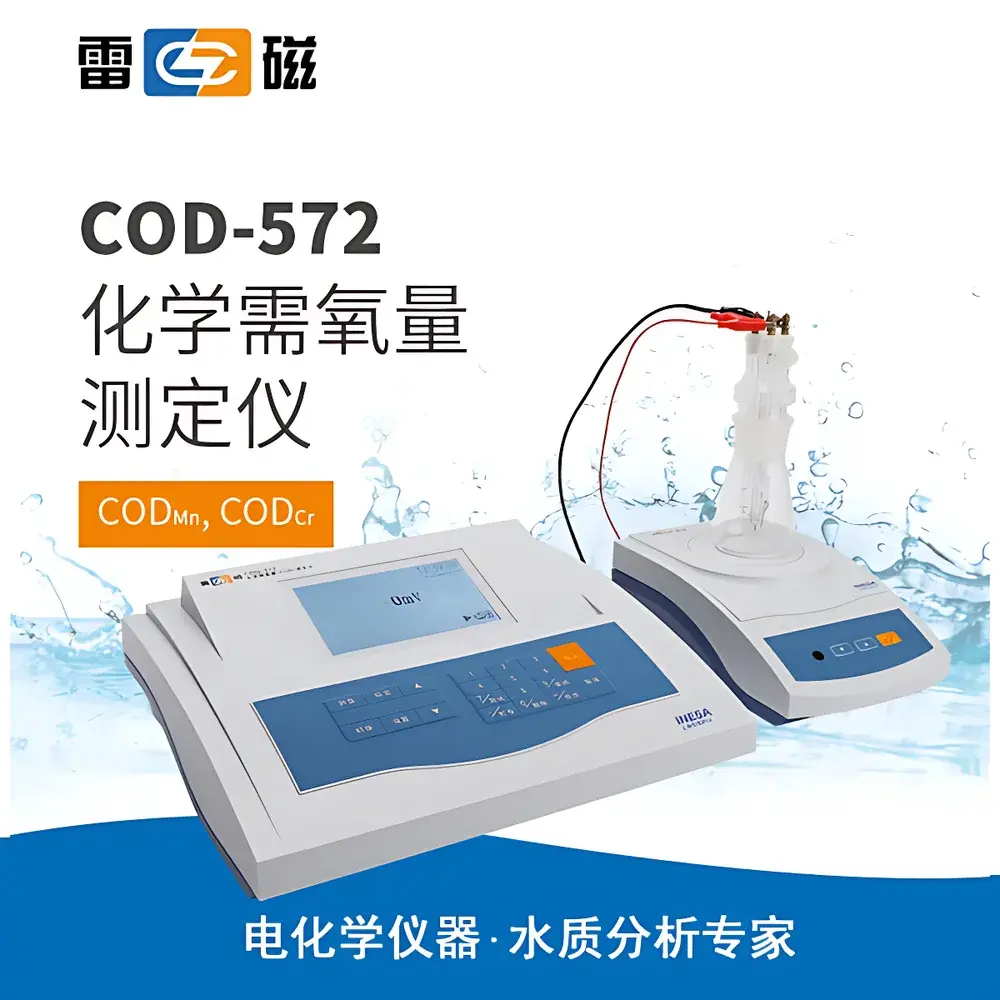
Leici COD-572 Coulometric Chemical Oxygen Demand Analyzer
| Brand | Leici |
|---|---|
| Origin | Shanghai, China |
| Manufacturer Type | Direct Manufacturer |
| Regional Classification | Domestic (China) |
| Model | COD-572 |
| Price Range | USD 700 – 1,400 (FOB Shanghai) |
| Instrument Type | Benchtop Laboratory Analyzer |
| Measurement Principle | Coulometric Titration (ASTM D1252–04, ISO 8467:1993 compliant) |
| COD Range | (0.0–100.0) mg/L (standard), extendable to (100.0–1000) mg/L via dilution or high-range mode |
| Accuracy | ±2 mg/L (absolute error at ≤100 mg/L) |
| Repeatability | RSD ≤ 2% |
| Power Supply | AC 220 V ±10%, 50 Hz ±1% |
| Dimensions (W×D×H) | 300 × 235 × 100 mm |
| Weight | 3.0 kg |
Overview
The Leici COD-572 is a benchtop coulometric chemical oxygen demand (COD) analyzer engineered for precision, reproducibility, and operational simplicity in environmental laboratories conducting routine wastewater, surface water, and effluent quality assessments. Unlike colorimetric or open-reflux spectrophotometric methods, the COD-572 implements controlled-potential coulometric titration—electrochemically generating titrant (Fe3+) in situ from Fe2+ electrolyte within a sealed reaction cell. This eliminates dependency on standardized potassium dichromate solutions, volumetric burettes, or manual endpoint detection, thereby reducing analyst variability, reagent waste, and calibration drift. The system conforms to the fundamental electrochemical principles outlined in ISO 8467:1993 and aligns with the measurement logic of ASTM D1252–04 (Method B: Coulometric Titration), supporting traceable, GLP-compliant COD quantification across regulatory and research workflows.
Key Features
- Integrated coulometric titration cell with platinum working electrode and auxiliary Ag/AgCl reference system, optimized for stable current efficiency and low background interference.
- Three selectable electrolysis current modes (10 mA, 20 mA, 40 mA) enabling dynamic range adaptation—low current for sub-10 mg/L precision; high current for rapid oxidation of complex organic matrices up to 1000 mg/L (post-dilution).
- Backlit LCD interface with intuitive Chinese-language menu navigation—designed for seamless operation without external PC dependency.
- On-device COD calculation engine: automatically computes and displays final COD concentration (mg/L) using Faraday’s law, electrode charge integration, and user-defined sample volume inputs—no manual stoichiometric conversion required.
- Dual-method calibration memory: stores up to 10 preconfigured standardization profiles each for permanganate-based (Mn-method) and dichromate-based (Cr-method) protocols—including nominal sample volume, electrolyte batch ID, and slope correction factors.
- Built-in data management: retains 200 measurement records per method (Mn/Cr), with timestamp, sample ID, operator code, range mode, and raw coulombic charge value—exportable via USB port for audit-ready reporting.
Sample Compatibility & Compliance
The COD-572 accepts clarified, filtered aqueous samples with suspended solids < 20 mg/L and chloride concentrations ≤ 1000 mg/L (within specification when using chloride-compensating electrolyte). It supports direct analysis of domestic sewage, industrial process water, bioreactor influents, and treated effluents. All measurement procedures comply with ISO/IEC 17025:2017 requirements for method validation, including documented uncertainty budgets for repeatability (RSD ≤ 2%), trueness (±2 mg/L bias ≤100 mg/L), and intermediate precision. The instrument architecture supports 21 CFR Part 11–ready software upgrades (via optional Leici LabLink Suite) for electronic signatures, audit trails, and role-based access control—facilitating GMP/GLP-aligned QA/QC documentation.
Software & Data Management
While fully functional as a standalone unit, the COD-572 interfaces with Leici’s LabLink Desktop Software (v3.2+) via USB virtual COM port. This enables automated report generation (PDF/CSV), trend analysis across calibration batches, QC charting (X-bar/R), and secure archival compliant with ISO 14001 environmental management systems. Raw charge-integration logs include metadata tags for instrument serial number, firmware version, ambient temperature, and electrolyte lot traceability—critical for regulatory submissions under EPA Method 410.4 or EU Directive 2000/60/EC monitoring frameworks.
Applications
- Regulatory compliance testing for municipal wastewater treatment plants (WWTPs) reporting to national discharge permits.
- In-process monitoring of anaerobic digesters and activated sludge units to optimize hydraulic retention time and oxygen demand loading.
- Environmental impact assessment (EIA) field labs requiring rapid, reagent-minimized COD screening prior to full-speciation analysis.
- Academic research on biodegradability kinetics, where coulometric resolution supports low-concentration kinetic modeling (e.g., first-order BOD5/COD correlation studies).
- Quality assurance for industrial pretreatment facilities handling textile, pharmaceutical, or food-processing effluents.
FAQ
Does the COD-572 require daily standardization with certified reference materials?
No—coulometric titration inherently references Faraday’s constant; only periodic verification using NIST-traceable COD standards (e.g., potassium hydrogen phthalate) is recommended every 30 days or after 50 analyses.
Can chloride interference be mitigated without mercury sulfate?
Yes—the instrument supports optional chloride-tolerant electrolyte formulations (e.g., Fe2+/Ag+ dual-anolyte system), validated to 2000 mg/L Cl− per ISO 8467 Annex B.
Is firmware upgrade capability available?
Yes—field-upgradable via USB stick; latest firmware includes enhanced data encryption, extended storage partitioning, and multi-language UI toggle (English/Chinese/Spanish).
What maintenance intervals are recommended for the titration cell?
Electrode polishing and membrane replacement every 6 months under continuous use; full cell recalibration advised after any physical disassembly or electrolyte refill.
How is measurement uncertainty reported per ISO/IEC 17025?
Uncertainty components include current source stability (±0.3%), charge integration resolution (±0.1 C), sample volume pipetting (±0.5%), and reference standard CRM uncertainty (±0.8%)—combined expanded uncertainty (k=2) is ≤ ±3.1 mg/L at 50 mg/L COD.
Related Products







