
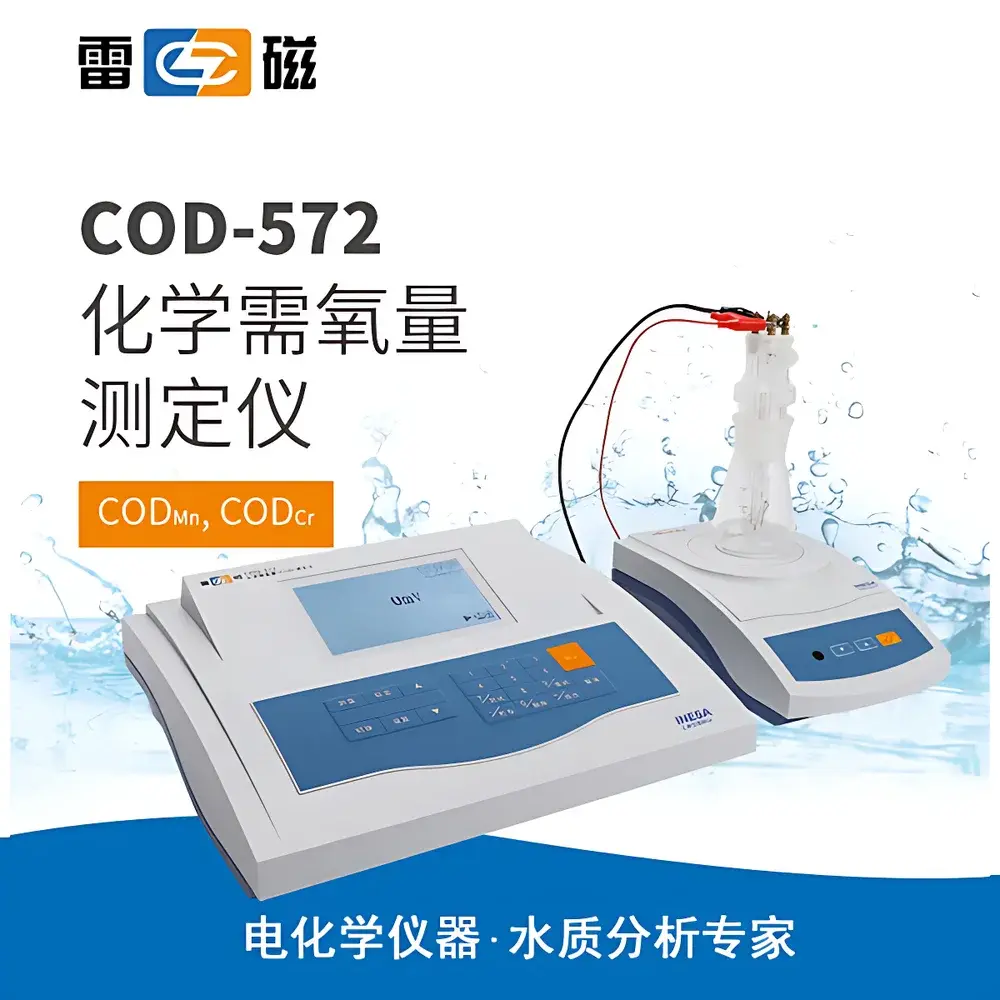
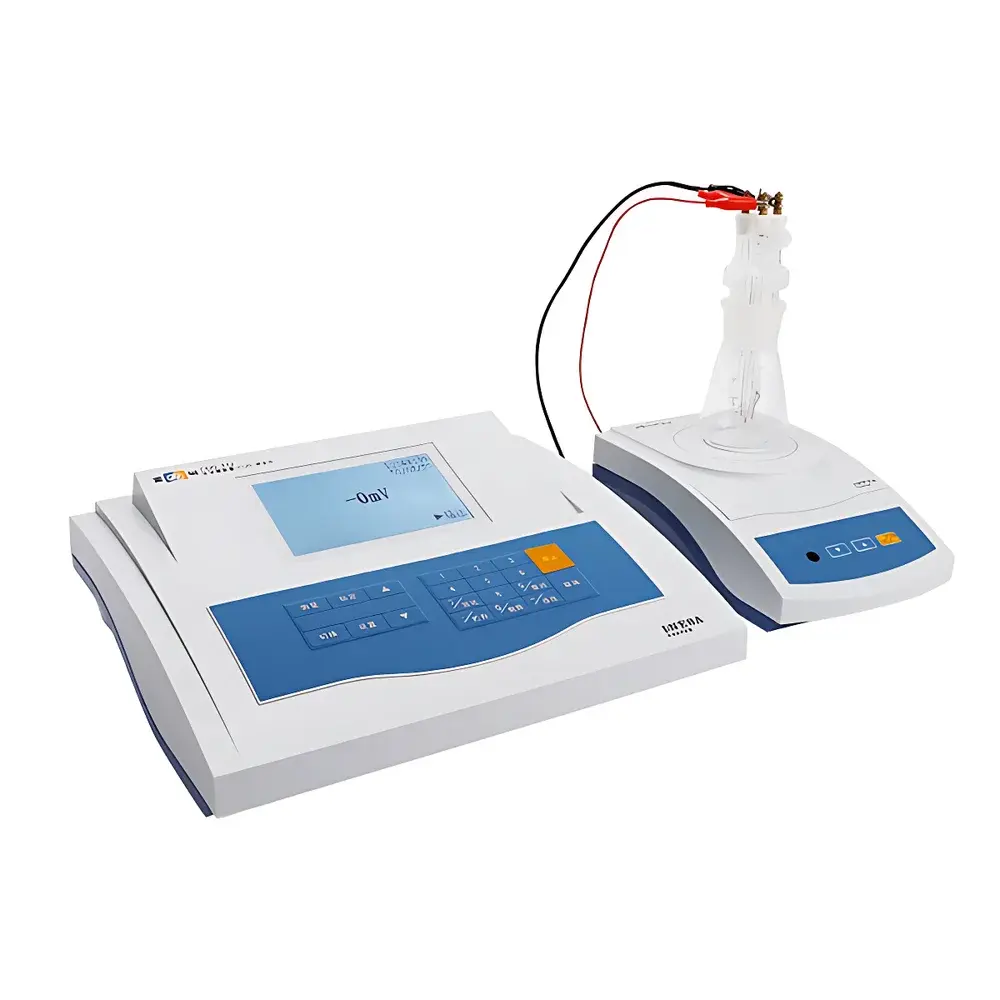
Leici COD-572 Coulometric Chemical Oxygen Demand Analyzer
| Brand | Leici |
|---|---|
| Origin | Shanghai, China |
| Model | COD-572 |
| Instrument Type | Laboratory Benchtop Analyzer |
| Measurement Principle | Coulometric Titration (ASTM D1252–04, ISO 8467) |
| COD Range | 0.0–100.0 mg/L (standard), extendable to 100.0–1000 mg/L |
| Accuracy | ±2 mg/L (absolute error, certified reference standards) |
| Repeatability | ≤2% RSD (n=6, mid-range calibration standard) |
| Electrolysis Current Options | 10 mA, 20 mA, 40 mA |
| Data Storage Capacity | 200 measurements each for permanganate (Mn) and dichromate (Cr) methods |
| Calibration Memory | 10 user-defined standard volume configurations per method |
| Power Supply | AC 220 V ±10%, 50 Hz ±1% |
| Dimensions (W×D×H) | 300 × 235 × 100 mm |
| Weight | 3.0 kg |
Overview
The Leici COD-572 is a laboratory-grade coulometric chemical oxygen demand (COD) analyzer engineered for precision, traceability, and operational efficiency in environmental water quality laboratories. Unlike conventional colorimetric or manual titrimetric systems, the COD-572 implements the electrochemical principle of coulometric titration—where a precisely controlled electric current generates titrant (Fe²⁺/Fe³⁺ redox species in situ via electrolysis of ferrous ammonium sulfate)—eliminating reliance on standardized chemical reagents, volumetric glassware, or daily titrant standardization. This method conforms to the fundamental electrochemical equivalence defined in ASTM D1252–04 (Test Methods for Chemical Oxygen Demand of Water) and aligns with the theoretical basis of ISO 8467:1993 (Water quality — Determination of permanganate index — Method using potassium permanganate). The instrument delivers direct digital readout of COD concentration (mg/L O₂) without manual calculation, reducing operator-induced variability and supporting GLP-compliant workflows.
Key Features
- Coulometric titration architecture: Eliminates need for standardized titrant solutions and eliminates associated calibration drift, storage instability, and safety hazards from concentrated oxidants.
- Triple-step electrolysis current selection (10 mA / 20 mA / 40 mA): Enables dynamic range optimization—low current for high-precision sub-10 mg/L measurements; higher currents for rapid analysis of wastewater effluents up to 1000 mg/L.
- Dual-method support: Independent calibration memory for both dichromate (Cr⁶⁺ reduction) and permanganate (Mn⁷⁺ reduction) protocols—each accommodating up to 10 user-defined standard volumes for matrix-matched calibration.
- Integrated LCD interface with native English menu navigation: Supports intuitive method selection, real-time current monitoring, endpoint detection visualization, and status diagnostics.
- Built-in data management: Stores 200 measurement records per method (dichromate & permanganate), each timestamped and tagged with electrolysis current, sample volume, and calibration ID—enabling retrospective audit trails.
- Compact benchtop form factor (300 × 235 × 100 mm, 3.0 kg): Designed for space-constrained QC labs, EPA-certified testing facilities, and university teaching laboratories requiring regulatory-grade reproducibility.
Sample Compatibility & Compliance
The COD-572 is validated for use with clarified aqueous samples including surface water, drinking water, treated wastewater, and industrial effluents—with optional pre-dilution for high-COD matrices. It supports both low-range (0.0–100.0 mg/L) and extended-range (100–1000 mg/L) quantification under identical coulometric principles, ensuring method consistency across concentration orders of magnitude. The system complies with core requirements for regulated environmental testing: measurement uncertainty budgeting per ISO/IEC 17025:2017 Annex A.3, documentation integrity aligned with US EPA Method 410.4 (for dichromate-based COD), and data retention structures compatible with FDA 21 CFR Part 11 (electronic records & signatures) when integrated with compliant LIMS environments. All firmware operations maintain non-volatile memory integrity during power interruption.
Software & Data Management
No external PC software is required for routine operation; all configuration, calibration, and reporting occur via the embedded interface. Each stored record includes: date/time stamp, selected method (Cr or Mn), applied current setting, sample volume (mL), measured charge (coulombs), and final COD result (mg/L). Data export is supported via RS-232 serial interface (optional USB-to-serial adapter) for integration into laboratory information management systems (LIMS) or statistical process control (SPC) platforms. Audit logs capture user-initiated actions—including calibration updates, data deletion events, and method parameter changes—meeting GLP/GMP traceability expectations. Firmware supports field-upgradable calibration coefficients and diagnostic self-tests.
Applications
- Regulatory compliance monitoring: Routine COD verification for municipal wastewater treatment plants (WWTPs) subject to NPDES permits.
- Environmental impact assessment: Baseline and post-intervention COD profiling of rivers, lakes, and groundwater near industrial zones.
- Research & development: Kinetic studies of biodegradability and oxidation efficiency in novel wastewater treatment processes.
- Academic instruction: Hands-on training in electroanalytical chemistry, redox stoichiometry, and environmental metrology principles.
- Quality assurance in pharmaceutical manufacturing: Effluent screening per ICH Q5C guidelines where organic load monitoring supports water system validation.
FAQ
Does the COD-572 require daily standardization of titrant solutions?
No. Coulometric generation of Fe²⁺ eliminates the need for prepared titrant solutions, standardization, or expiration tracking.
Can the instrument differentiate between dichromate and permanganate methods during analysis?
Yes. User-selectable method mode ensures independent calibration curves, endpoint algorithms, and data categorization for each oxidant system.
Is the ±2 mg/L accuracy specification valid across the full 0–1000 mg/L extended range?
The ±2 mg/L absolute accuracy applies to the primary 0.0–100.0 mg/L range. For the extended 100–1000 mg/L range, accuracy is expressed as ≤±2% of reading (per ISO 8467 Annex B validation protocol).
How is measurement repeatability verified?
Repeatability (≤2% RSD) is determined per ISO 5725-2:1994 using six replicate analyses of a certified reference material (CRM) at 50 mg/L COD, under identical current and volume settings.
What maintenance is required for long-term operational reliability?
Routine maintenance includes periodic cleaning of the electrolysis cell with dilute nitric acid, electrode polishing every 200 analyses, and annual verification of current source linearity using a calibrated digital multimeter.







