
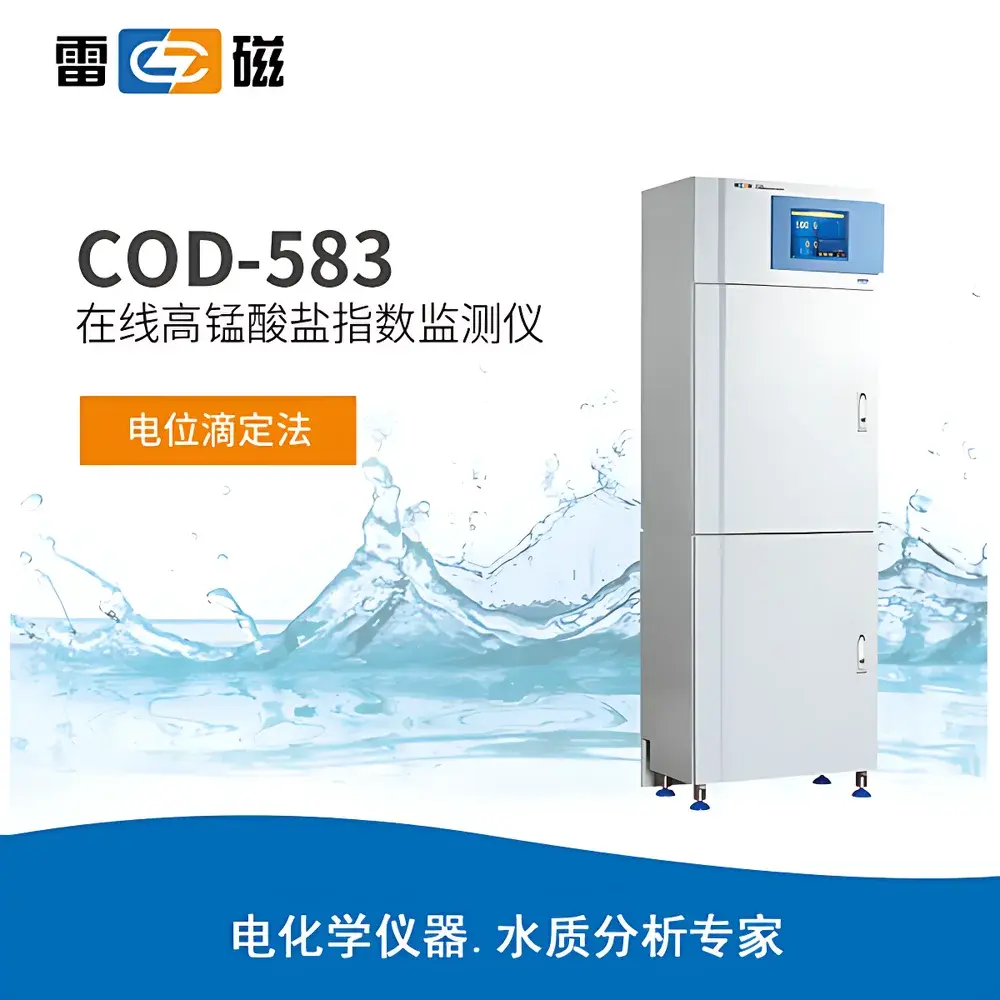
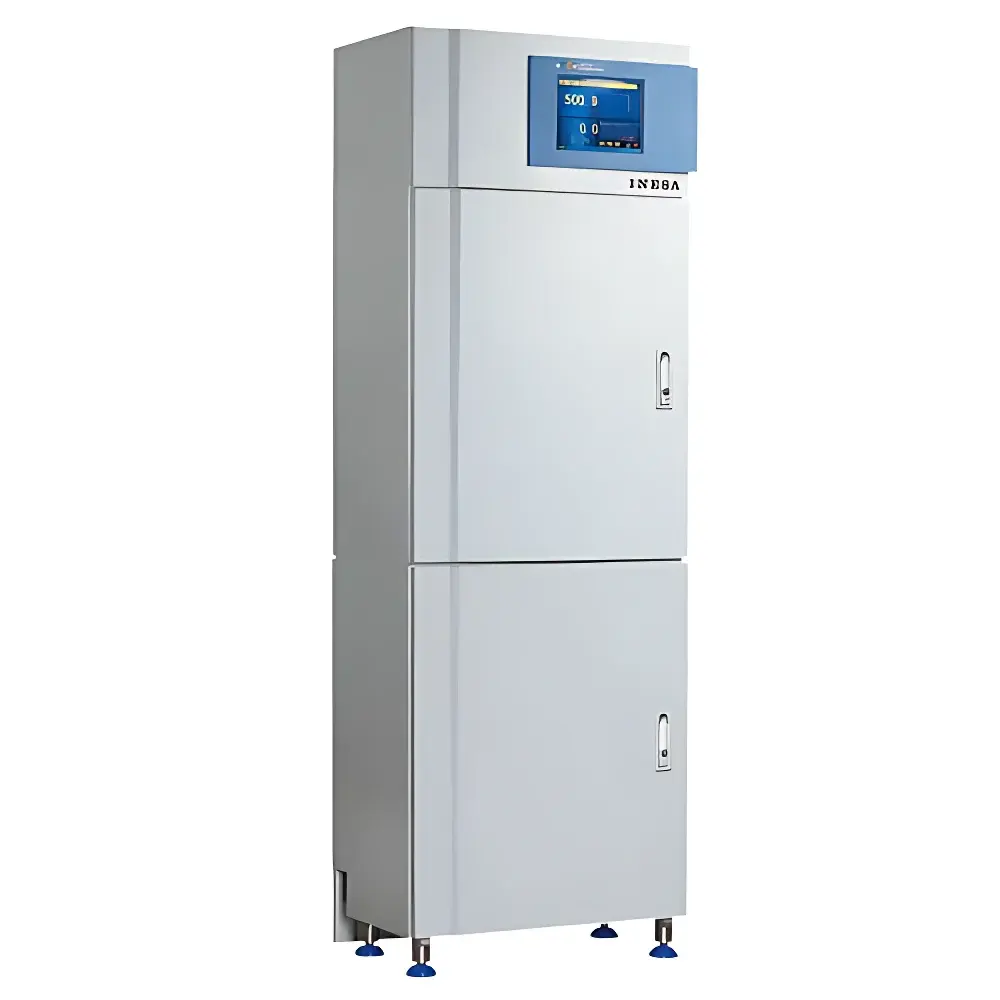
Leici COD-583 Online Permanganate Index Analyzer
| Brand | Leici |
|---|---|
| Origin | Shanghai, China |
| Manufacturer Type | Authorized Distributor |
| Product Origin | Domestic (China) |
| Model | COD-583 |
| Price | USD 16,500 (FOB Shanghai) |
| Measurement Principle | Potassium Permanganate Oxidation with ORP Endpoint Detection |
| Instrument Type | Online Analyzer |
| Repeatability | ≤ ±5% |
| Accuracy | ±10% of Full Scale (Actual Water Sample Comparison) |
Overview
The Leici COD-583 Online Permanganate Index Analyzer is an industrial-grade, fully automated water quality monitoring system engineered for continuous, unattended measurement of the permanganate index (CODMn) in surface water, effluent discharge points, and wastewater treatment process streams. It operates on the standardized potassium permanganate oxidation method—aligned with GB/T 11892–1989 (Chinese National Standard for Permanganate Index Determination) and functionally consistent with ISO 8467:1993 (Water Quality — Determination of Permanganate Index). The analyzer employs a redox titration principle: acidified water samples are oxidized by a precisely dosed potassium permanganate solution under controlled temperature and reaction time; the endpoint is detected potentiometrically via an ORP (Oxidation-Reduction Potential) electrode, eliminating subjective visual endpoint interpretation and ensuring high reproducibility across variable matrix conditions.
Key Features
- ORP-based endpoint detection ensures objective, stable, and interference-resistant endpoint identification—critical for turbid or colored natural waters.
- High-precision sequential injection analysis (SIA) architecture with a 16,000-step micro-stepper motor drive delivers volumetric accuracy of ±0.0025 mL per titrant delivery, minimizing cumulative dosing error.
- Dedicated per-sample metering eliminates cross-contamination between injections; no shared reagent lines or carryover between measurements.
- Chemically resistant FEP transparent tubing (ID ≥ 1.0 mm) reduces particulate clogging risk and enables real-time flow path inspection.
- Integrated zero-point and span verification routines—programmable at user-defined intervals (1–99 days)—to detect and correct baseline drift and sensitivity degradation.
- Robust power-loss recovery: Upon re-energization, the system automatically purges residual reagents, reinitializes fluidic pathways, and resumes scheduled operation without manual intervention.
- Self-diagnostic firmware continuously monitors valve actuation, pump performance, electrode response stability, and reagent level—generating actionable fault codes for predictive maintenance.
- Modular multi-port corrosion-resistant selection valve extends service life in aggressive chemical environments typical of wastewater matrices.
- Touchscreen HMI (Human-Machine Interface) with localized English menu navigation supports on-site configuration, calibration logging, and alarm history review.
Sample Compatibility & Compliance
The COD-583 is validated for use with raw surface water (rivers, lakes, reservoirs), municipal and industrial effluents, and activated sludge process streams. It meets operational requirements for Class I–III surface water monitoring per China’s “Environmental Monitoring Technical Specifications” (HJ/T 91–2002) and supports compliance reporting under China’s “Water Pollution Prevention and Control Law.” While not certified to EPA Method 410.4 or ISO/IEC 17025 for accredited lab use, its performance characteristics—including ≤±5% repeatability and ≤±10% actual-sample bias—align with field-deployable instrument specifications defined in ISO 5667-16:2009 (Water quality — Sampling — Part 16: Guidance on biologically sensitive sampling). All wetted materials comply with USP Class VI and FDA 21 CFR 177.1550 for fluoropolymer components.
Software & Data Management
The embedded controller supports Modbus RTU (RS-485) and ASCII protocol (RS-232) for seamless integration into SCADA, DCS, or PLC-based plant automation systems. One standard 4–20 mA analog output is provided (optional dual-channel configuration available); up to six programmable relay outputs support alarm staging (e.g., low reagent, high deviation, maintenance due). Data logging includes timestamped measurement values, calibration events, diagnostic flags, and power cycle records—retained for ≥30 days onboard. Remote access is enabled via Ethernet (optional) with secure HTTP/HTTPS interface supporting read-only data export in CSV format. Audit trail functionality complies with GLP-aligned record-keeping principles, including immutable timestamps and operator ID tagging for critical actions.
Applications
- Real-time surveillance of source water quality at intake stations for drinking water utilities.
- Regulatory compliance monitoring at municipal and industrial wastewater discharge points (e.g., TP, TN, and CODMn co-monitoring).
- Process control feedback in biological treatment units—detecting organic loading shifts before BOD/COD excursions occur.
- Long-term trend analysis in ecological monitoring networks assessing eutrophication pressure in lakes and reservoirs.
- Performance verification of tertiary treatment stages (e.g., ozonation, activated carbon filtration) where permanganate index serves as surrogate for non-biodegradable organics.
FAQ
What is the minimum measurement cycle time?
The shortest configurable analysis interval is 40 minutes, including sample aspiration, digestion, titration, endpoint detection, and system rinse.
Can the instrument operate unattended for extended periods?
Yes—designed for ≥720 hours mean time between failures (MTBF), with monthly maintenance requiring ~30 minutes for reagent replacement and tubing inspection.
Is remote calibration supported?
Remote initiation of zero/span checks is supported; however, physical standard solutions must be introduced manually at the sampling manifold.
Does the system meet cybersecurity requirements for industrial networks?
The base configuration includes password-protected configuration access and write-protected data export; optional TLS 1.2 encryption and role-based user permissions are available upon request.
How is drift correction handled during long-term deployment?
Automated zero and span verification routines—scheduled independently—generate correction factors applied in real time to raw sensor outputs, maintaining traceability to initial calibration.
Related Products







