
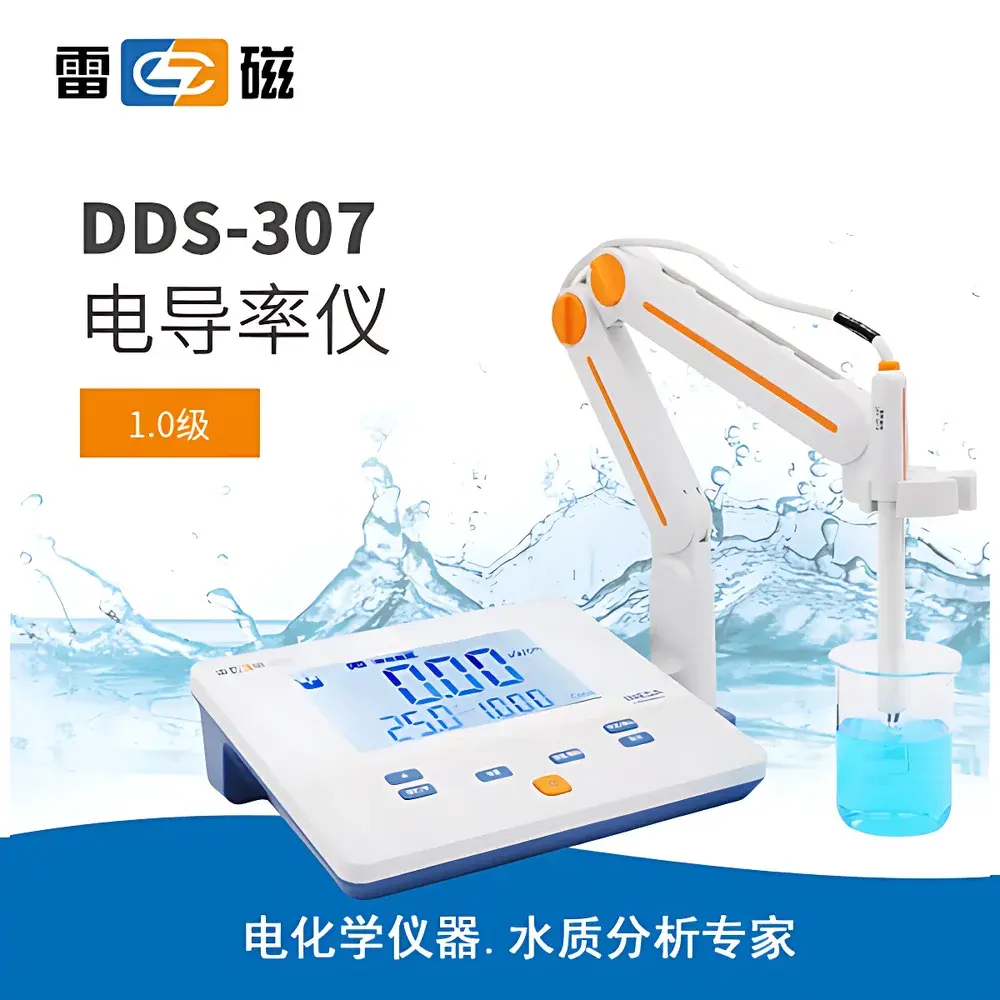
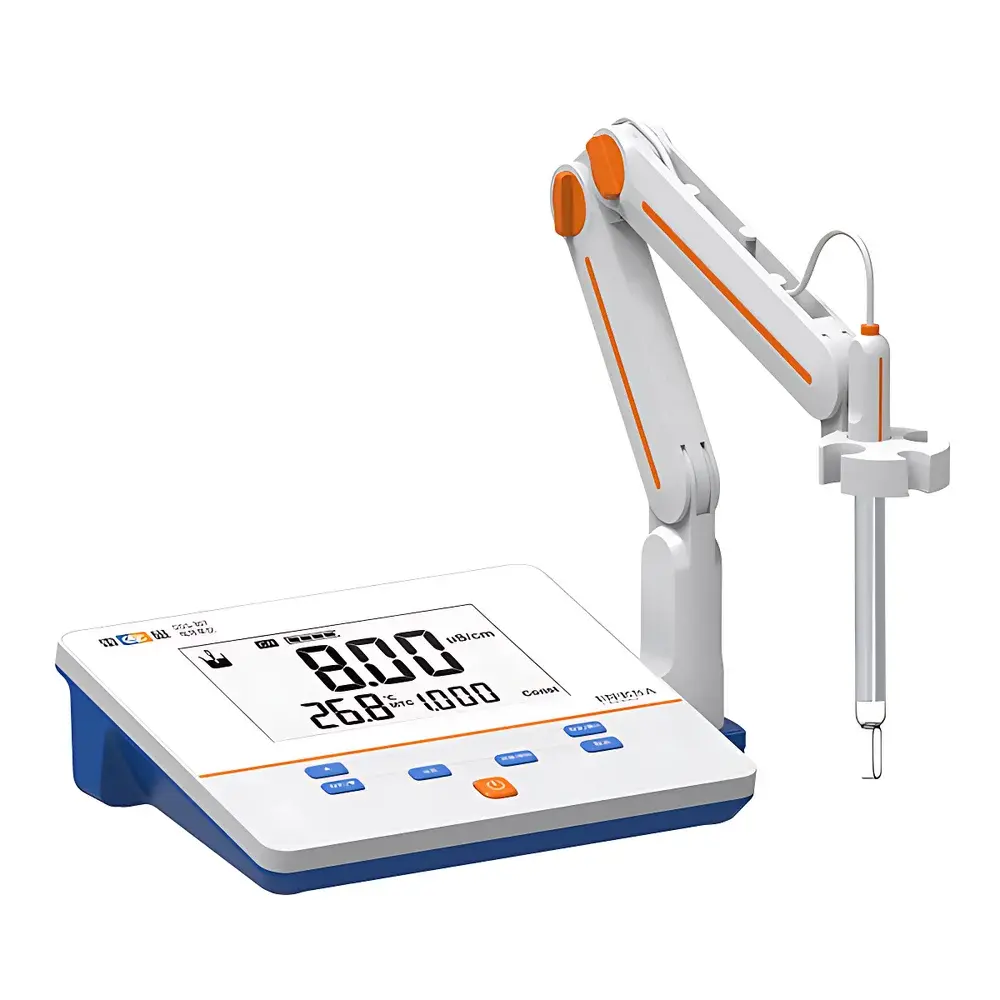
Leici DDS-307 Benchtop Conductivity Meter
| Brand | Leici |
|---|---|
| Origin | Shanghai, China |
| Instrument Type | Benchtop Laboratory Conductivity Meter |
| Measurement Parameter | Single-parameter (Conductivity) |
| Conductivity Range | 0.00 µS/cm to 200 mS/cm |
| Accuracy | ±1.0% FS |
| Minimum Resolution | 0.01 µS/cm (auto-ranging) |
| Temperature Compensation | Manual |
| Calibration | 1-point calibration with auto-recognition of 4 GB-standard conductivity solutions |
| Electrode Constant Support | Automatic frequency switching compatible with K = 1.0 cell |
| Data Storage | 50 measurement sets |
| Display | High-resolution LCD with key-based navigation |
| Enclosure Rating | IP54 |
| Power Supply | AC/DC adapter (Input: 100–240 V AC |
| Output | 20 V DC / 1500 mA) |
| Dimensions (W×D×H) | 242 × 195 × 68 mm |
| Weight | 0.9 kg |
Overview
The Leici DDS-307 Benchtop Conductivity Meter is a precision-engineered electrochemical instrument designed for reliable, routine conductivity measurements in academic, industrial, and quality control laboratories. Based on the fundamental principle of two-electrode AC conductometric measurement—where a known alternating current is applied across a pair of platinum electrodes immersed in solution, and the resulting voltage drop is used to calculate conductance—the DDS-307 delivers stable, reproducible readings across an extended dynamic range from 0.00 µS/cm to 200 mS/cm. Its architecture conforms to national standard JJG 376–2007 (Verification Regulation for Conductivity Meters) and aligns with international metrological practices for laboratory-grade benchtop conductivity instrumentation. The meter employs automatic frequency selection to minimize polarization effects and ensure optimal signal-to-noise ratio across varying sample conductivities—particularly critical when measuring ultrapure water (low µS/cm) or concentrated brines (high mS/cm). Designed for daily use in controlled environments, it operates without integrated temperature sensing but supports manual temperature input for compensation per ISO 7888 and ASTM D1125 guidelines.
Key Features
- High-contrast LCD display with intuitive key-based interface for rapid parameter navigation and real-time value monitoring
- Auto-ranging resolution down to 0.01 µS/cm, dynamically optimized per selected measurement segment
- IP54-rated enclosure providing dust resistance and limited water ingress protection—suitable for standard laboratory benchtop deployment
- Integrated electrode detection circuitry enabling automatic recognition of connected conductivity cells and validation of electrode constant (K = 1.0)
- Intelligent endpoint detection algorithm supporting both equilibrium-mode (stable reading lock) and continuous-monitoring operation
- One-point calibration workflow with built-in recognition of four nationally certified GB standard solutions (e.g., 1413 µS/cm, 12.88 mS/cm)
- Power management system featuring auto-shutdown after 10 minutes of inactivity and full data retention during unexpected power loss
Sample Compatibility & Compliance
The DDS-307 is validated for aqueous electrolyte solutions including deionized water, buffer preparations, process streams, and environmental samples. It is not intended for non-aqueous, viscous, or highly oxidizing media. While lacking embedded temperature sensing, its manual temperature compensation function enables adherence to standardized reporting protocols requiring conductivity correction to 25 °C. The instrument meets China’s mandatory verification requirements under JJG 376–2007 and satisfies general-purpose laboratory compliance expectations aligned with ISO/IEC 17025 documentation practices. Though not equipped with audit-trail or electronic signature capabilities, its 50-entry local memory supports basic traceability for GLP-aligned workflows where handwritten logbooks remain acceptable.
Software & Data Management
Data handling is performed entirely via front-panel controls: users may store up to 50 complete measurement records—including conductivity value, temperature input, date/time stamp, and calibration status—directly into non-volatile memory. Stored entries support review, selective deletion, and sequential export via visual scrolling. No USB, Bluetooth, or PC connectivity is provided; therefore, data transfer requires manual transcription or optional third-party RS-232 adapters (not included). The firmware implements checksum-verified memory writes and retains all settings—including calibration coefficients and user preferences—across power cycles, ensuring continuity in multi-shift or shared-lab environments.
Applications
- Quality assurance of purified water systems (PW, WFI pre-testing) in pharmaceutical manufacturing
- Routine monitoring of boiler feedwater, cooling tower make-up, and wastewater effluent conductivity
- Calibration verification of inline conductivity sensors in pilot-scale chemical reactors
- Teaching laboratories for undergraduate electrochemistry and analytical chemistry courses
- Environmental field labs performing standardized surface water profiling per EPA Method 120.1
- Food & beverage QC for salt concentration estimation in brine solutions and dairy processing rinsates
FAQ
Does the DDS-307 support automatic temperature compensation (ATC)?
No—it requires manual temperature entry prior to measurement. An external Pt100 or thermistor probe cannot be connected.
Can I use a conductivity cell with a different cell constant (e.g., K = 0.1 or K = 10)?
The instrument is factory-configured for K = 1.0 cells only. Using other constants requires manual calculation of final conductivity values.
Is the device compliant with FDA 21 CFR Part 11?
No—no electronic signatures, audit trails, or user access controls are implemented.
What is the maximum allowable sample temperature during measurement?
The specified operating ambient range is 5–35 °C; no thermal rating is defined for sample solutions beyond this limit.
How frequently should calibration be performed?
Per ISO 7888, calibration is recommended before each analytical session or at least once per shift when used continuously.



