
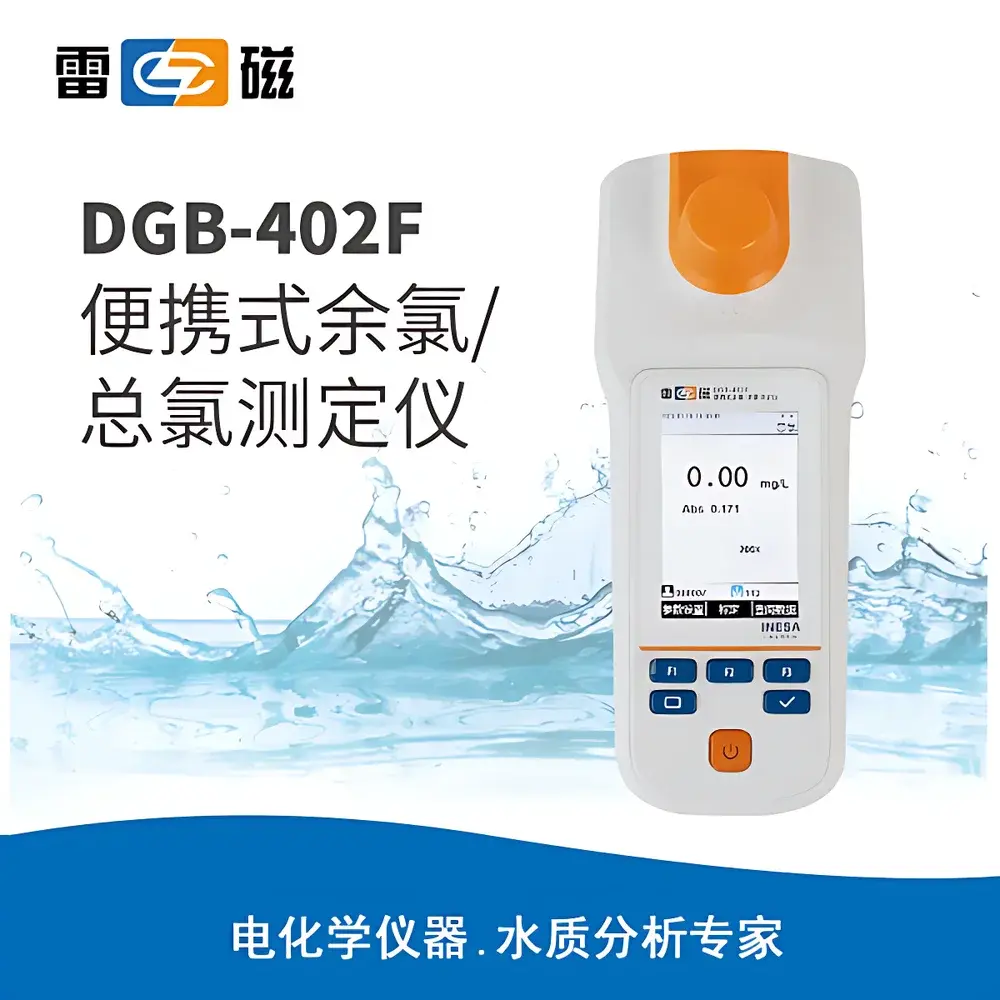
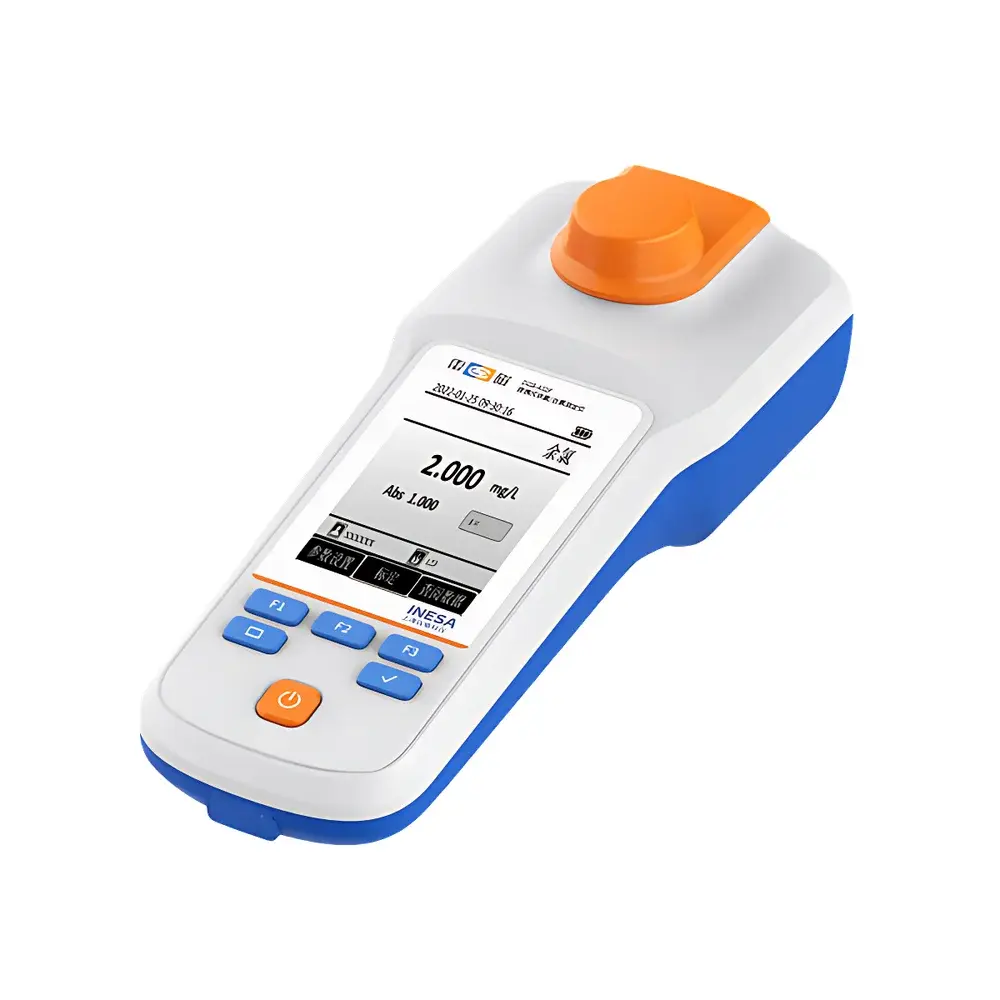
LeiCi DGB-402F Portable Residual and Total Chlorine Analyzer
| [Brand | LeiCi |
|---|---|
| Origin | Shanghai, China |
| Model | DGB-402F |
| Instrument Type | Portable |
| Measurement Principle | DPD Spectrophotometry |
| Measurable Parameters | Residual Chlorine, Total Chlorine |
| Range | 0–5 mg/L |
| Accuracy | ±0.05 mg/L (≤1 mg/L) |
| Repeatability | ≤2.0% |
| Resolution | Concentration: 0.001 mg/L |
| Absorbance | 0.001 ABS |
| LOD | ≤0.02 mg/L |
| Wavelength | 515 nm LED |
| Calibration | 1–3 point user-defined or factory-default curves |
| Data Storage | 200 entries per parameter |
| Protection Rating | IP65 |
| Operating Temperature | 5–35 °C |
| Relative Humidity | ≤85% RH |
| Power | Rechargeable Li-ion battery |
| Dimensions | 85 × 230 × 50 mm |
| Weight | ~0.5 kg] |
Overview
The LeiCi DGB-402F Portable Residual and Total Chlorine Analyzer is a field-deployable spectrophotometric instrument engineered for precise, on-site quantification of free residual chlorine and total chlorine in aqueous matrices. It operates on the standardized N,N-diethyl-p-phenylenediamine (DPD) colorimetric method—fully compliant with ISO 7393-2:2018, APHA Standard Methods 4500-Cl G, and GB/T 5750.11–2023 (Chinese National Standard for Drinking Water Quality). The analyzer employs a stable 515 nm high-intensity LED light source coupled with a precision optical path and calibrated photodetector to convert DPD-induced color development into quantitative chlorine concentration values. Designed for operational continuity in variable environmental conditions, it delivers laboratory-grade reproducibility without requiring benchtop infrastructure—making it suitable for routine monitoring, emergency response, and regulatory compliance verification across municipal water distribution, swimming pool management, healthcare facility effluent control, and wastewater disinfection validation.
Key Features
- Integrated dual-parameter measurement capability for both residual and total chlorine using standardized DPD chemistry
- High-stability 515 nm LED optical system with <1% wavelength drift over 10,000 hours lifetime
- IP65-rated enclosure ensuring dust-tight and low-pressure water jet resistance for outdoor and industrial use
- Intelligent endpoint detection algorithm that automatically confirms reaction completion and triggers stable absorbance acquisition
- On-device dilution factor input with real-time back-calculation of undiluted sample concentration
- Configurable calibration: supports 1–3 point user-defined curves alongside full factory curve restoration
- Adjustable backlight intensity and auto-power-off (configurable timeout: 1–30 min) to extend battery life
- Dual data retention architecture: local storage (200 records each for residual and total chlorine) with timestamp, operator ID, and measurement conditions
Sample Compatibility & Compliance
The DGB-402F accepts standard 25 mm round glass or disposable plastic cuvettes and is validated for use with raw and treated drinking water, recreational pool/spa water, cooling tower makeup, hospital sterilization effluents, and chlorinated process streams. All reagent kits—including DPD powder, potassium iodide, and acidic buffer—are formulated to meet APHA-recommended stoichiometric ratios and shelf-life specifications (24 months unopened at 4–30 °C). The instrument’s firmware enforces GLP-compliant data handling: each stored result includes measurement date/time, ambient temperature, operator code (user-definable), calibration status, and cuvette identification. Audit trails are preserved during power cycles and support traceability under ISO/IEC 17025 and US EPA Method 334.0 requirements.
Software & Data Management
Data export is enabled via USB interface using LeiCi’s certified PC communication software (v3.2+), which supports CSV and XML output formats compatible with LIMS integration. The software provides batch report generation, trend visualization, and statistical summary (mean, SD, CV%) across user-defined date ranges. RS-232 serial output allows direct connection to thermal strip printers for hard-copy documentation during field audits. All stored measurements retain full metadata required for FDA 21 CFR Part 11 compliance when used with validated software configurations and electronic signature protocols. Firmware updates are delivered via signed binary packages to ensure integrity and version-controlled deployment.
Applications
- Routine verification of chlorine residual in municipal water distribution networks pre- and post-booster stations
- Compliance testing for WHO Guidelines for Drinking-water Quality and EU Directive 98/83/EC
- Real-time adjustment of chlorine dosing systems in swimming pools and aquatic facilities
- Validation of disinfection efficacy in healthcare wastewater prior to discharge
- Field assessment of chlorine decay kinetics during pipeline transit studies
- Emergency response screening following natural disasters or infrastructure failures
FAQ
What reagents are required for residual vs. total chlorine measurement?
Residual chlorine requires DPD powder only; total chlorine requires DPD powder plus potassium iodide reagent to oxidize combined chlorine species.
Can the instrument be calibrated with NIST-traceable standards?
Yes—calibration solutions traceable to NIST SRM 3113a (chlorine standard) or equivalent certified reference materials are fully supported.
Is the device suitable for seawater or high-salinity samples?
While not optimized for >10,000 ppm TDS, acceptable accuracy is maintained up to 5,000 ppm chloride when using the recommended sample pretreatment protocol (dilution + matrix-matched calibration).
How is measurement uncertainty reported in compliance documentation?
The instrument reports combined standard uncertainty per GUM (JCGM 100:2008), incorporating repeatability, calibration curve fit error, photometric noise, and reagent lot variability—documented in the included Certificate of Conformance.
Related Products







