
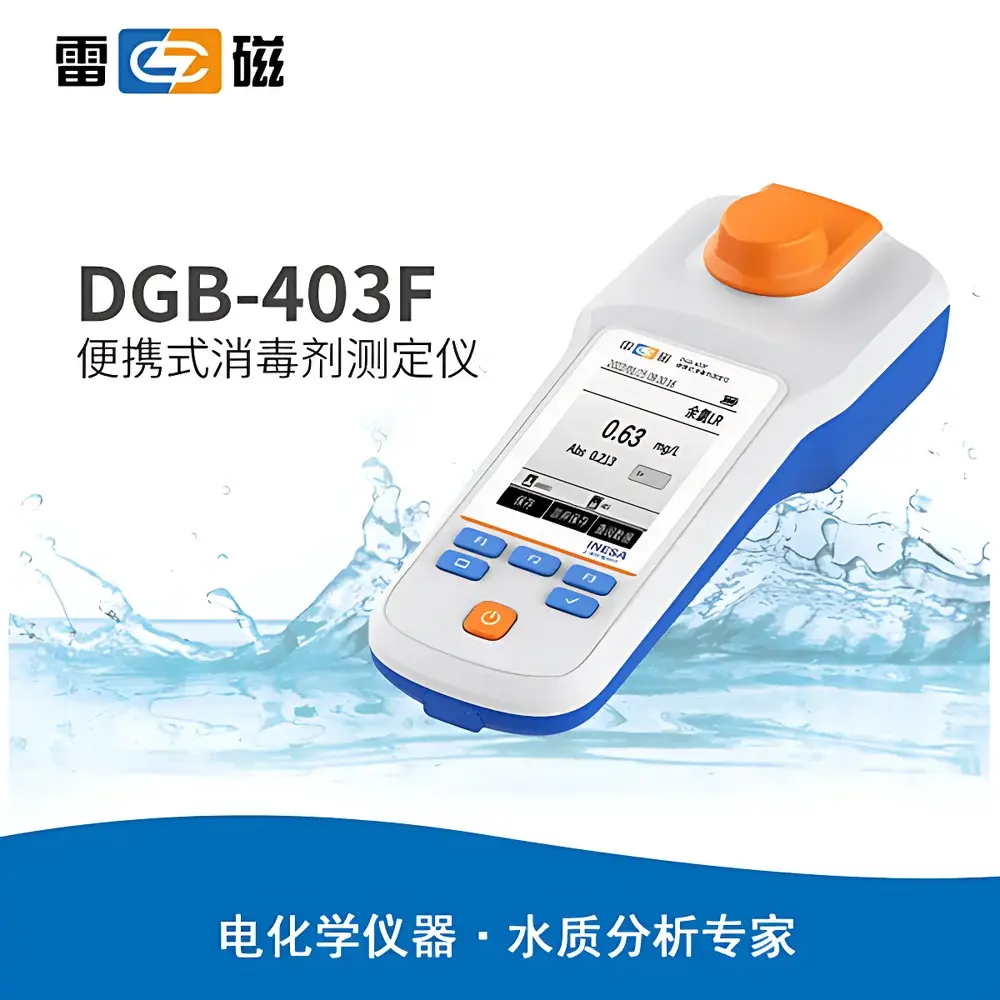
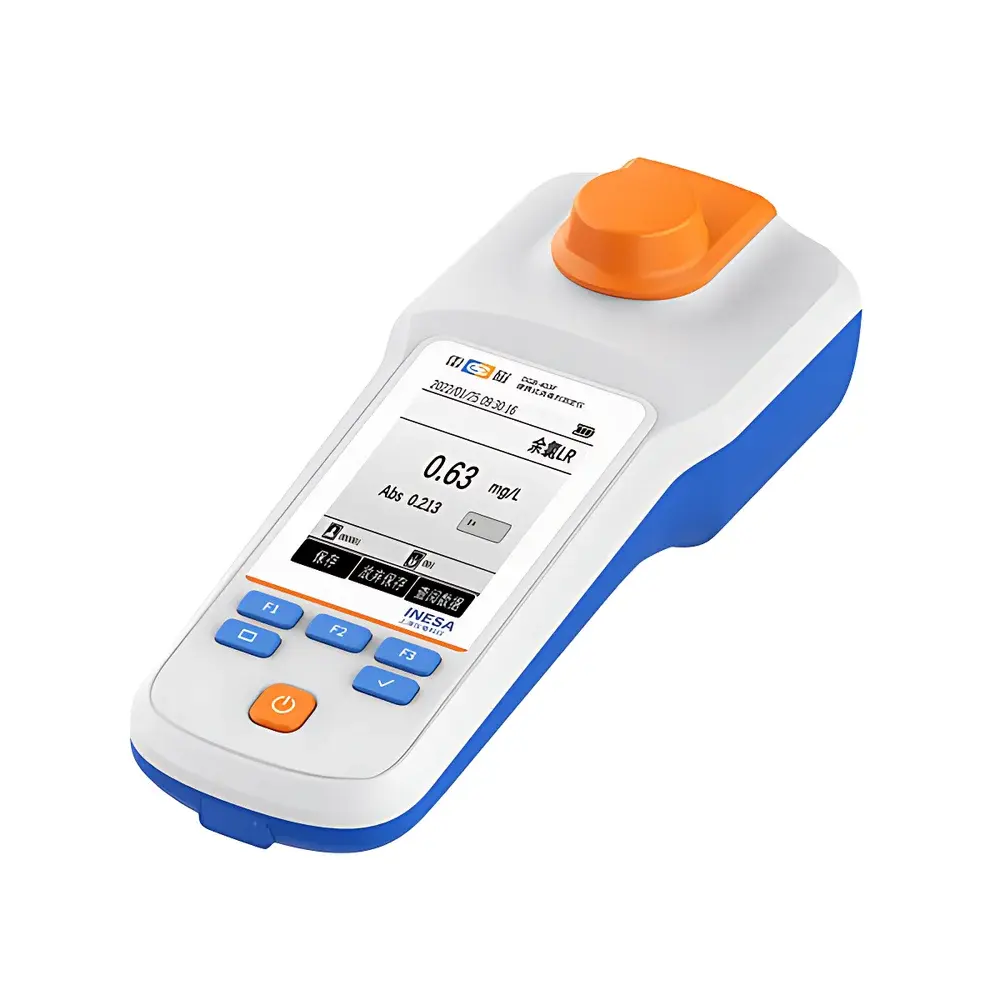
Leici DGB-403F Portable Residual Chlorine and Chlorine Dioxide Analyzer
| Brand | Leici |
|---|---|
| Origin | Shanghai, China |
| Model | DGB-403F |
| Instrument Type | Portable |
| Measurement Principle | DPD Spectrophotometry |
| Measurable Parameters | Residual Chlorine (LR/HR), Total Chlorine (LR/HR), Chlorine Dioxide (LR/HR), Monochloramine (LR/HR), Chlorite, Chlorate, Hydrogen Peroxide |
| Residual Chlorine HR Range | 0.20–12.0 mg/L |
| Accuracy (Residual Cl₂ HR) | ±0.1 mg/L or ±5% |
| Repeatability (Residual Cl₂ HR) | ≤1% |
| Resolution (Residual Cl₂ HR) | 0.1 mg/L |
| LOD (Residual Cl₂ HR) | ≤0.2 mg/L |
Overview
The Leici DGB-403F Portable Residual Chlorine and Chlorine Dioxide Analyzer is a field-deployable spectrophotometric instrument engineered for quantitative determination of disinfectant residuals in drinking water, wastewater effluent, swimming pools, cooling towers, and distribution systems. It operates on the standardized N,N-diethyl-p-phenylenediamine (DPD) colorimetric method—fully compliant with APHA Standard Methods 4500-Cl G, ISO 7393-2, and EPA Method 334.1. The analyzer employs a dual-wavelength optical system with stable LED light sources and precision photodiode detection to minimize interferences from turbidity, colored organics, or oxidant cross-reactivity. Its compact architecture integrates a high-resolution LCD display, embedded calibration algorithms, and intelligent endpoint recognition to ensure operator-independent measurement consistency across variable environmental conditions.
Key Features
- Multi-parameter capability: Simultaneous support for residual chlorine (low/high range), total chlorine (low/high range), chlorine dioxide (low/high range), monochloramine (low/high range), chlorite, chlorate, and hydrogen peroxide—each with dedicated DPD-based reaction protocols.
- Intelligent endpoint detection: Real-time kinetic monitoring of color development enables automatic reading at optimal reaction completion, eliminating subjective timing errors.
- Configurable dilution factor compensation: User-defined dilution ratios trigger automatic back-calculation of original sample concentration, reducing manual error in high-concentration applications.
- Calibration flexibility: Supports factory-loaded standard curves, full curve reset, and user-defined calibration points (up to 10-point custom curves) with traceable curve metadata (date, operator ID, standard lot).
- Ruggedized field design: IP65-rated enclosure ensures dust-tight and low-pressure water jet resistance; includes shock-absorbing portable carrying case with molded instrument cradle and accessory compartment.
- Power resilience: Integrated rechargeable lithium-ion battery provides ≥12 hours of continuous operation; supports USB-C charging from PCs, power banks, or AC adapters (input: 100–240 VAC; output: 5 VDC / 2 A).
Sample Compatibility & Compliance
The DGB-403F accommodates standard 25 mm diameter glass cuvettes or 5 mm pathlength rectangular cells, enabling seamless integration with existing lab workflows and field sampling kits. All measurement modes adhere to internationally recognized validation criteria: accuracy meets ±5% RSD or ±0.1 mg/L (whichever is greater) for high-range residual chlorine per ISO 8467:2021 Annex B; repeatability remains ≤1% RSD under controlled temperature (20–25 °C) and humidity (<80% RH). Data integrity conforms to GLP requirements through timestamped, operator-ID-tagged storage, audit-trail-enabled calibration history, and non-erasable memory architecture. While not FDA 21 CFR Part 11 certified out-of-box, its data export protocol (CSV via USB) supports downstream validation for regulated environments.
Software & Data Management
The instrument stores up to 200 datasets per parameter group (e.g., 200 residual chlorine records, 200 chlorine dioxide records), each containing measured value, date/time stamp, operator ID, calibration ID, cuvette ID, and dilution factor. Data retrieval, deletion, and export are accessible via on-device menu navigation. USB interface enables bidirectional communication with Windows-based Leici DataLink software, supporting batch export, report generation (PDF/Excel), trend visualization, and electronic signature integration for QA/QC documentation. RS-232 serial port compatibility allows direct connection to thermal printers for real-time hardcopy output during field audits or regulatory inspections.
Applications
- Drinking water utilities: Routine verification of chlorine residual at entry points, storage reservoirs, and remote distribution nodes.
- Wastewater treatment plants: Monitoring post-disinfection chlorine decay and chlorine dioxide efficacy against resistant pathogens.
- Recreational water facilities: Compliance testing for CDC Model Aquatic Health Code (MAHC) thresholds in pools and spas.
- Pharmaceutical water systems: USP purified water and WFI disinfectant residue screening during sanitization cycles.
- Food & beverage processing: Validation of chlorine-based CIP rinse concentrations in dairy, brewery, and bottling lines.
- Emergency response: Rapid deployment during natural disasters or infrastructure failures to assess disinfectant adequacy in temporary water supplies.
FAQ
What standards does the DGB-403F comply with for residual chlorine measurement?
It implements DPD Method 4500-Cl G (APHA), ISO 7393-2, and EPA 334.1 for residual and total chlorine, with documented performance against ISO 8467:2021 validation benchmarks.
Can the instrument store calibration curves from multiple operators?
Yes—each calibration event is logged with operator ID, date, and standard batch number; up to 10 user-defined curves may be stored and recalled independently.
Is the battery replaceable by the end user?
No—the Li-ion battery is sealed and service-replaceable only by authorized Leici technical centers to maintain IP65 integrity and calibration traceability.
Does the device support external barcode scanning for sample ID input?
Not natively; however, Leici DataLink software accepts imported CSV files with pre-assigned sample IDs, enabling traceability integration with LIMS platforms.
How is photometric drift compensated during extended field use?
The optical system performs automatic zero-point correction before each measurement cycle using dark-current referencing and LED intensity stabilization firmware.







