
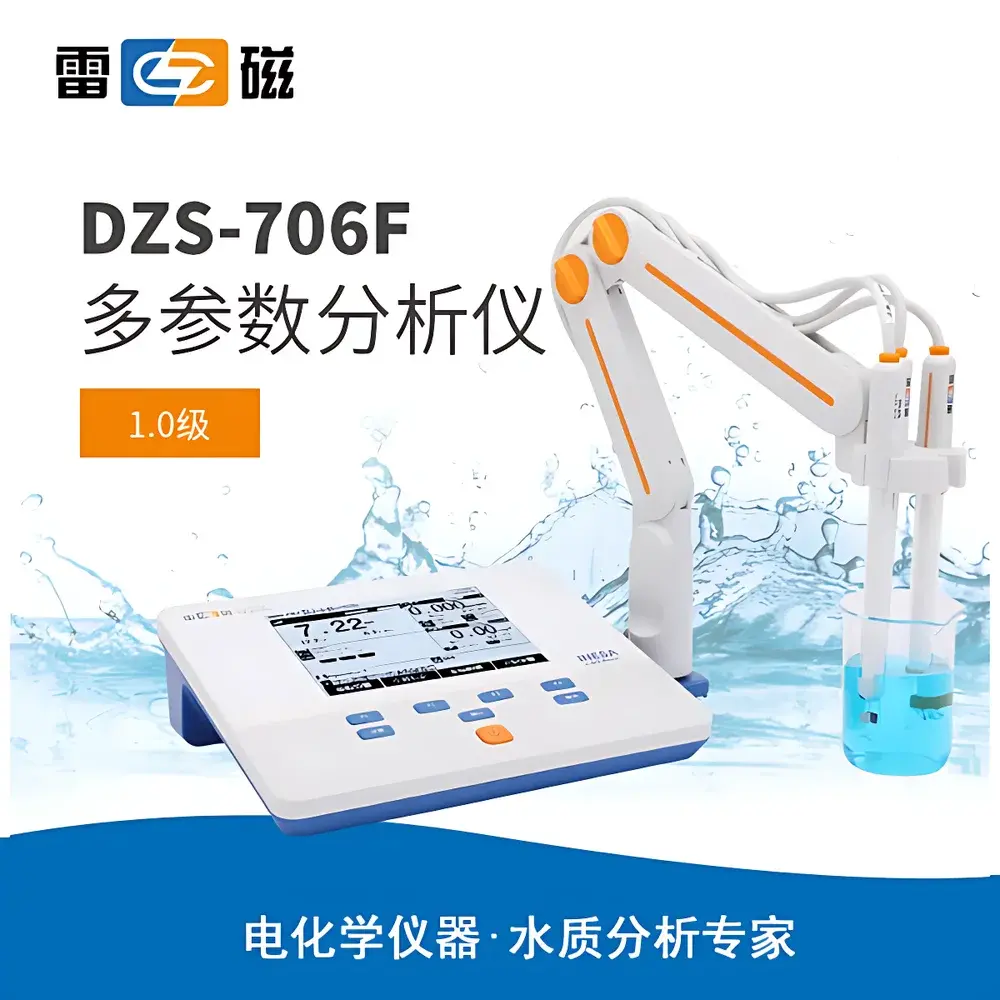
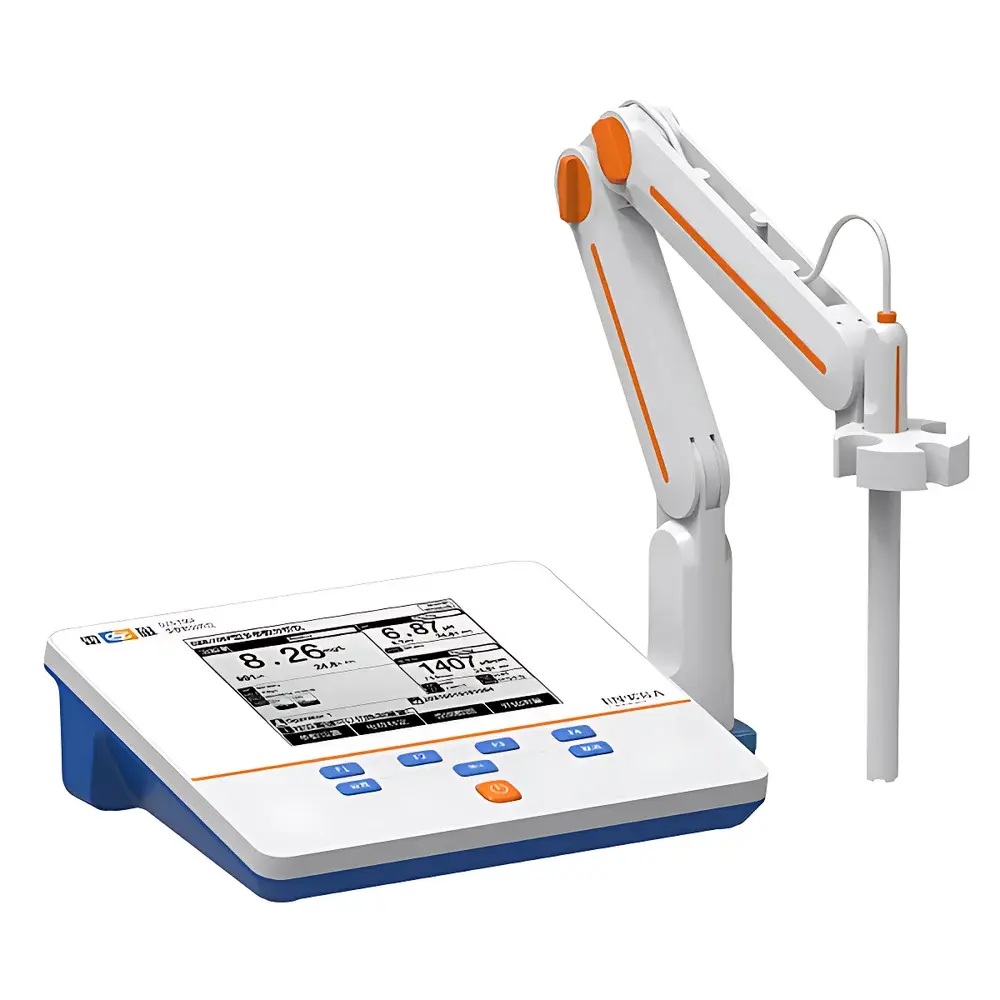
LeiCi DZS-706F Multi-Parameter Water Quality Analyzer
| [Brand | LeiCi |
|---|---|
| Origin | Shanghai, China |
| Model | DZS-706F |
| Instrument Type | Benchtop Laboratory Water Quality Analyzer |
| Measured Parameters | pH/pX, ORP (mV), Conductivity, Resistivity, TDS, Salinity, Dissolved Oxygen (DO), DO Saturation, Temperature |
| Measurement Principle | Potentiometric (pH/ion), Inductive/Two-Electrode Conductometry, Polarographic (Clark-type) Dissolved Oxygen |
| Accuracy | pH ±0.01, Conductivity ±1.0% FS, DO ±0.30 mg/L, Temperature ±0.3 °C (0–60 °C) |
| Resolution | pH 0.01, Conductivity 0.001 µS/cm, DO 0.01 mg/L, Temp 0.1 °C |
| Calibration | Up to 5-point pH/pX, 3-point conductivity, zero/full-scale DO |
| Compensation | Automatic temperature (−5 to 110 °C), atmospheric pressure (kPa/mbar/Torr/atm), salinity |
| Data Management | 500 datasets per parameter group, GLP-compliant audit trail, RS-232 & USB interfaces |
| Enclosure Rating | IP54 |
| Power | DC 9 V (AC 100–240 V adapter) |
| Dimensions | 242 × 195 × 68 mm |
| Weight | 0.9 kg] |
Overview
The LeiCi DZS-706F Multi-Parameter Water Quality Analyzer is a benchtop laboratory instrument engineered for precise, traceable, and compliant measurement of critical water quality parameters in environmental monitoring, municipal water treatment, academic research, and industrial process control laboratories. It integrates three independent electrochemical measurement modules—potentiometric (pH/pX/mV), conductometric (conductivity/resistivity/TDS/salinity), and polarographic (dissolved oxygen)—within a single robust architecture. The analyzer operates on established physicochemical principles: pH and ion activity are determined via Nernstian potential response across a glass or ion-selective membrane; conductivity is measured using two-electrode or inductive cell technology with automatic frequency switching to optimize signal-to-noise ratio across six decades of range (0.001 µS/cm to 1000 mS/cm); dissolved oxygen is quantified via Clark-type amperometric detection, where oxygen diffusion through a selective membrane generates a current proportional to partial pressure. All measurements incorporate real-time, algorithm-driven compensation—temperature, atmospheric pressure, and salinity—to ensure metrological integrity under variable field-simulated conditions.
Key Features
- High-resolution 4.3-inch color TFT LCD display with intuitive icon-based navigation and multilingual UI support (English preconfigured)
- Triple integrated measurement engine: pH/pX/mV, conductivity/resistivity/TDS/salinity, and polarographic DO/DO saturation
- GLP-compliant data management system with timestamped, user-ID-tagged storage of up to 500 datasets per parameter type—including calibration history, electrode diagnostics, and environmental metadata
- Automatic endpoint recognition modes: auto-read, timed-read, interval-read, and manual-hold—optimized for regulatory sample throughput
- Comprehensive electrode diagnostics: impedance monitoring, slope evaluation, asymmetry potential logging, and life-cycle tracking for pH, conductivity, and DO sensors
- Dual compensation architecture: temperature compensation (−5.0 to 110.0 °C) with selectable reference points (20/25 °C); full atmospheric pressure compensation for DO (kPa, mbar, Torr, atm) with manual salinity override
- IP54-rated enclosure with dust-resistant housing, protective dust cover, and ergonomic electrode stand—suitable for shared lab environments with variable ambient conditions
- Firmware-upgradable platform supporting future protocol expansion, custom ion mode definition, and enhanced compliance reporting templates
Sample Compatibility & Compliance
The DZS-706F is validated for aqueous matrices including surface water, groundwater, wastewater effluent, drinking water, seawater dilutions, and process rinse solutions. Its modular electrode configuration—standard triple-junction pH electrode, graphite composite conductivity cell (cell constant 1.0 cm⁻¹), and replaceable membrane DO probe—ensures compatibility with low-ionic-strength (e.g., ultrapure water), high-salinity (up to 8.00% NaCl), and organically laden samples. The instrument conforms to international performance standards: pH accuracy meets JJG 119–2018 (Chinese national verification regulation equivalent to ISO 7888); conductivity accuracy aligns with ASTM D1125–22 (Standard Test Methods for Electrical Conductivity and Resistivity of Water); DO measurement adheres to ISO 5814:2012 (Water quality — Determination of dissolved oxygen — Electrochemical probe method). Full GLP traceability is enforced via mandatory user login, electronic signature prompts for calibration events, and immutable audit logs exportable via USB or RS-232.
Software & Data Management
Data acquisition and reporting are governed by an embedded operating system supporting dual interface protocols: RS-232 enables direct connection to serial printers for immediate hardcopy output (configurable report formats include minimal, full calibration, and GLP-compliant); USB 2.0 facilitates secure bidirectional communication with Windows-based PC software (LeiCi LabLink v3.x), enabling batch export of CSV/Excel files, calibration certificate generation, trend charting, and deviation flagging against user-defined action limits. All stored records contain mandatory metadata: operator ID, sample ID, date/time stamp, ambient temperature/pressure, electrode serial numbers, calibration coefficients, and raw sensor outputs. The system enforces 21 CFR Part 11–ready workflows—including electronic signatures, role-based access control, and tamper-evident audit trails—when deployed in regulated QA/QC environments.
Applications
- Regulatory compliance testing per EPA Method 150.1 (conductivity), 365.1 (phosphate interference-corrected pH), and 360.1 (DO by membrane electrode)
- Wastewater treatment plant influent/effluent monitoring—tracking nitrification/denitrification via pH-DO coupling and conductivity-based salinity load estimation
- Drinking water distribution system integrity assessment—correlating resistivity shifts with pipe corrosion indicators and TDS anomalies
- Academic limnology studies—long-term lake stratification profiling using synchronized temperature-conductivity-DO vertical casts
- Pharmaceutical water system validation (PW/WFI)—routine checks of conductivity against USP specifications and DO saturation in purified water loops
- Environmental impact assessments—field-deployable lab verification of in-situ sensor networks using standardized buffer and standard solution traceability
FAQ
Does the DZS-706F support calibration traceability to NIST or other national standards?
Yes—calibration routines accept user-defined standard solutions with certified values; built-in buffer groups include NIST, DIN, and GB reference materials. Certificate of Conformance (CoC) documentation is provided with each instrument.
Can the instrument store calibration data separately for multiple electrodes of the same type?
Yes—electrode-specific calibration profiles are saved with unique identifiers; users may assign names (e.g., “Lab-pH-01”, “Field-DO-03”) and recall them per measurement session.
Is the polarographic DO probe compatible with sulfide-rich or hydrogen sulfide-containing samples?
The standard Clark-type membrane is susceptible to poisoning by reduced sulfur species; for such matrices, we recommend periodic membrane replacement and use of a dedicated sulfide-tolerant DO probe (optional accessory, model DZS-DO-SULF).
How does the instrument handle conductivity measurements below 20 µS/cm?
For ultra-low conductivity (e.g., deionized water), the analyzer automatically engages low-frequency excitation and recommends pairing with a 0.1 cm⁻¹ or 0.01 cm⁻¹ cell—available as optional accessories—to minimize polarization error and improve resolution.
Is remote firmware update supported over USB without proprietary hardware?
Yes—firmware updates are delivered as signed .bin files; installation requires only the included USB cable and LeiCi LabLink software—no additional programming dongles or service visits required.
Related Products







