
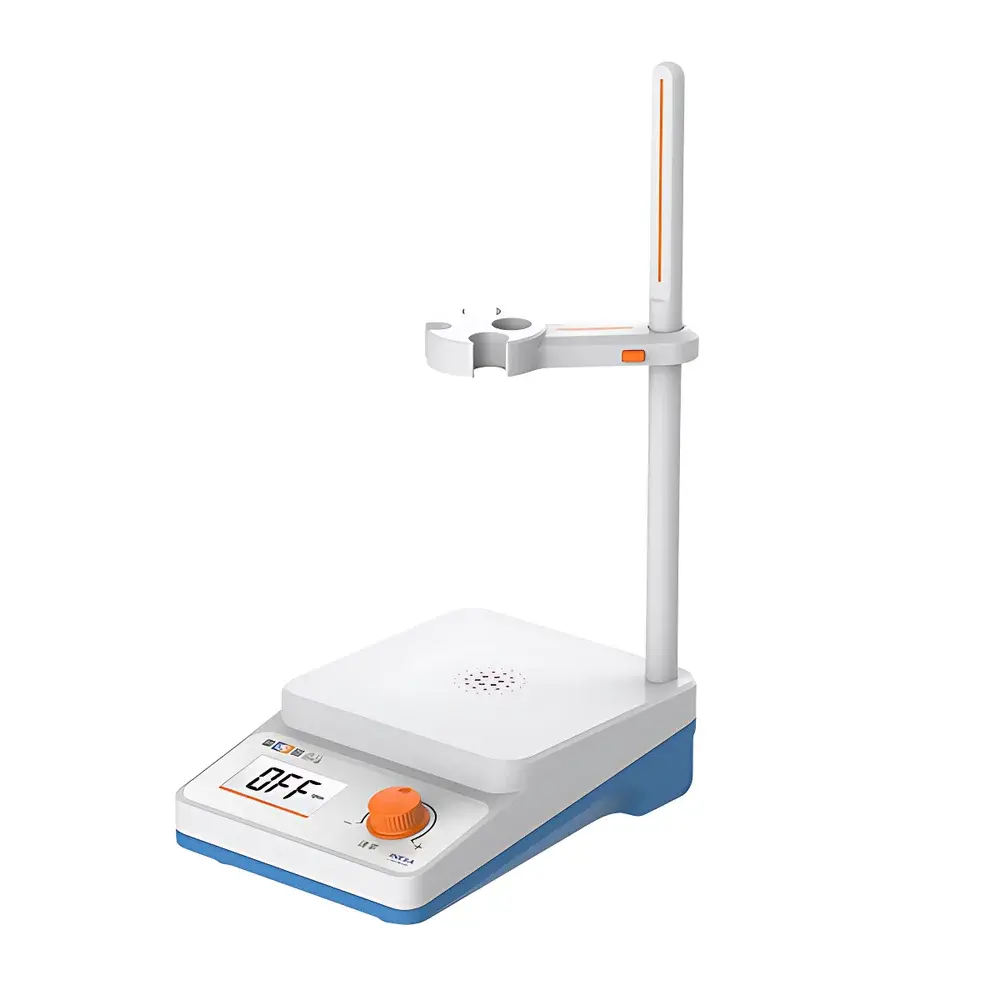
Leici JB-11 Magnetic Stirrer
| Brand | Leici |
|---|---|
| Origin | Shanghai, China |
| Manufacturer Type | Authorized Distributor |
| Country of Origin | China |
| Model | JB-11 |
| Instrument Type | Magnetic Stirrer |
| Max. Stirring Volume | 1000 mL |
| Speed Range | 100–1800 rpm |
| Speed Display | Segment LCD |
| Speed Accuracy | ±5% or ±10 rpm |
| Plate Dimensions | 135 mm × 132 mm |
| Plate Material | PC+ABS |
| Stir Bar Included | φ6 × 20 mm |
| Operating Environment | 0–40 °C, ≤85% RH |
| Power Supply | AC 100–240 V input / DC 9 V output |
| Dimensions (L×W×H) | 135 × 195 × 55 mm |
| Weight | ~0.5 kg |
Overview
The Leici JB-11 Magnetic Stirrer is an entry-level yet highly reliable benchtop mixing instrument engineered for consistent, low-noise agitation of liquid samples in routine laboratory workflows. It operates on the principle of magnetic coupling: a rotating permanent magnet beneath the non-magnetic work surface induces synchronous rotation of a Teflon-coated or PTFE-encapsulated stir bar immersed in the sample vessel. This contactless drive mechanism eliminates mechanical wear, minimizes contamination risk, and ensures stable operation across a wide viscosity range — from aqueous buffers to moderately viscous solutions (e.g., polymer precursors or cell culture media). Designed specifically for applications requiring reproducible mixing without heating, the JB-11 serves as a foundational tool in analytical chemistry, quality control labs, educational settings, and electrochemical testing environments where thermal interference must be avoided.
Key Features
- Adjustable speed control across a broad 100–1800 rpm range, enabling optimization for both gentle suspension of precipitates and vigorous homogenization of heterogeneous mixtures.
- Segment-type LCD display provides real-time, easy-to-read speed indication — eliminating ambiguity during multi-step protocols or unattended operation.
- Memory function retains the last set speed; unit resumes at that value upon power-up, reducing setup time and minimizing operator variability between sequential experiments.
- Engraved alignment markings on the PC+ABS composite plate assist precise centering of glassware (e.g., beakers, Erlenmeyer flasks), promoting stable stir bar rotation and preventing orbital wobble or “jumping” at higher speeds.
- Integrated electrode holder accommodates up to three standard 6-mm diameter electrodes — supporting simultaneous pH measurement, reference electrode positioning, and auxiliary sensor integration during titrations or potentiometric assays.
- Compact footprint (135 × 195 × 55 mm) and lightweight construction (~0.5 kg) facilitate placement within fume hoods, laminar flow cabinets, or crowded benchtops without compromising accessibility or safety clearance.
Sample Compatibility & Compliance
The JB-11 is compatible with standard borosilicate glass, polypropylene, and polycarbonate containers up to 1000 mL capacity. Its non-heating design makes it suitable for temperature-sensitive reagents, enzymatic reactions, and volatile organic solvents where thermal drift could compromise assay integrity. While not certified for hazardous area use, the device complies with IEC 61010-1:2010 (Safety Requirements for Electrical Equipment for Measurement, Control, and Laboratory Use) regarding dielectric strength, creepage distance, and protective earth continuity. The DC 9 V power architecture enhances electrical isolation and reduces electromagnetic interference — critical when operating near sensitive instrumentation such as potentiostats or microbalances. No regulatory certification (e.g., CE, UL, or FDA 21 CFR Part 11) is claimed, as the unit performs no data acquisition or electronic recordkeeping functions.
Software & Data Management
The Leici JB-11 operates as a standalone analog-electronic instrument with no embedded firmware, network interface, or digital communication protocol (e.g., RS-232, USB, or Bluetooth). Consequently, it does not generate electronic records, support audit trails, or integrate with LIMS or ELN platforms. All operational parameters — including speed setting and runtime — are manually controlled and observed. This architecture aligns with laboratories maintaining paper-based SOPs or those prioritizing simplicity, long-term reliability, and minimal validation burden. For users requiring traceable speed logging or remote monitoring, external data loggers or video-based process documentation may be employed per internal QA procedures.
Applications
- Routine dissolution and dilution preparation in pharmaceutical QC labs prior to HPLC or UV-Vis analysis.
- Homogenization of calibration standards and buffer stock solutions in clinical chemistry departments.
- Supporting redox titrations and pH-stat experiments via synchronized electrode positioning and stable stirring.
- Cell suspension maintenance during short-term viability assays in academic life science labs.
- Pre-mixing of reagent kits and catalyst slurries in materials synthesis workflows.
- Use in GLP-compliant environmental testing labs where mixing consistency — rather than data capture — is the primary performance criterion.
FAQ
Does the JB-11 include a heating function?
No. The JB-11 is a non-heating magnetic stirrer. It provides only rotational agitation.
What stir bar size is supplied with the unit?
One PTFE-coated stir bar measuring Ø6 × 20 mm is included as standard equipment.
Can the JB-11 be used with corrosive or organic solvents?
Yes — provided the stir bar coating (PTFE) and container material are chemically compatible. Avoid prolonged exposure to strong oxidizers (e.g., hot nitric acid) or halogenated solvents that may degrade PTFE.
Is the speed setting digitally controlled or analog?
Speed is adjusted via a calibrated rotary encoder; the displayed value on the segment LCD reflects the actual motor drive frequency, with accuracy specified as ±5% or ±10 rpm, whichever is greater.
Does the electrode holder accommodate all standard electrode diameters?
The holder is designed for electrodes with 6 mm outer diameter. Adapters or custom mounts would be required for 12 mm or microelectrodes.



