
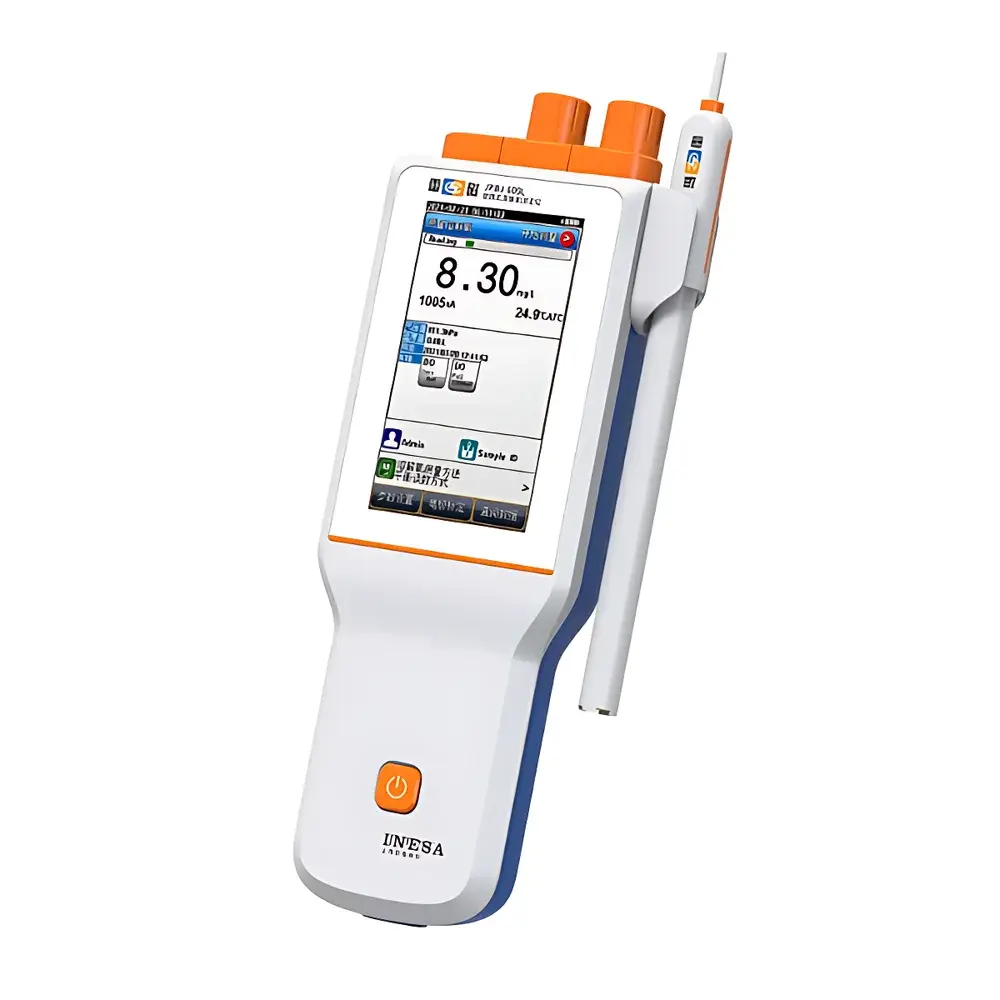
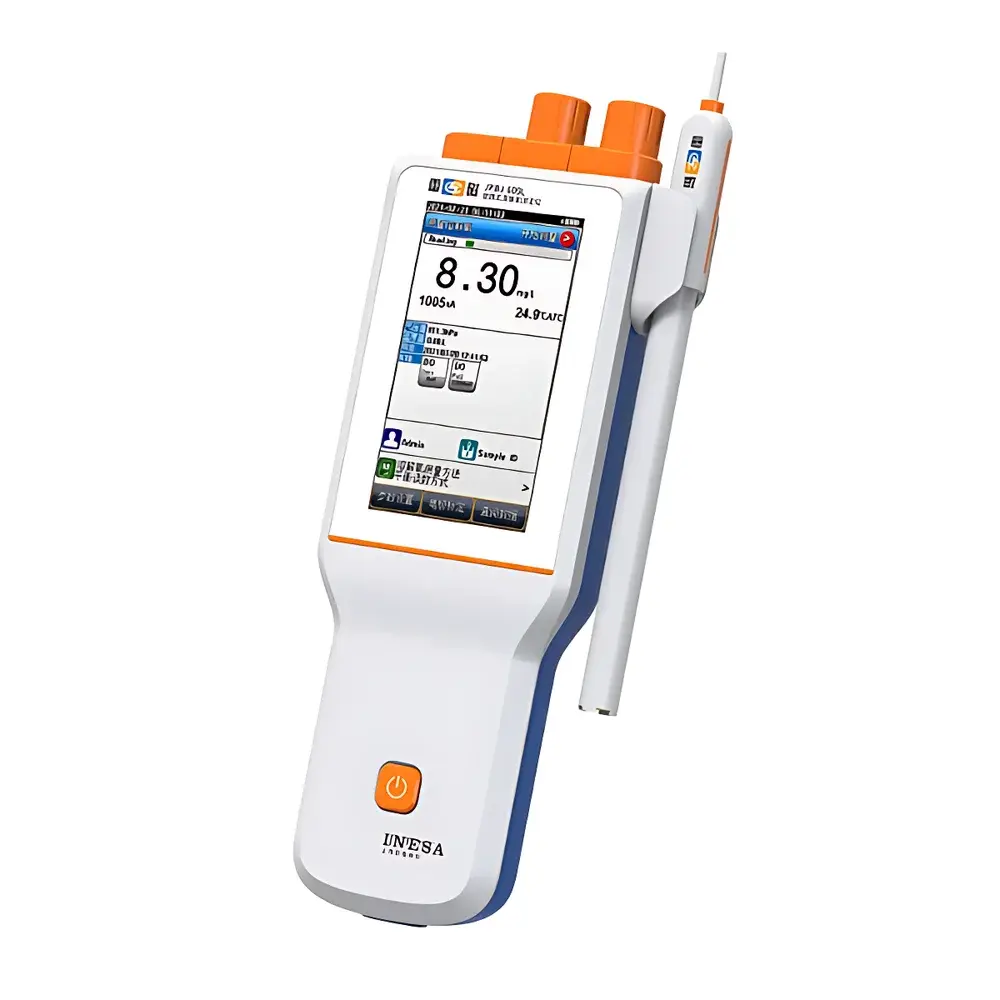
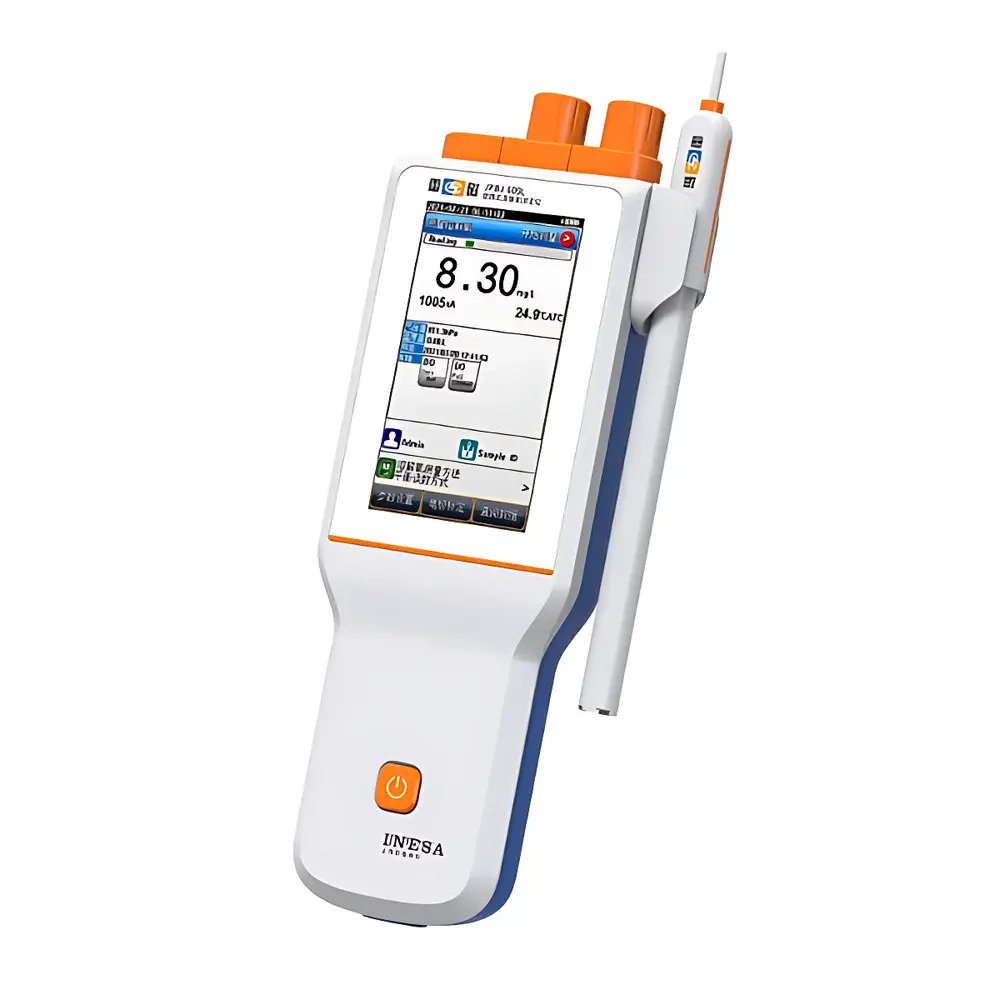
Leici JPBJ-609L Portable Dissolved Oxygen Meter
| Brand | Leici |
|---|---|
| Origin | Shanghai, China |
| Manufacturer Type | Authorized Distributor |
| Origin Category | Domestic (China) |
| Model | JPBJ-609L |
| Instrument Type | Field-Portable |
| Measurement Principle | Polarographic Electrochemical Sensor |
| Measurement Range | 0.00–50.00 mg/L |
| Accuracy | ±0.10 mg/L |
| Display | High-Resolution Color TFT Touchscreen |
| Language Support | English & Chinese |
| Temperature Units | °C / °F |
| IP Rating | IP65 |
| Temperature Compensation | Automatic/Manual |
| Atmospheric Pressure Compensation | kPa, mbar, Torr, atm (manual selection) |
| Salinity Compensation | Manual |
| Calibration Modes | Zero-Oxygen and Full-Scale (100% air-saturated) |
| Data Storage Capacity | 1000 measurement records |
| Connectivity | USB 2.0, Bluetooth 4.2, U Disk interface, QR code scanner compatible |
| Power Supply | Rechargeable Li-ion battery (USB-C charging support), PC/mobile power bank compatible |
| GLP Compliance | Yes — full audit trail, user authentication, timestamped records |
Overview
The Leici JPBJ-609L Portable Dissolved Oxygen Meter is an engineered field-deployable instrument designed for precise, on-site measurement of dissolved oxygen (DO) concentration in aqueous environmental samples—including surface water, groundwater, wastewater, aquaculture systems, and drinking water distribution networks. It operates on the polarographic electrochemical principle: a Clark-type sensor generates a diffusion-limited current proportional to the partial pressure of molecular oxygen at the cathode surface, which is then converted to concentration units (mg/L) using temperature-, atmospheric pressure-, and salinity-corrected algorithms. The device complies with standard methodologies referenced in ISO 5814:2012 (Water quality — Determination of dissolved oxygen — Electrochemical probe method) and ASTM D888-22 (Standard Test Methods for Dissolved Oxygen in Water), supporting regulatory monitoring requirements under national and regional water quality frameworks.
Key Features
- High-resolution color TFT touchscreen with intuitive icon-driven navigation and dual-language (English/Chinese) interface for global field operators.
- IP65-rated enclosure ensures dust-tight operation and protection against low-pressure water jets—suitable for outdoor deployment in rain, high humidity, or splash-prone environments.
- Integrated polarographic DO probe with built-in thermistor for simultaneous temperature measurement; supports automatic or manual temperature compensation across 0–50 °C.
- Multi-unit atmospheric pressure compensation (kPa, mbar, Torr, atm) and manual salinity correction (0–70 g/L) enable accurate DO reporting across diverse geographic elevations and brackish water matrices.
- Intelligent endpoint detection with configurable reading modes: auto-hold, timed interval (1–300 s), scheduled logging, and manual capture—optimized for both single-point verification and longitudinal profiling.
- Comprehensive calibration management: zero-oxygen (sodium sulfite) and full-scale (air-saturated water) calibrations with real-time status indicators, expiration alerts, and traceable calibration history.
- Rechargeable lithium-ion battery with USB-C input, supporting >12 hours of continuous operation and seamless charging via laptop, power bank, or field solar charger.
Sample Compatibility & Compliance
The JPBJ-609L is validated for use with natural waters, treated effluents, process streams, and biological media where DO concentrations fall within 0.00–50.00 mg/L. Its polarographic sensor exhibits minimal flow dependence above 10 cm/s and stable response time (t90 < 30 s) under typical ambient conditions. The instrument adheres to Good Laboratory Practice (GLP) requirements through mandatory user authentication (three-tier permission levels), encrypted timestamped data storage, and immutable audit logs—including operator ID, calibration events, environmental parameters, and measurement metadata. All stored records meet traceability criteria per ISO/IEC 17025:2017 and are exportable in CSV or XML format for integration into accredited laboratory information management systems (LIMS).
Software & Data Management
Data handling is governed by a secure embedded operating system supporting up to 1000 measurement sets with full contextual metadata (date/time, location tag via optional GPS pairing, operator ID, probe serial number, calibration IDs). USB 2.0 and Bluetooth 4.2 interfaces enable bidirectional communication with Windows/macOS PCs using Leici’s certified PC Suite software—enabling batch export, statistical analysis (mean, SD, CV%), trend visualization, and PDF report generation. U-disk read/write capability allows direct file transfer without host software. QR code scanner compatibility facilitates rapid sample ID entry from pre-printed labels. All data exchanges comply with FDA 21 CFR Part 11 principles when used with configured electronic signatures and audit trail activation.
Applications
- Regulatory compliance monitoring for municipal wastewater treatment plants (e.g., activated sludge basin DO control, effluent discharge verification).
- Ecological field surveys assessing hypoxic zones in rivers, lakes, and estuaries.
- Aquaculture facility management—real-time DO optimization for fish health and feed efficiency.
- Drinking water quality assurance during distribution network sampling and reservoir stratification studies.
- Educational and research applications requiring portable, GLP-aligned DO quantification with full data provenance.
FAQ
What electrode technology does the JPBJ-609L use?
It employs a factory-calibrated polarographic (Clark-type) membrane-covered sensor with Ag/AgCl reference and Pt cathode, optimized for long-term stability and low drift in field conditions.
Is the instrument suitable for seawater measurements?
Yes—manual salinity compensation (0–70 g/L) and pressure correction ensure accuracy across marine, brackish, and freshwater matrices.
Does it support remote data upload to cloud platforms?
While native cloud connectivity is not embedded, exported CSV/XML files can be ingested into third-party cloud LIMS or IoT platforms via standard API integrations.
How often does the DO membrane require replacement?
Typical membrane and electrolyte service life is 6–12 months depending on usage frequency and sample matrix; replacement kits are available as Leici OEM accessories (Part No. DO-MEM-KIT-JPBJ).
Can multiple users share one instrument with individual data segregation?
Yes—role-based access control (Administrator, Technician, Viewer) enforces data isolation and action-level permissions aligned with ISO 17025 personnel competency requirements.







