
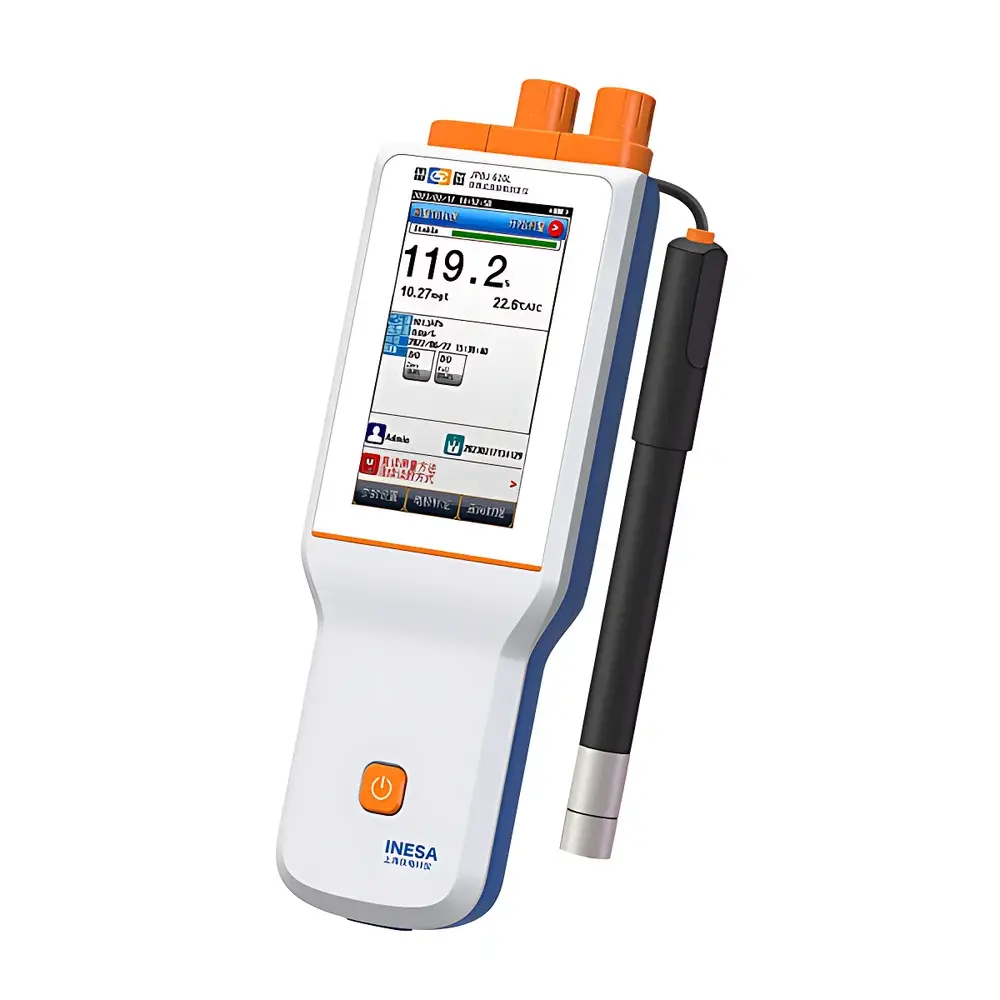
Leici JPBJ-610L Portable Fluorescence-Based Dissolved Oxygen Meter
| Brand | Leici |
|---|---|
| Origin | Shanghai, China |
| Model | JPBJ-610L |
| Instrument Type | Portable |
| Measurement Principle | Fluorescence Quenching |
| Dissolved Oxygen Range | 0.00–20.00 mg/L |
| Accuracy | ±0.30 mg/L (full-scale error) |
| Resolution | 0.01 mg/L |
| Repeatability | 0.15 mg/L |
| Response Time | ≤60 s (90% response at 20 °C) |
| DO Saturation Range | 0.0–200.0 % |
| Temperature Range | 0.0–50.0 °C |
| Temp. Accuracy | ±0.3 °C |
| Salt Compensation Range | 0.0–50.0 g/L |
| Atmospheric Pressure Compensation | 50.0–110.0 kPa |
| IP Rating | IP65 |
| Power | Rechargeable Li-ion battery (DC5V input compatible) |
| Dimensions | 90 × 255 × 40 mm |
| Weight | 0.5 kg |
Overview
The Leici JPBJ-610L is a field-deployable, fluorescence-based dissolved oxygen (DO) meter engineered for high-reliability water quality assessment in environmental monitoring, wastewater treatment, aquaculture, and drinking water distribution systems. Unlike traditional Clark-type polarographic sensors, the JPBJ-610L employs optical fluorescence quenching technology—where molecular oxygen modulates the lifetime and intensity of a ruthenium-based luminophore immobilized on the sensor tip. This principle eliminates membrane replacement, electrode polarization, and sample agitation requirements, delivering stable, maintenance-light operation with inherent resistance to sulfide, chloride, and flow-rate interference. The instrument simultaneously reports dissolved oxygen concentration (mg/L), saturation (%), and temperature (°C or °F), with automatic or manual compensation for temperature, atmospheric pressure (in kPa, mbar, Torr, or atm), and salinity (0.0–50.0 g/L). Its compact form factor, IP65-rated enclosure, and integrated lithium-ion battery support extended unattended operation in humid, dusty, or rain-exposed outdoor environments.
Key Features
- 4.3-inch high-resolution color TFT touchscreen with intuitive icon-driven interface and multilingual support (English & Chinese)
- Fluorescence-based DO sensing: zero-maintenance operation—no membrane changes, no polarization time, no stirring dependency
- Triple-compensation architecture: automatic/manual temperature (0.0–50.0 °C), atmospheric pressure (50.0–110.0 kPa), and manual salinity (0.0–50.0 g/L)
- Smart endpoint detection: supports auto-read, timed-read, interval-read, and manual sampling modes
- Robust data integrity framework: GLP-compliant audit trail, user-level access control (three-tier permissions with password protection), calibration logging with timestamped alerts
- IP65-rated housing with silicone protective sleeve, wrist strap, electrode cradle, and rugged portable carrying case
- Dual connectivity: USB interface (PC communication via proprietary software), USB host port (U-disk read/write), Bluetooth 4.2 for wireless data export to tablets or cloud gateways
- Intelligent power management: real-time battery status indicator, low-voltage warning, charging progress feedback, and adjustable backlight intensity
Sample Compatibility & Compliance
The JPBJ-610L is validated for use across freshwater, estuarine, seawater, effluent, and potable water matrices. Its fluorescence probe exhibits minimal drift under variable conductivity (<200 mS/cm) and pH (4–12), and remains unaffected by common redox interferents such as H₂S, Fe²⁺, and NO₂⁻. Calibration is performed via two-point protocol: zero-oxygen (sodium sulfite solution) and air-saturation (temperature- and pressure-corrected). The instrument complies with ISO 5814:2012 (Water quality — Determination of dissolved oxygen — Electrochemical probe method) and supports traceable calibration records required under EPA Method 360.1 and ASTM D888-22. Data storage adheres to GLP principles—each of the 1,000 measurement records includes operator ID, timestamp, calibration history, ambient conditions, and electrode serial number.
Software & Data Management
Data acquisition, review, and export are managed through Leici’s PC-based LeiData Pro software (Windows 10/11 compatible), which enables batch export to CSV, PDF, or Excel formats with embedded metadata. The system enforces 21 CFR Part 11–compatible electronic signatures during calibration and report generation when configured with user authentication. On-device data handling includes statistical functions (mean, SD, min/max), trend visualization, and customizable pass/fail thresholds. USB mass storage mode permits direct file transfer without software installation. Bluetooth pairing enables synchronization with third-party LIMS platforms supporting RFCOMM or BLE GATT profiles—ideal for distributed monitoring networks requiring centralized QA/QC oversight.
Applications
- Field verification of DO compliance in municipal wastewater discharge points per NPDES permit limits
- In-situ profiling of hypolimnetic oxygen depletion in reservoirs and lakes during stratification seasons
- Real-time DO monitoring in recirculating aquaculture systems (RAS) to prevent hypoxic stress in finfish and shellfish
- Verification of aeration efficiency in activated sludge basins and oxidation ditches
- Source water quality screening during emergency response (e.g., algal bloom events, chemical spills)
- Educational laboratory use for environmental science curricula emphasizing optical sensing principles and water chemistry fundamentals
FAQ
Does the JPBJ-610L require membrane replacement or electrolyte refilling?
No—fluorescence-based sensing eliminates consumable membranes and internal electrolytes.
Can the instrument store calibration data with timestamps and operator IDs?
Yes—GLP-compliant logging captures all calibrations with user credentials, date/time stamps, and environmental parameters.
Is Bluetooth transmission encrypted and compatible with enterprise-grade LIMS?
Bluetooth 4.2 supports standard AES-CCM encryption; integration with validated LIMS requires configuration via Leici’s API documentation.
What is the expected service life of the optical DO probe under routine field use?
The sensor tip maintains factory-calibrated performance for ≥24 months under typical environmental exposure, with optional annual verification against NIST-traceable standards.
Does the device meet international shipping and electromagnetic compatibility (EMC) requirements?
Yes—the unit conforms to IEC 61326-1:2013 (EMC for laboratory equipment) and UN 38.3 for lithium battery transport.
Related Products







