
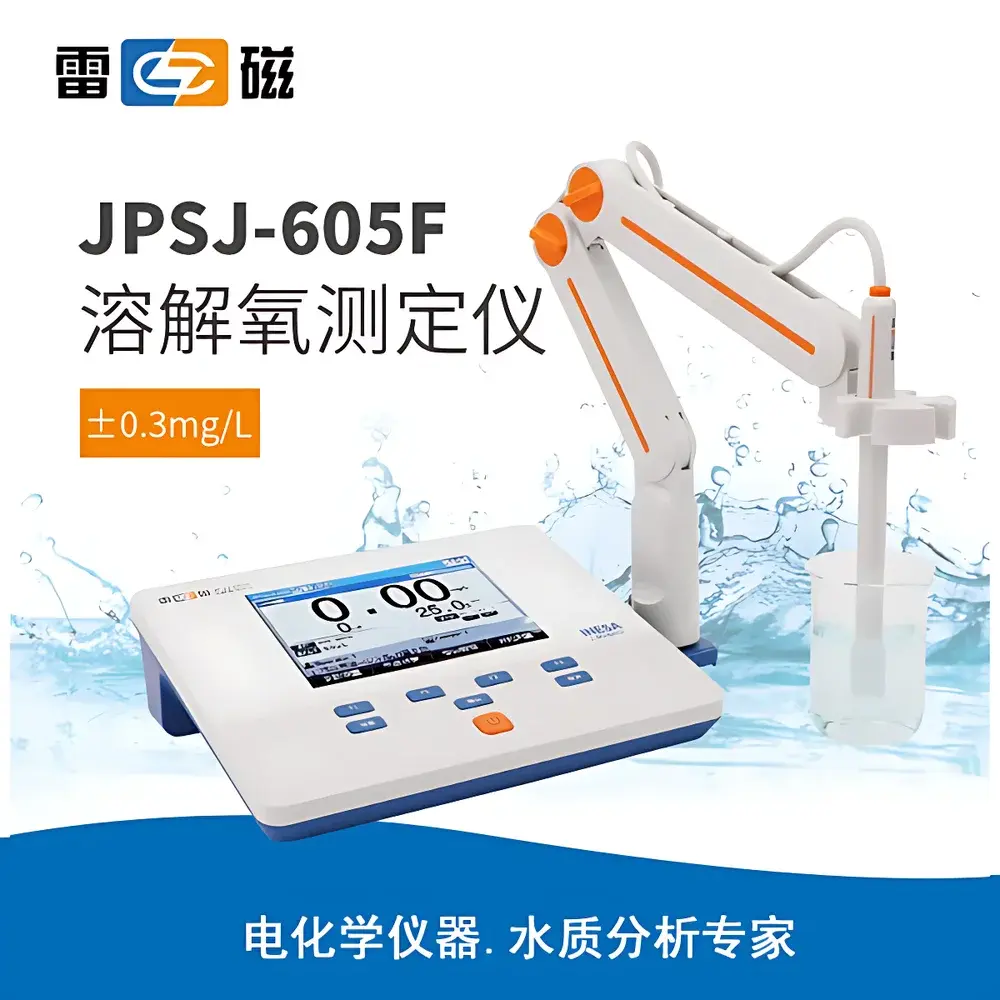
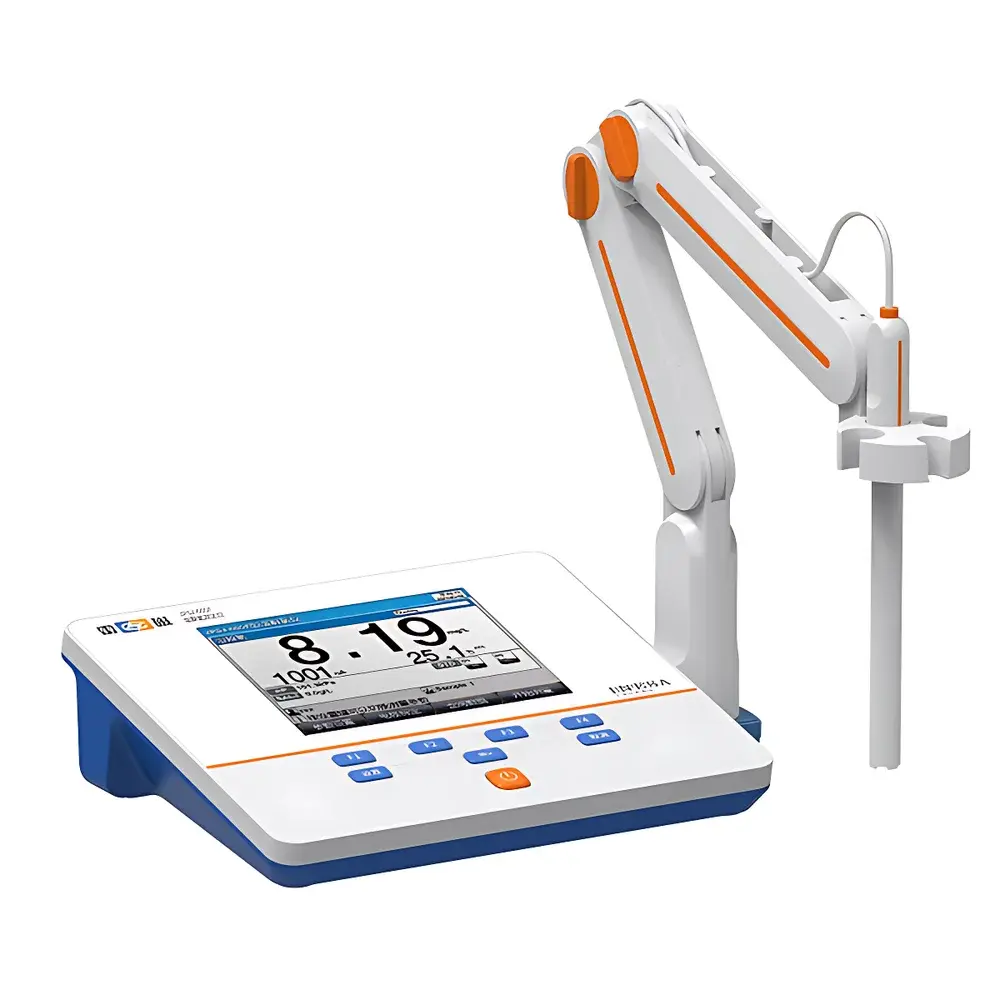
Leici JPSJ-605F Portable Dissolved Oxygen Meter
| Brand | Leici |
|---|---|
| Origin | Shanghai, China |
| Model | JPSJ-605F |
| Instrument Type | Portable |
| Measurement Principle | Polarographic Electrochemical Probe |
| Dissolved Oxygen Range | (0.00–50.00) mg/L |
| Accuracy | ±0.30 mg/L (≤20.00 mg/L) |
| Repeatability | 0.15 mg/L |
| Detection Limit | 0.01 mg/L |
| Temperature Compensation | Automatic (–10.0 to 135.0 °C) |
| Atmospheric Pressure Compensation | kPa, mmHg, atm |
| Response Time | ≤45 s (90% response at 20.0 °C) |
| Salt Compensation | Manual |
| IP Rating | IP54 |
| Data Storage | 500 sets |
| Interface | RS-232, USB |
| Compliance | GLP-compliant data logging |
Overview
The Leici JPSJ-605F Portable Dissolved Oxygen Meter is a field-deployable, electrochemical analytical instrument engineered for precise and reliable measurement of dissolved oxygen (DO) concentration, saturation percentage, and temperature in aqueous environmental samples. It operates on the Clark-type polarographic principle—utilizing a membrane-covered cathode and silver/silver chloride anode immersed in an electrolyte solution. Oxygen diffuses through a selective gas-permeable membrane, undergoes reduction at the cathode surface, and generates a current proportional to the partial pressure of oxygen in the sample. This current is linearly converted into concentration units (mg/L) and saturation (%), with real-time compensation for temperature, atmospheric pressure, and salinity. Designed for routine water quality monitoring in rivers, lakes, wastewater treatment plants, aquaculture systems, and laboratory-based field studies, the JPSJ-605F delivers high reproducibility under variable ambient conditions while maintaining robustness against mechanical shock and moisture ingress (IP54-rated enclosure).
Key Features
- High-resolution color LCD display with intuitive icon-based navigation and dual-unit support (°C/°F)
- Automatic endpoint recognition with multiple read modes: continuous auto-read, timed reading, interval sampling, and manual hold
- Integrated automatic temperature compensation (ATC) and configurable atmospheric pressure compensation (kPa, mmHg, or atm)
- Two-point calibration protocol: zero-oxygen (sodium sulfite) and full-scale (air-saturated water or Winkler-standard reference)
- Manual salinity correction to adjust DO solubility curves per sample-specific ionic strength
- Onboard diagnostics including power-on self-test, low-battery warning, electrode status monitoring, and error-code reporting
- Dual power options: AC adapter (100–240 V AC input / 9 V DC output) and internal rechargeable battery (operational autonomy ≥12 h)
- Compact ergonomic design (242 × 195 × 68 mm; 0.9 kg) with integrated electrode holder and protective dust cover
Sample Compatibility & Compliance
The JPSJ-605F is validated for use across freshwater, brackish water, and low-conductivity effluent matrices within the operational pH range of 4.0–10.0. Its polarographic sensor exhibits minimal interference from common ions (e.g., Cl⁻, NO₃⁻, SO₄²⁻) and negligible cross-sensitivity to CO₂ or H₂S when operated within specified temperature and flow-rate parameters. The instrument conforms to fundamental performance criteria outlined in ISO 5814:2012 (Water quality — Determination of dissolved oxygen — Electrochemical probe method) and supports traceable data integrity requirements aligned with Good Laboratory Practice (GLP). All stored measurements include timestamp, operator ID (user-definable), calibration history, and environmental metadata (temperature, pressure, salinity)—enabling full auditability during regulatory inspections or third-party verification.
Software & Data Management
Data handling is facilitated via dual communication interfaces: an RS-232 port enables direct connection to industry-standard serial printers for immediate hardcopy reporting (configurable print templates include sample ID, DO value, saturation %, temperature, and calibration status); a USB interface permits bidirectional transfer of up to 500 measurement records—including raw sensor signals, compensated values, and user annotations—to Windows-based PCs using Leici’s proprietary communication software. Export formats include CSV and TXT for downstream analysis in Excel, MATLAB, or LIMS platforms. All data entries are immutable post-acquisition and tagged with sequential record IDs, ensuring compliance with ALCOA+ principles (Attributable, Legible, Contemporaneous, Original, Accurate, Complete, Consistent, Enduring, Available) as referenced in FDA 21 CFR Part 11 guidance for electronic records.
Applications
- Regulatory compliance monitoring of surface water bodies per national EPA or EU WFD directives
- In-process control of aeration basins and activated sludge systems in municipal and industrial wastewater treatment facilities
- Ecological assessment of hypolimnetic oxygen depletion in stratified reservoirs and lakes
- Quality assurance testing in pharmaceutical water systems (PW, WFI) where DO serves as an indirect indicator of microbial risk
- Educational laboratories conducting limnology, environmental chemistry, and aquatic toxicology experiments
- Field validation of online DO analyzers and sensor network calibration campaigns
FAQ
What type of electrochemical sensor does the JPSJ-605F employ?
It uses a Clark-type polarographic dissolved oxygen probe with a Teflon gas-permeable membrane, Pt cathode, and Ag/AgCl reference anode.
Does the instrument support automatic pressure compensation during field use?
Yes—users may select kPa, mmHg, or atm units and input local barometric pressure manually; no external barometer is required.
Can the JPSJ-605F be used in seawater applications?
It is suitable for low-to-moderate salinity environments (<25 g/L); manual salinity compensation must be applied based on measured conductivity or known chloride concentration.
Is firmware upgrade capability available?
Yes—the device supports over-the-air updates via USB to extend functionality, improve algorithm stability, or incorporate new calibration protocols.
How is data integrity ensured during long-term deployments?
Each stored record includes embedded calibration timestamps, sensor diagnostic flags, and operator-defined identifiers—fully traceable under GLP audit frameworks.
Related Products







