
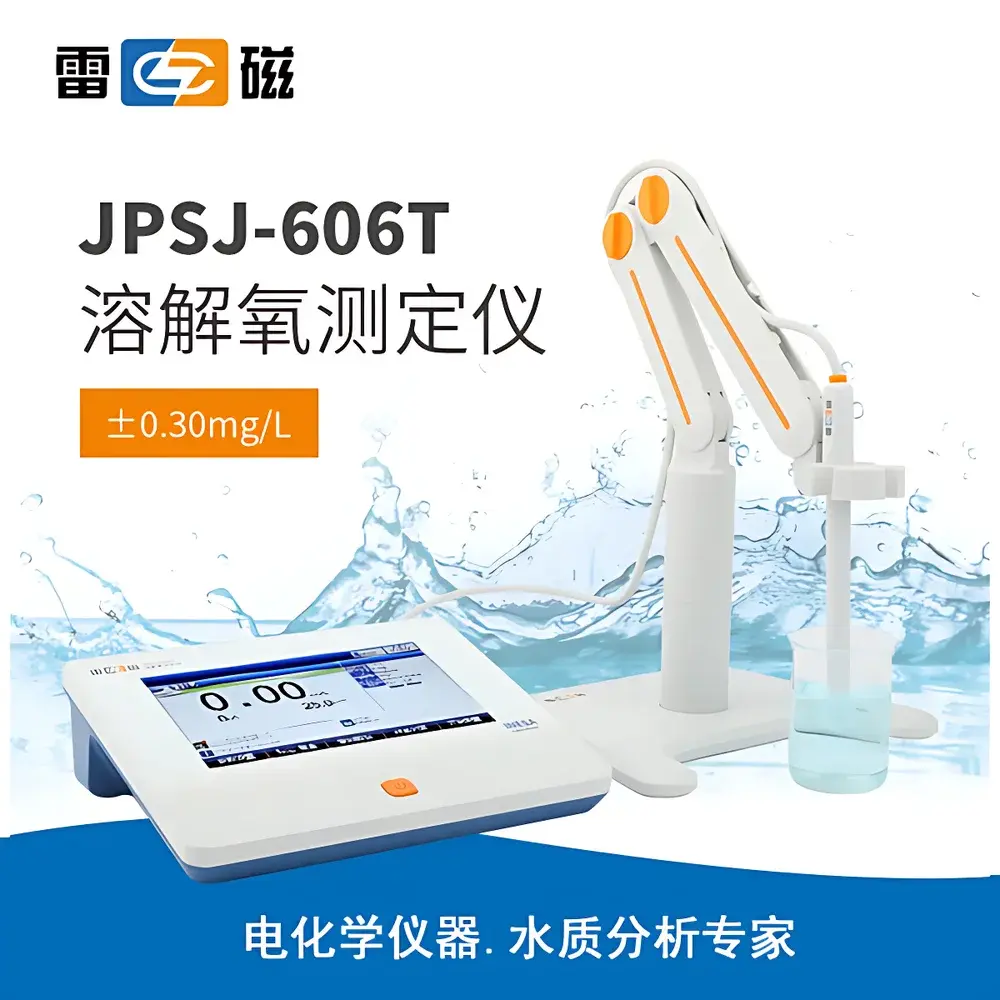
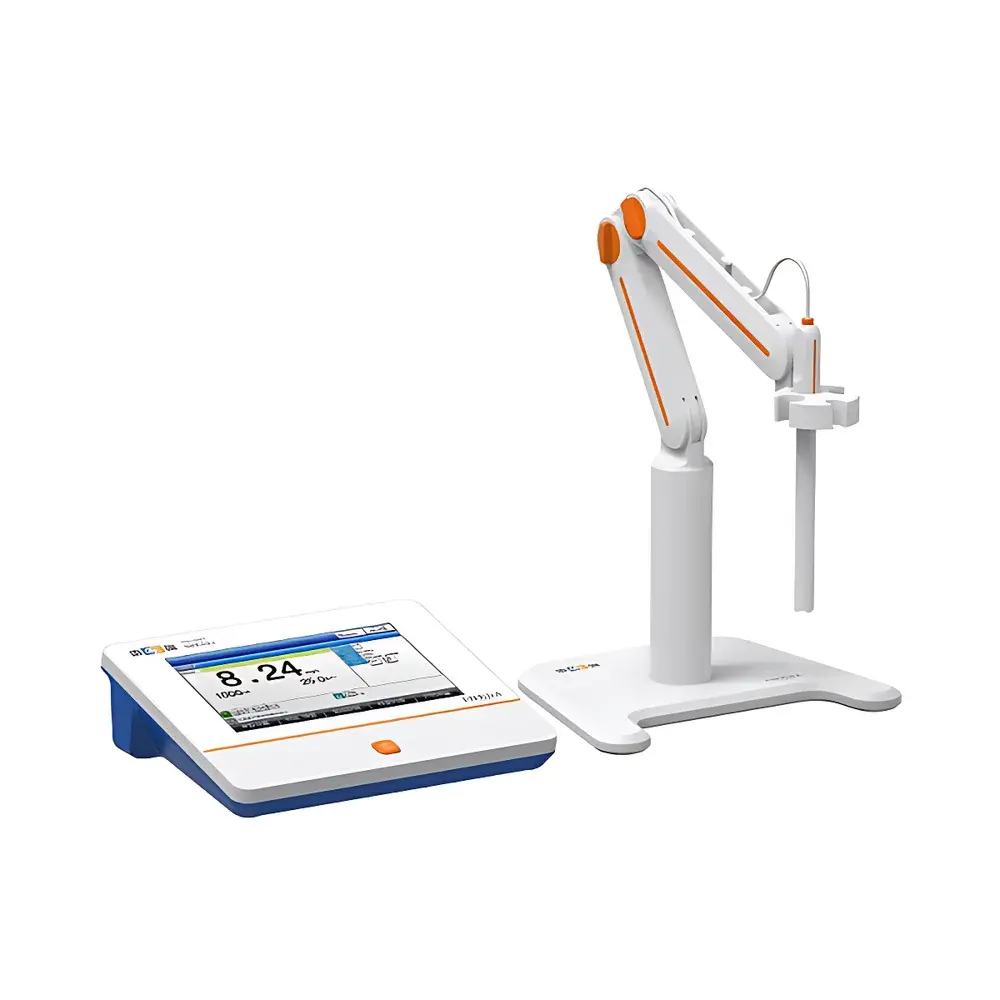
Leici JPSJ-606T Dissolved Oxygen Meter
| Brand | Leici |
|---|---|
| Origin | Shanghai, China |
| Manufacturer Type | Authorized Distributor |
| Product Origin | Domestic (China) |
| Model | JPSJ-606T |
| Instrument Type | Benchtop Laboratory Meter |
| Measurement Principle | Polarographic Electrochemical Probe |
| DO Range (Electronic Unit) | 0.00–99.99 mg/L |
| Accuracy | ±0.10 mg/L (0.00–50.00 mg/L) |
| Instrument Accuracy | ±0.30 mg/L (≤20.00 mg/L) |
| Repeatability | ±2.0% |
| Response Time | ≤45 s (90% response at 20.0 °C) |
| Temperature Range | −10.0–135.0 °C |
| Temp. Accuracy | ±0.3 °C (0.0–60.0 °C) |
| Saturation Range | 0.0–600.0 % |
| Salt Compensation | Manual |
| Atmospheric Pressure Compensation | Auto/Manual (kPa, mbar, Torr, atm) |
| Data Storage Capacity | 1000 datasets |
| Compliance | GLP-compliant |
Overview
The Leici JPSJ-606T Dissolved Oxygen Meter is a benchtop laboratory instrument engineered for high-reproducibility measurement of dissolved oxygen (DO) concentration, saturation percentage, and temperature in aqueous samples. It operates on the polarographic electrochemical principle—utilizing a Clark-type membrane-covered sensor with a gold cathode and silver/silver chloride anode immersed in an electrolyte solution. Oxygen diffuses through a selective gas-permeable membrane and is reduced at the cathode surface, generating a current linearly proportional to the partial pressure of dissolved O2. This analog signal is digitized and compensated in real time for temperature, atmospheric pressure, and salinity—ensuring traceable, metrologically sound results across diverse environmental, wastewater, aquaculture, and research applications.
Key Features
- 7-inch high-resolution color TFT touchscreen with intuitive icon-based navigation and dual-language support (English & Chinese)
- IP54-rated enclosure for dust resistance and limited water splashing protection—suitable for routine lab environments
- Smart endpoint detection algorithms supporting auto-read, timed-read, interval-read, and manual sampling modes
- Comprehensive calibration management: zero-oxygen and full-scale (air-saturated) calibration with configurable reminders, forced calibration prompts, and standard solution verification
- Multi-parameter compensation: automatic temperature compensation (ATC), optional manual salinity input (0–80 g/kg), and selectable atmospheric pressure units (kPa, mbar, Torr, atm)
- Robust data governance architecture compliant with Good Laboratory Practice (GLP) and Good Manufacturing Practice (GMP) requirements—including user-level permission tiers, password-protected access, audit-trail-enabled operation logs, and electronic signature readiness
- Dual connectivity options: RS-232 port for direct thermal or dot-matrix printer output (configurable report formats), and USB interface for secure PC synchronization via proprietary communication software
- Expandable peripheral support: compatible with automated sample changers for unattended batch analysis and UVC-compatible barcode scanners for sample ID traceability
Sample Compatibility & Compliance
The JPSJ-606T is optimized for liquid-phase measurements in freshwater, seawater, wastewater effluents, biological reactors, and pharmaceutical process streams. Its polarographic probe delivers stable performance across pH 2–12 and conductivity ranges up to 200 mS/cm. The instrument meets functional equivalence to ISO 5814:2012 (Water quality — Determination of dissolved oxygen — Electrochemical probe method) and supports method validation per ASTM D888 and USP . All stored data include timestamp, operator ID, calibration history, environmental compensation parameters, and raw sensor signal metadata—enabling full forensic traceability during regulatory audits. Firmware updates preserve configuration integrity and are digitally signed to prevent unauthorized modification.
Software & Data Management
Data handling conforms to ALCOA+ principles (Attributable, Legible, Contemporaneous, Original, Accurate, Complete, Consistent, Enduring, Available). Each of the 1000 internal storage slots records DO concentration (mg/L), saturation (%), temperature (°C/°F), pressure (kPa), salinity (g/kg), electrode status, and calibration coefficients. Export formats include CSV and PDF, with optional encryption and digital watermarking. PC software provides statistical analysis (mean, SD, RSD, min/max), trend visualization, and customizable report templates aligned with ISO/IEC 17025 documentation standards. Audit trails capture all user actions—including login/logout events, parameter changes, calibration executions, and data deletions—with immutable timestamps and operator attribution.
Applications
- Environmental monitoring labs conducting EPA Method 360.1 and ISO 5815-1 compliance testing
- Wastewater treatment plants performing aeration basin optimization and BOD5 incubation control
- Aquaculture facilities maintaining optimal O2 thresholds for fish health and feed conversion efficiency
- Pharmaceutical water systems (PW, WFI) verifying microbial growth inhibition conditions per USP
- Academic research in limnology, biogeochemistry, and microbial ecology requiring long-term stability and inter-lab comparability
- Food & beverage QA/QC for process water and fermentation broth monitoring
FAQ
What electrochemical principle does the JPSJ-606T employ?
It uses polarographic amperometry with a Clark-type membrane-covered sensor, where O2 diffusion governs cathodic current generation.
Does the instrument support regulatory compliance for pharmaceutical use?
Yes—it provides GMP-aligned operation logs, 21 CFR Part 11–ready data integrity controls, and full traceability required for PW/WFI system qualification.
Can the meter compensate for variable salinity in marine samples?
Yes—manual salinity input (0–80 g/kg) enables accurate DO correction using the Garcia et al. (2003) solubility model.
Is firmware upgrade capability available in the field?
Yes—secure over-the-air (USB) firmware updates maintain metrological validity without service intervention.
How is data integrity ensured during transfer to LIMS or ELN systems?
All exports include cryptographic checksums, embedded metadata headers, and optional PKI-based digital signatures for non-repudiation.







