
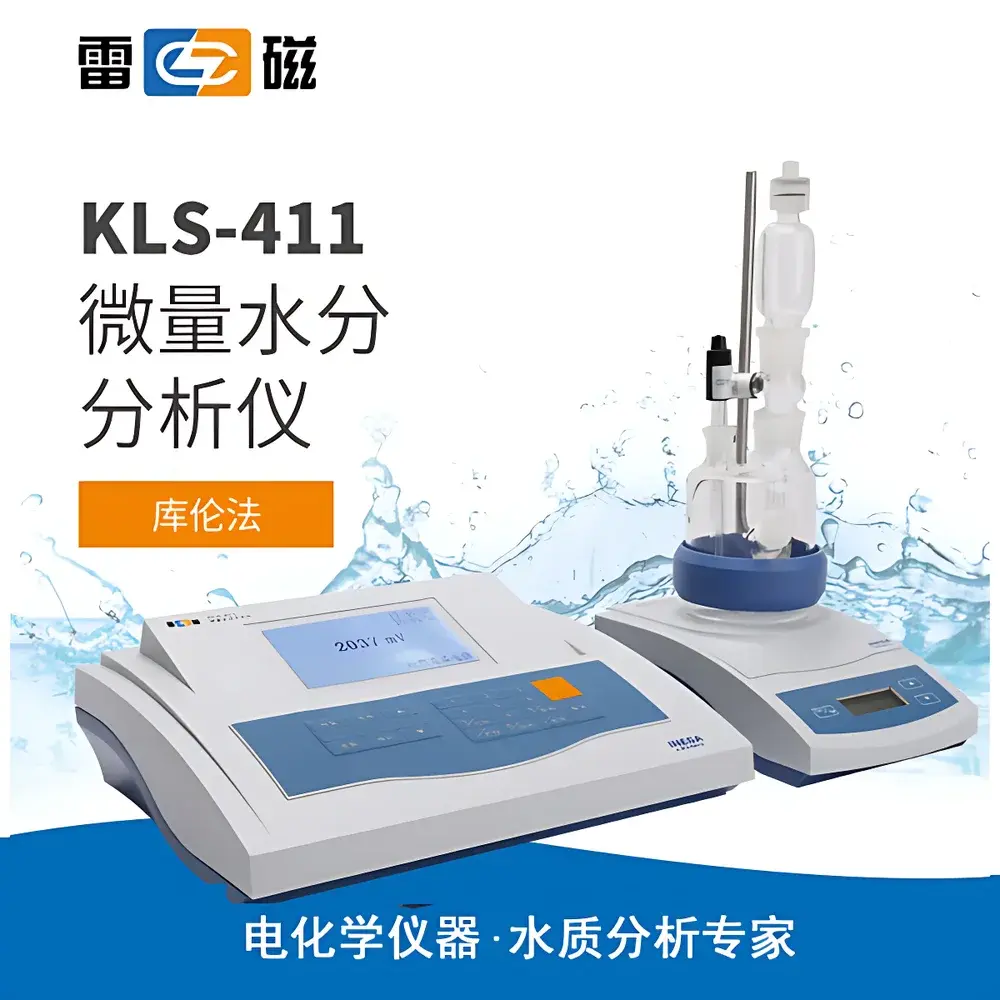
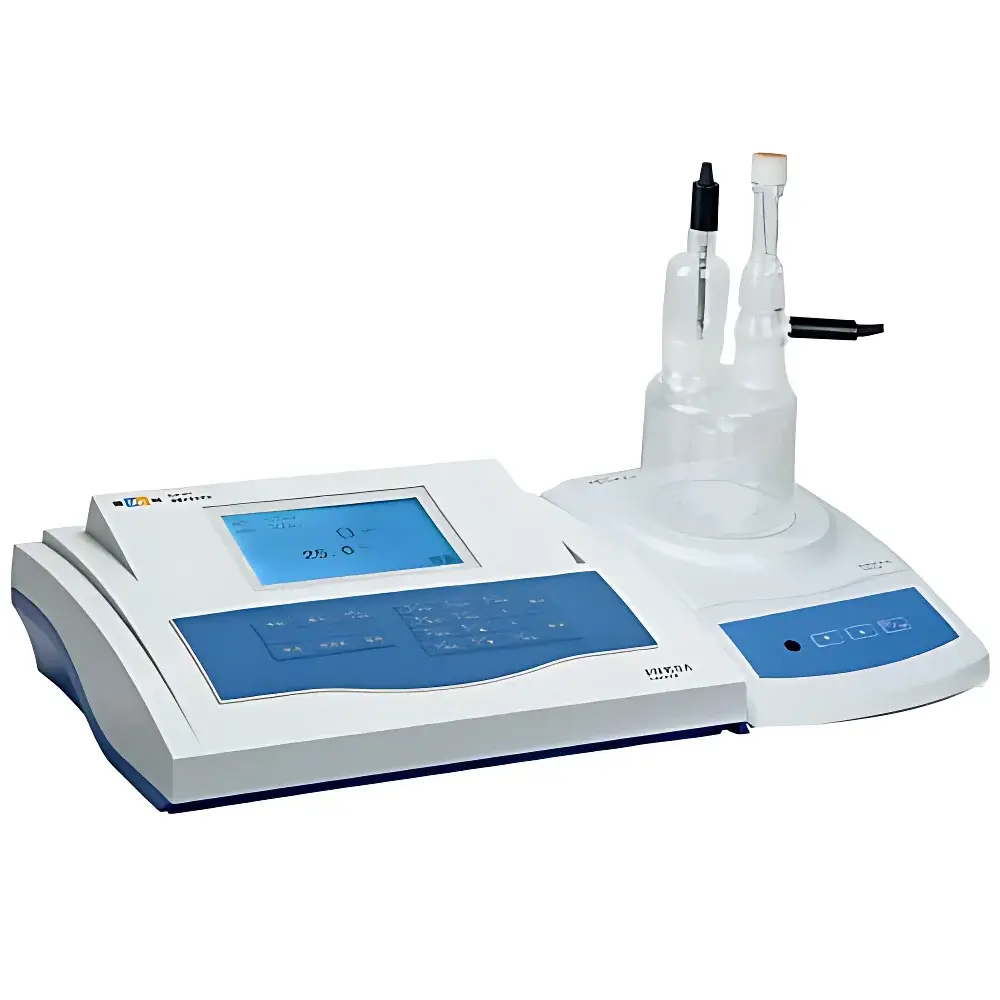
Leici KLS-411 Karl Fischer Coulometric Moisture Analyzer
| Brand | Leici |
|---|---|
| Origin | Shanghai, China |
| Manufacturer Type | Authorized Distributor |
| Origin Category | Domestic (China) |
| Model | KLS-411 |
| Pricing | USD 1,650 (FOB Shanghai) |
| Titration Mode | Fully Automatic Coulometric Titration |
| Instrument Type | Coulometric Karl Fischer Moisture Analyzer |
| Water Content Range | 10 µg to 20 mg |
| Measurement Accuracy | ≤ ±3% RSD |
| Electrolysis Current Settings | 10 mA / 20 mA / 50 mA / 100 mA |
| Polarization Current Error | ±0.2 µA |
| Electrolysis Current Basic Error | ±0.5% of reading |
| Indication Error | ±(5% of calibration point + 3) µg |
| Repeatability | ≤3% RSD |
| Power Supply | (220 ± 22) V, (50 ± 1) Hz |
| Dimensions (W×D×H) | 300 × 235 × 100 mm |
| Weight | 3 kg |
| Interface | RS-232 for printer and data export |
Overview
The Leici KLS-411 Karl Fischer Coulometric Moisture Analyzer is a precision electrochemical instrument engineered for trace-level water quantification in non-aqueous matrices. It operates on the principle of coulometric Karl Fischer titration—where iodine is generated electrochemically at the anode via Faraday’s law—and measures water content based on the total charge required to oxidize iodide to iodine in the presence of sulfur dioxide, methanol, and a base. This method delivers high sensitivity and reproducibility for samples containing water in the range of 10 µg to 20 mg, making it suitable for quality control laboratories handling pharmaceutical excipients, lubricants, polymers, solvents, and petrochemical products where regulatory compliance demands sub-100 ppm moisture detection.
Key Features
- Fully automatic coulometric titration with real-time current regulation across four discrete electrolysis current levels (10, 20, 50, and 100 mA), enabling adaptive response to sample water load and optimized assay speed.
- Membrane-separated dual-platinum electrode system minimizes interference from redox-active species and ensures stable endpoint detection in complex organic media including chlorinated solvents, hydrocarbon oils, and viscous resins.
- Pre-formulated, low-toxicity Leici “Odorless K-F Reagent” eliminates routine reagent standardization—reducing operator error and analytical downtime while complying with OSHA and REACH guidelines for laboratory chemical safety.
- Integrated LCD interface with intuitive menu navigation supports standalone operation; no external PC required for routine analysis, calibration, or result review.
- Onboard data management allows storage of up to 200 test records with timestamp, sample ID, water mass (µg), and calculated % w/w; entries are searchable, editable, and deletable directly from the front panel.
- RS-232 serial port enables direct connection to thermal printers for GLP-compliant hard-copy reporting and facilitates future integration into LIMS environments via ASCII protocol.
Sample Compatibility & Compliance
The KLS-411 is validated for use with anhydrous and low-polarity matrices commonly encountered in QC workflows—including silicone oils, transformer oils, ethyl acetate, acetonitrile, polyethylene glycol, and lyophilized APIs. Its coulometric design avoids volumetric drift issues associated with reagent aging, ensuring consistent performance over extended run times. The instrument meets essential metrological requirements aligned with ASTM E203–22 (“Standard Test Method for Water Using Volumetric or Coulometric Karl Fischer Titration”) and ISO 760:1978 (“Determination of Water—Karl Fischer Method”). While not pre-certified for FDA 21 CFR Part 11, its audit trail–capable data logging (with user ID prompts and immutable timestamps) supports GMP/GLP documentation practices when deployed with controlled access protocols and periodic verification per USP and EP 2.5.12.
Software & Data Management
No proprietary software installation is required for basic operation. All measurement parameters—including current setting, endpoint threshold, stirring speed, and sample weight entry—are configured locally. Result files exported via RS-232 follow fixed-width ASCII format compatible with Excel, LabArchives, and most LIMS platforms. For regulated environments, users may implement supplementary electronic record controls (e.g., password-protected configuration changes, printed report signatures) to satisfy ALCOA+ principles. Firmware updates are delivered via USB-to-serial adapter and require factory-issued hex files—ensuring version integrity and traceability.
Applications
- Pharmaceutical manufacturing: Residual moisture testing of active pharmaceutical ingredients (APIs), excipients, and final dosage forms per ICH Q5C stability guidance.
- Petrochemical QA: Water content verification in jet fuels (ASTM D6304), lubricating oils (ASTM D1744), and refrigerants to prevent corrosion and phase separation.
- Electronics materials: Quantification of moisture in solder pastes, conformal coatings, and encapsulants where <50 ppm H₂O can induce delamination or wire bond failure.
- Polymers & composites: Monitoring hygroscopic uptake in nylon, PBT, and carbon-fiber prepregs prior to molding or curing cycles.
- Research laboratories: Method development for novel K-F reagents, solvent compatibility screening, and kinetic studies of water liberation from hydrated salts.
FAQ
Is the KLS-411 compliant with 21 CFR Part 11?
It is not natively compliant but supports implementation of Part 11 controls through procedural safeguards (e.g., defined user roles, electronic signatures on printed reports, and secure audit logs). Validation documentation must be developed internally per your organization’s SOPs.
Does the instrument require daily reagent standardization?
No—coulometric operation with Leici’s stabilized, pre-mixed reagent eliminates the need for aqueous standardization. System verification using certified water standards (e.g., 1.00 mg H₂O/ampoule) is recommended before each analytical batch.
Can the KLS-411 measure samples with >20 mg water?
No. For higher water loads, volumetric KF titration (e.g., Leici KF-1B series) is recommended to maintain stoichiometric accuracy and avoid electrolyte saturation.
What maintenance is required for the electrode assembly?
The membrane electrode should be cleaned weekly with dry filter paper and rinsed with anhydrous methanol; full replacement is advised every 6–12 months depending on usage frequency and matrix aggressiveness.
Is remote monitoring or network connectivity supported?
Not out-of-the-box. Ethernet or Wi-Fi modules are not integrated; however, RS-232 output can be bridged to TCP/IP networks using third-party serial servers compliant with Modbus RTU or custom ASCII parsing scripts.
Related Products




