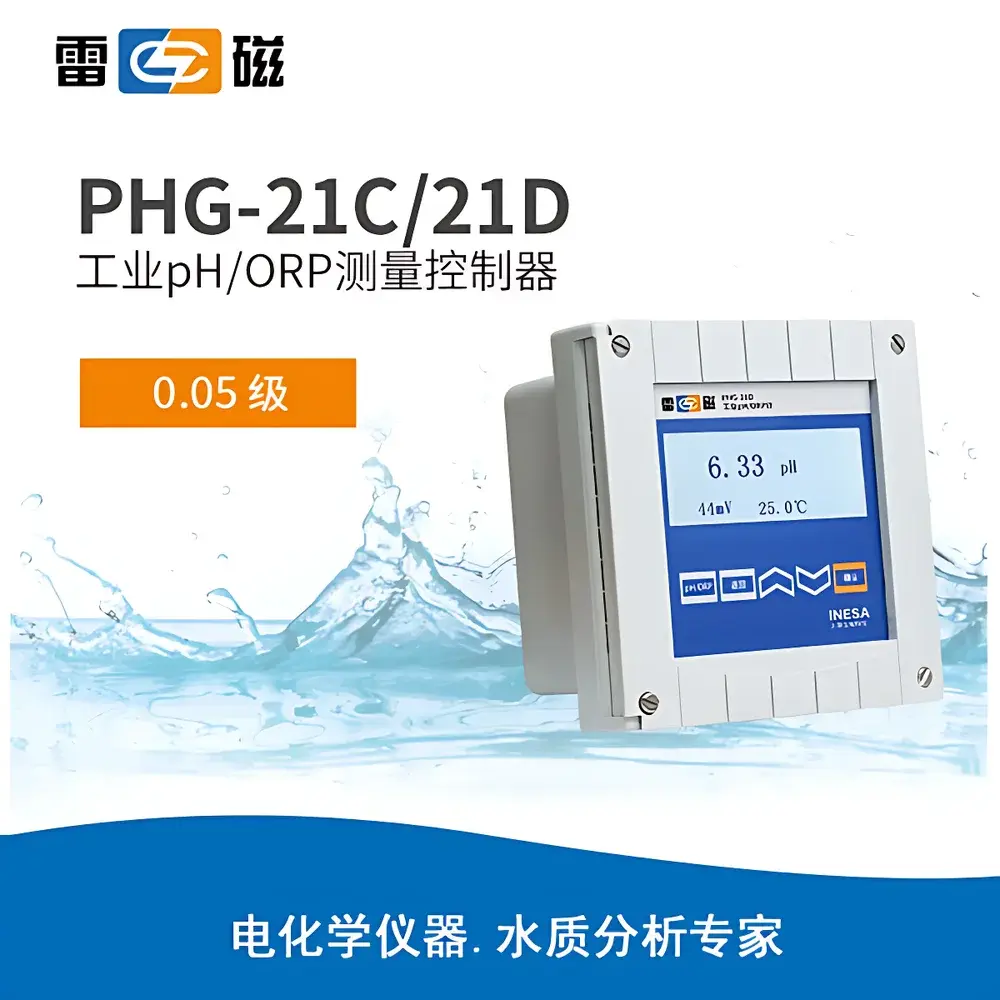
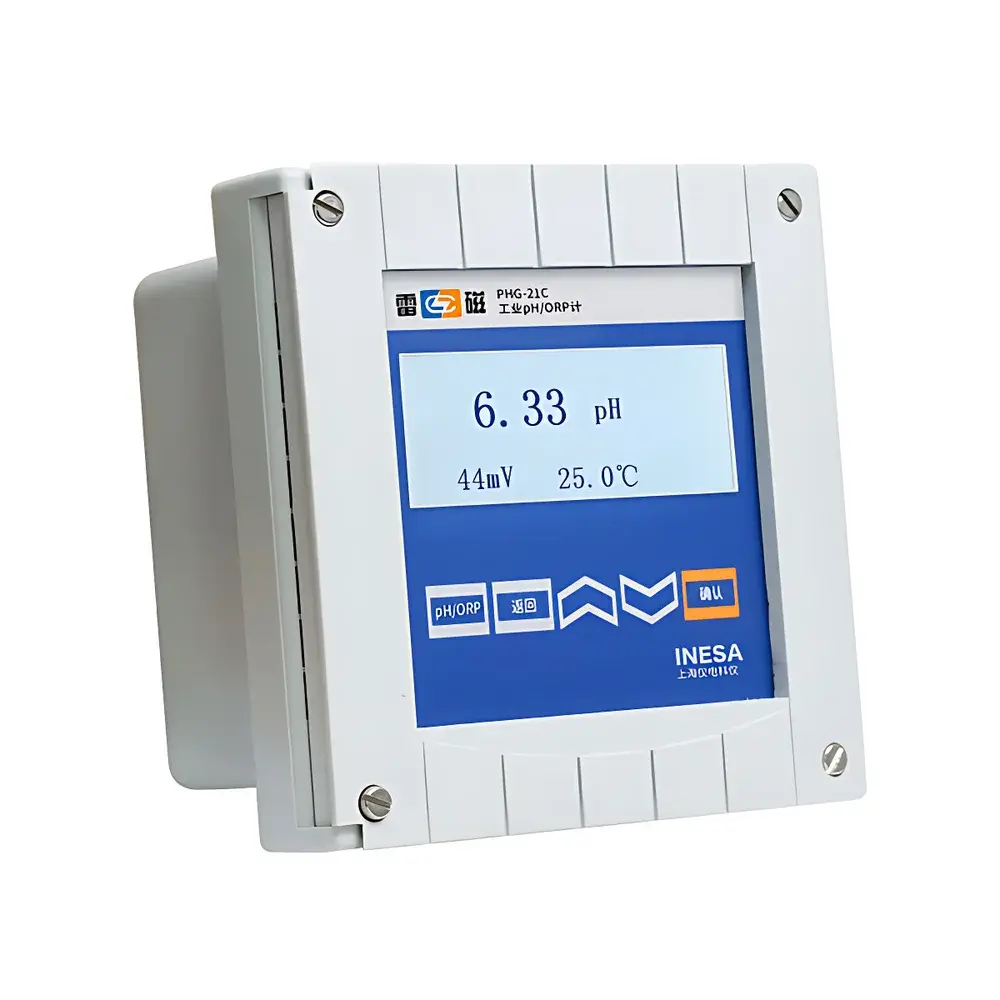
Leici PHG-21C / PHG-21D Industrial pH/ORP Transmitter and Controller
| Brand | Leici |
|---|---|
| Origin | Shanghai, China |
| Model | PHG-21C, PHG-21D |
| Measurement Range | pH (0.00–14.00), ORP (−1800–+1800 mV), Temperature (−10.0–120.0 °C) |
| Resolution | 0.01 pH, 1 mV, 0.1 °C |
| Accuracy | ±0.05 pH, ±10 mV, ±1.0 °C |
| Repeatability | ≤0.02 pH, ≤3 mV |
| Input Impedance | ≥1 × 10¹² Ω |
| Input Current | ≤2 × 10⁻¹² A |
| Stability | ≤±0.02 pH/24 h |
| Output | Isolated 4–20 mA DC (configurable span) |
| Enclosure Rating | IP65 |
| Power Supply | AC 220 V ±10 %, 50 Hz ±1 Hz or DC 24 V |
| Dimensions | 144 × 144 × 163 mm |
| Weight | 2.5 kg |
Overview
The Leici PHG-21C and PHG-21D are DIN-rail mountable industrial pH/ORP transmitters engineered for continuous, high-stability measurement in demanding process environments. These instruments operate on potentiometric principles—measuring the electrochemical potential difference between a pH-sensitive glass electrode (or ORP redox electrode) and a stable reference electrode—converted into calibrated digital output via high-impedance analog front-end circuitry. Designed for integration into centralized control systems, they deliver real-time monitoring of aqueous process streams across chemical synthesis, petroleum refining, metallurgical leaching, pharmaceutical water systems, power plant boiler feedwater, and municipal or industrial wastewater treatment. Both models comply with fundamental requirements for industrial sensor interfacing per IEC 61000-6-2 (EMC immunity) and IEC 61000-6-4 (EMC emission), and support operation under ambient conditions ranging from −10 °C to 55 °C.
Key Features
- True dual-parameter capability: simultaneous acquisition and display of pH, ORP (mV), and temperature—with manual toggle between pH and ORP modes on the local LCD interface.
- Automatic temperature compensation (ATC) using Pt100 or thermistor input, enabling accurate pH correction across the full operational temperature range (−10.0 to 120.0 °C).
- Intelligent calibration logic: auto-recognition of standard buffer solutions at pH 4.00, 6.86, and 9.18; supports one-point and two-point calibration with slope and offset diagnostics.
- Robust 4–20 mA isolated current loop output with fully configurable upper/lower limits—enabling direct connection to DCS, PLC, or SCADA systems without external signal conditioning.
- Local alarm management: programmable high/low limit triggers with relay contact outputs (optional accessory) and non-volatile memory retention during power interruption.
- DIN 43700-compliant housing with IP65 ingress protection—suitable for wall or panel mounting in humid, dusty, or splash-prone industrial enclosures.
- Two hardware configurations: PHG-21C integrates an onboard measurement board for direct electrode connection (optimized for short cable runs ≤5 m); PHG-21D is a remote-display controller requiring paired transmitter modules (e.g., PHGF-27B, PHGF-28B, PHGF-43) for extended installations up to 100 m.
Sample Compatibility & Compliance
The PHG-21 series is validated for use with standard combination pH electrodes (e.g., double-junction, gel-filled, or refillable types) and platinum or gold-based ORP electrodes compliant with ISO 10523 and ASTM D1293. It accommodates both low-conductivity deionized water and high-ionic-strength brines, provided electrode selection matches sample chemistry (e.g., specialized electrodes for HF-containing media or sulfide-rich effluents). The instrument meets CE marking requirements for electromagnetic compatibility and low-voltage directive compliance. While not certified to SIL or ATEX standards out-of-the-box, its architecture supports integration into safety instrumented systems (SIS) when deployed with appropriately rated field devices and isolation barriers. Data logging and audit trail functionality are not embedded but can be enabled via external HART-enabled recorders or third-party SCADA historian modules aligned with FDA 21 CFR Part 11 data integrity expectations.
Software & Data Management
These controllers operate as embedded hardware-only devices with no onboard firmware update capability or USB/Ethernet connectivity. Configuration—including calibration constants, alarm thresholds, output scaling, and display units—is performed locally via membrane keypad navigation and a 128 × 64 pixel backlit monochrome LCD. All settings are retained in non-volatile EEPROM with battery-free retention exceeding 10 years. For enterprise-level data aggregation, the 4–20 mA analog output serves as the primary telemetry channel; optional HART-enabled transmitters (e.g., PHGF-46) extend digital diagnostics and configuration access via standard HART 7 protocol. No proprietary software is required, and integration with common industrial protocols (Modbus RTU over RS-485 available via add-on modules) enables seamless interoperability in multi-vendor automation architectures.
Applications
- Chemical manufacturing: pH control in neutralization reactors, scrubber effluent monitoring, and catalyst bath stabilization.
- Power generation: continuous monitoring of condensate polishing, demineralizer outlet water, and cooling tower blowdown.
- Pharmaceutical utilities: USP compliant conductivity-pH correlation checks in purified water (PW) and water for injection (WFI) distribution loops.
- Municipal wastewater: ORP-guided denitrification control in anoxic basins and pH-triggered lime dosing in final clarifiers.
- Metallurgical processing: real-time acid concentration tracking in heap leach pad runoff and electrolyte balance in electrowinning cells.
FAQ
What is the difference between PHG-21C and PHG-21D?
The PHG-21C contains an integrated measurement board and connects directly to pH/ORP electrodes—ideal for compact installations where the sensor is mounted within 5 meters. The PHG-21D lacks this board and must be used with a remotely located transmitter (e.g., PHGF-27B) that conditions the electrode signal before transmission over longer distances.
Does the device support automatic buffer recognition during calibration?
Yes—it identifies standard buffers at pH 4.00, 6.86, and 9.18 automatically and validates electrode response slope and asymmetry potential during two-point calibration.
Is temperature compensation mandatory for accurate pH measurement?
Yes—pH electrode sensitivity varies with temperature (Nernstian slope ≈ −59.16 mV/pH at 25 °C, decreasing at lower temperatures). ATC ensures measurement accuracy across the full −10.0 to 120.0 °C range.
Can the 4–20 mA output be scaled to non-standard ranges (e.g., 0–14 pH mapped to 4–20 mA)?
Yes—the upper and lower output limits are fully user-configurable, allowing custom linear mapping of any segment of the measured parameter range.
What is the minimum input impedance required for reliable electrode signal acquisition?
The electronic unit provides ≥1 × 10¹² Ω input impedance and ≤2 pA input bias current—meeting ISO 4787 and IUPAC recommendations for high-resistance glass electrode interfaces.
Related Products