
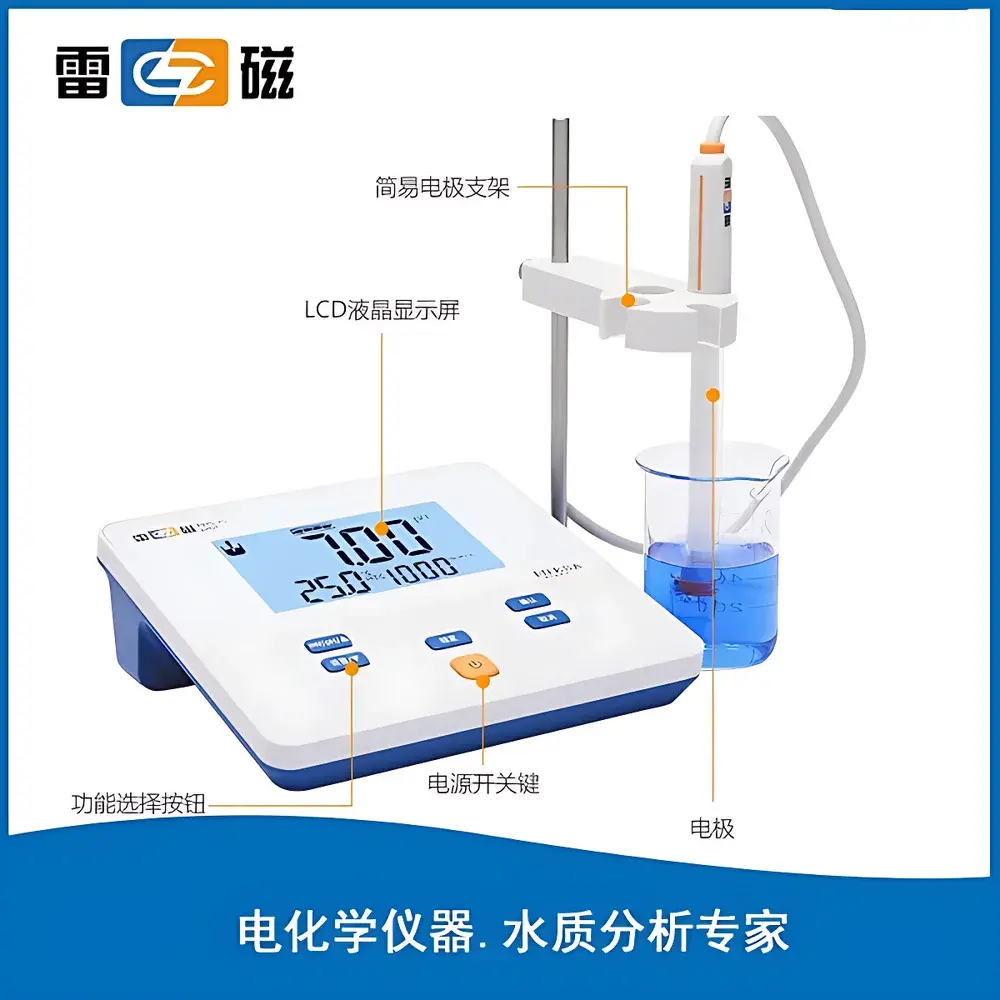
Leici PHS-25 Benchtop Digital pH Meter
| Brand | Leici |
|---|---|
| Origin | Shanghai, China |
| Instrument Type | Benchtop pH Meter |
| Measurement Range | 0.00–14.00 pH |
| Resolution | 0.01 pH |
| Accuracy | ±0.05 pH |
| Calibration | Manual 2-point with auto-recognition of three standard pH buffers (Chinese national buffer set) |
| Temperature Compensation | Manual, 0.0–60.0 °C |
| Input Impedance | ≥3×10¹¹ Ω |
| Stability | ±0.05 pH ±1 digit / 3 h |
| Display | LCD, dual-parameter (pH/mV) |
| Power Supply | DC 6 V, 300 mA |
| Dimensions (W×D×H) | 220 × 160 × 65 mm |
| Weight | 1.0 kg |
Overview
The Leici PHS-25 Benchtop Digital pH Meter is a precision electrochemical instrument engineered for routine pH and millivolt (mV) measurements in academic teaching laboratories, quality control environments, and industrial process support settings. Based on the potentiometric principle, it measures the electromotive force (EMF) generated across a pH-sensitive glass electrode and a reference electrode immersed in an aqueous sample—converting the Nernstian voltage response into a calibrated pH value. Designed to meet the performance requirements of Class 0.1 pH instruments per Chinese national standard JJG 119–2018 (equivalent to ISO 7027-1:2016 metrological framework for pH meters), the PHS-25 delivers reliable, repeatable results under controlled ambient conditions. Its architecture prioritizes operational simplicity and long-term stability over advanced automation—making it especially suitable for users requiring traceable, manual calibration workflows without software dependency.
Key Features
- Dual-parameter measurement capability: simultaneous display of pH and mV values with polarity indication
- High-contrast monochrome LCD display with optimized viewing angle and low-power consumption
- Two-point manual calibration protocol supporting automatic recognition of three nationally standardized pH buffer solutions (pH 4.01, 6.86, and 9.18 at 25 °C)
- Flexible calibration options: user-defined buffer values permitted when standard solutions deviate from nominal concentrations
- Manual temperature compensation (MTC) across 0.0–60.0 °C range, enabling correction of electrode slope variation due to thermal effects
- Input impedance exceeding 3×10¹¹ Ω ensures minimal loading error during high-resistance measurements (e.g., low-conductivity samples or aged electrodes)
- Robust mechanical design: compact footprint (220 × 160 × 65 mm), lightweight aluminum-chassis construction (1.0 kg), and DC-powered operation for electromagnetic noise immunity
Sample Compatibility & Compliance
The PHS-25 is validated for use with conventional combination pH electrodes such as the Leici E-201-C series. It supports aqueous samples with conductivity ≥20 µS/cm and total dissolved solids (TDS) < 5000 ppm. While not intended for direct sterilization or pressurized flow-through applications, it complies with general safety requirements outlined in IEC 61010-1:2010 for electrical equipment used in laboratory environments. Its calibration methodology aligns with ASTM D1293–22 (Standard Test Methods for pH of Water) and supports documentation practices consistent with basic GLP principles—including manual recording of calibration dates, buffer lot numbers, and electrode condition notes. The instrument does not include electronic audit trail or user access control; therefore, it is deployed in non-regulated or internally audited workflows where paper-based recordkeeping remains acceptable.
Software & Data Management
The PHS-25 operates as a standalone, firmware-controlled device with no embedded memory or digital interface. All measurement data must be recorded manually or transcribed externally. No proprietary software, driver packages, or connectivity protocols (e.g., USB, RS-232, Bluetooth) are integrated. This architecture eliminates cybersecurity risks associated with networked instrumentation while ensuring deterministic behavior and zero firmware update dependencies. For labs seeking digital data capture, compatibility is maintained with third-party analog-to-digital converters or chart recorders interfaced via mV output (where available on custom configurations). Calibration certificates and verification logs should be retained per institutional SOPs, referencing JJG 119–2018 verification intervals (typically annually) and electrode maintenance records.
Applications
- Undergraduate chemistry and environmental science laboratories for titration endpoint detection and buffer characterization
- Food and beverage QC testing of raw ingredients, intermediate products, and finished goods (e.g., dairy, brewing, fruit processing)
- Water treatment facility monitoring of influent/effluent pH prior to regulatory reporting
- Pharmaceutical excipient screening where moderate accuracy suffices for batch release checks
- Veterinary clinic water quality assessment and disinfectant solution verification
- Soil extract analysis (1:5 suspension method) in agricultural extension services
Note: For ultra-pure water (UPW), boiler feedwater, or low-ionic-strength samples (<5 µS/cm), the PHS-25 requires pairing with a specialized low-drift electrode (e.g., double-junction or sleeve-type reference) and strict adherence to static measurement protocols—though such applications fall outside its primary design envelope.
FAQ
What buffer standards are recognized by the PHS-25 during auto-calibration?
The instrument automatically identifies Chinese national standard buffers: pH 4.01 (potassium hydrogen phthalate), pH 6.86 (phosphate), and pH 9.18 (borax) at 25 °C.
Is temperature compensation mandatory for accurate readings?
No—manual temperature compensation is optional but recommended when sample temperature differs significantly from 25 °C; uncorrected measurements may incur slope-related deviation up to ±0.01 pH/°C.
Can the PHS-25 measure ORP (oxidation-reduction potential)?
Yes—the mV mode supports direct redox potential measurement using compatible platinum or calomel reference electrodes, with full-scale range of ±1400 mV and 1 mV resolution.
Does the PHS-25 comply with FDA 21 CFR Part 11?
No—it lacks electronic signatures, audit trails, and role-based access controls required for Part 11 compliance; it is intended for non-GxP environments.
What is the expected service life of the E-201-C electrode when used with the PHS-25?
Under typical usage (2–4 hours/day, proper storage in 3 M KCl), the electrode maintains ±0.05 pH accuracy for 12–18 months before recalibration frequency increases or drift exceeds specification limits.





