
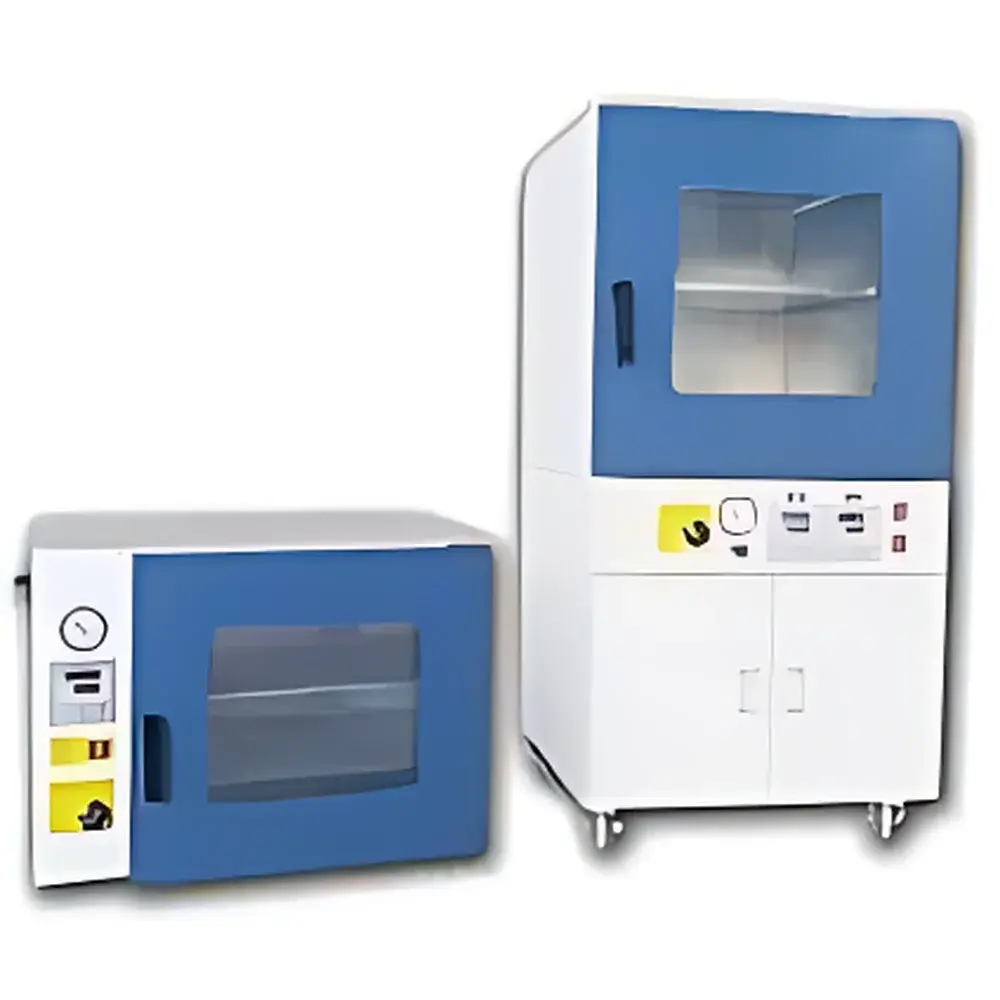
ZiQi DZF-6030 Benchtop Vacuum Drying Oven
| Brand | ZiQi |
|---|---|
| Origin | Shanghai, China |
| Manufacturer | Yes |
| Country of Origin | China |
| Model | DZF-6030 |
| Instrument Type | Vacuum Oven |
| Temperature Range | RT+10 to 250 °C |
| Temperature Uniformity | ±1 °C |
| Temperature Fluctuation | ±1 °C |
| Temperature Resolution | 0.1 °C |
| Vacuum Degree | ≤133 Pa |
| Chamber Dimensions (W×D×H) | 320×320×300 mm |
| External Dimensions (W×D×H) | 600×450×470 mm |
| Heating Method | Forced Air Circulation |
| Inner Chamber Material | Stainless Steel (SUS304) |
| Operating Ambient Temperature | +5 to 40 °C |
| Power Rating | 500 W |
| Voltage/Frequency | 220 V / 50 Hz |
| Shelf Configuration | 1 adjustable stainless steel shelf |
| Vacuum Pump | Optional external pump (not included) |
Overview
The ZiQi DZF-6030 is a compact benchtop vacuum drying oven engineered for precise thermal processing under reduced-pressure conditions. It operates on the principle of lowering the ambient pressure inside the chamber to reduce the boiling point of solvents and moisture—enabling gentle, low-temperature drying of heat-sensitive, oxygen-labile, or thermally unstable materials. Unlike conventional convection ovens, the DZF-6030 eliminates oxidative degradation by removing atmospheric oxygen during operation, making it particularly suitable for applications in pharmaceutical stability testing, lyophilization pre-drying, polymer curing, catalyst activation, and analytical sample preparation where chemical integrity must be preserved. Its forced-air circulation system ensures uniform heat distribution across the stainless-steel chamber while maintaining stable vacuum integrity via a dual-layer tempered glass door and compression-molded silicone gasket.
Key Features
- Stainless steel inner chamber (SUS304) with mirror-finished surfaces for corrosion resistance, easy cleaning, and long-term dimensional stability under repeated thermal cycling.
- Dual-layer tempered and shatter-resistant observation window enables real-time visual monitoring without compromising vacuum integrity.
- Adjustable door latch mechanism and high-compliance silicone door seal ensure consistent vacuum retention down to ≤133 Pa—verified per ISO 2787:2015 vacuum performance guidelines.
- Microprocessor-based PID temperature controller with dual digital display (setpoint & actual temperature), auto-tuning capability, and programmable ramp-soak profiles.
- Proportional heating power modulation prevents overshoot at low setpoints (e.g., <50 °C), enhancing reproducibility for delicate biological samples and hygroscopic compounds.
- Benchtop footprint (600 × 450 × 470 mm) optimized for limited lab space; compatible with standard laboratory-grade vacuum pumps (e.g., two-stage rotary vane or diaphragm types).
Sample Compatibility & Compliance
The DZF-6030 accommodates a broad range of sample formats—including Petri dishes, weighing boats, glass desiccators, ceramic crucibles, and small-volume reaction vessels—within its 30.7 L working volume (320 × 320 × 300 mm). It supports drying protocols aligned with ASTM E145–22 (Standard Specification for Gravity-Convection and Forced-Ventilation Ovens) and ISO 12099:2017 (Animal feeding stuffs — Guidance on vacuum drying for moisture determination). While not certified for GMP manufacturing environments, its construction and control architecture support GLP-compliant documentation when paired with external audit-trail-capable data loggers. The absence of internal fans near the chamber walls minimizes particulate generation—critical for cleanroom-adjacent QC labs handling APIs or reference standards.
Software & Data Management
The DZF-6030 operates via embedded firmware without proprietary software dependencies. All operational parameters—including temperature setpoint, dwell time, vacuum status, and real-time chamber temperature—are displayed locally and retained in non-volatile memory across power cycles. For traceability, users may integrate third-party USB or RS485-enabled temperature/vacuum data loggers compliant with FDA 21 CFR Part 11 requirements (when configured with electronic signatures and audit trail functionality). No cloud connectivity or remote control interface is provided—ensuring data sovereignty and minimizing cybersecurity exposure in regulated research settings.
Applications
- Pre-drying of samples prior to Karl Fischer titration or loss-on-drying (LOD) analysis per USP <731>.
- Dehydration of enzyme powders, probiotics, and peptide conjugates without denaturation.
- Removal of residual solvents from thin-film coatings and nanomaterial dispersions.
- Conditioning of hygroscopic reference standards (e.g., potassium hydrogen phthalate) before gravimetric calibration.
- Accelerated aging studies of packaging materials under inert gas purging (N₂ or Ar).
- Post-synthesis solvent removal from metal-organic frameworks (MOFs) and porous carbons.
FAQ
Does the DZF-6030 include a built-in vacuum pump?
No. As a benchtop model, the DZF-6030 requires an externally connected vacuum pump. Compatible options include oil-lubricated rotary vane pumps (for ultimate vacuum <10 Pa) or dry diaphragm pumps (for maintenance-free operation at ≤133 Pa).
Can this oven be used for sterilization or microbial decontamination?
It is not designed or validated for sterility assurance. While elevated temperatures under vacuum can reduce bioburden, the unit lacks steam generation, pressure cycling, or biological indicator validation pathways required for autoclave-equivalent sterilization per ISO 17665.
What safety certifications does the DZF-6030 carry?
The unit complies with IEC 61010-1:2010 for electrical safety in laboratory equipment. CE marking is not affixed; users are responsible for local regulatory conformity assessment prior to deployment.
Is over-temperature protection integrated?
Yes—a redundant mechanical over-temperature cut-off switch (independent of the PID controller) interrupts heating if chamber temperature exceeds 270 °C, preventing thermal runaway.
How often should the silicone door gasket be replaced?
Under normal use (≤5 cycles/day), replacement is recommended every 18–24 months or immediately upon visible cracking, compression set, or vacuum decay exceeding 5 Pa/min at 133 Pa holding pressure.



