
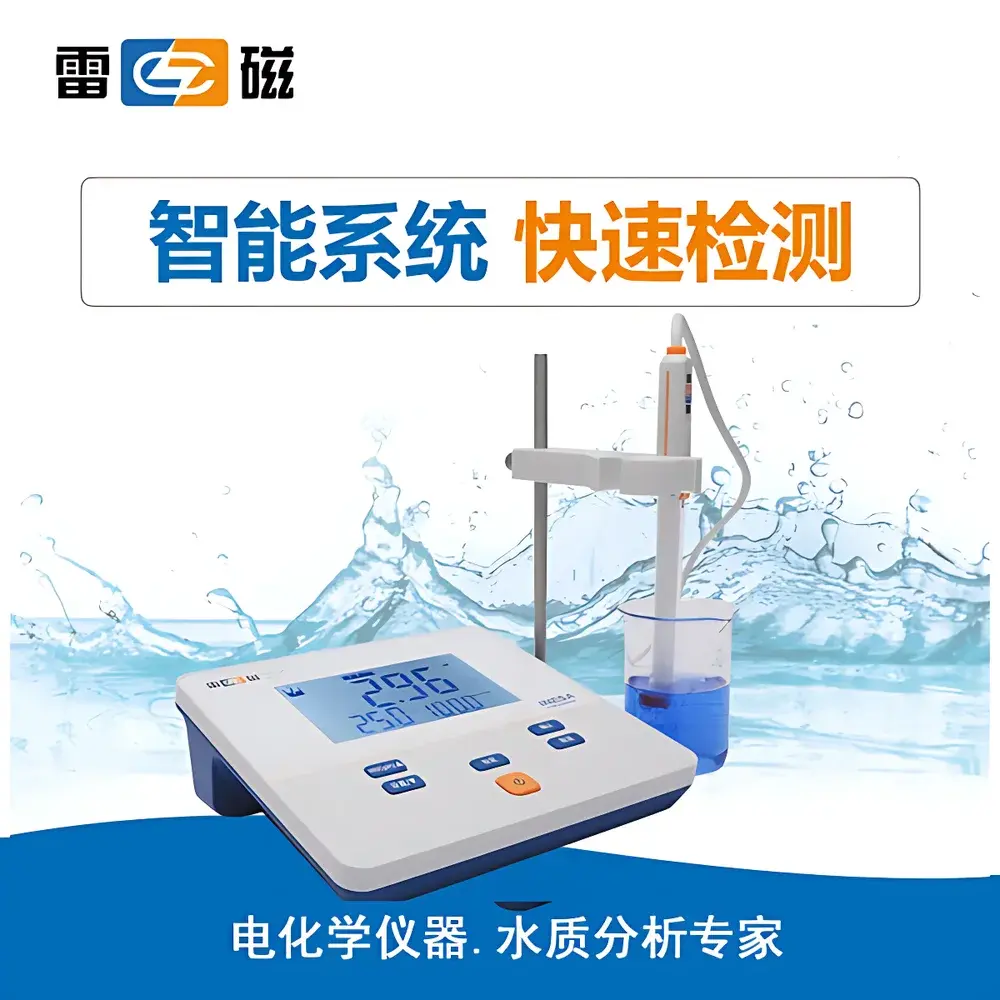
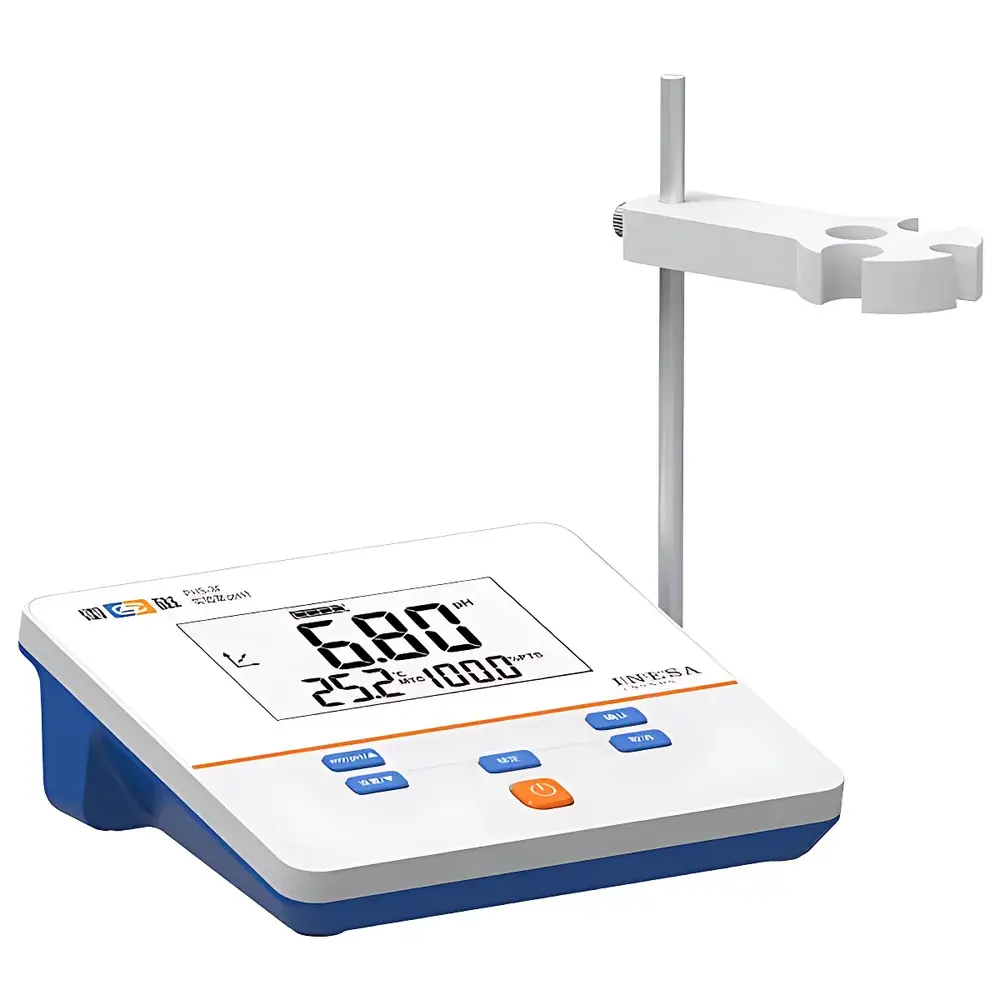
Leici PHS-2F Benchtop pH Meter
| Brand | Leici |
|---|---|
| Origin | Shanghai, China |
| Instrument Type | Benchtop |
| Parameter Capability | Dual (pH and mV) |
| pH Measurement Range | 0.00–14.00 pH |
| pH Resolution | 0.01 pH |
| pH Accuracy | ±0.01 pH |
| mV Range | −1800 to +1800 mV |
| mV Resolution | 1 mV |
| mV Accuracy | ±0.1% FS |
| Temperature Compensation | Manual |
| Calibration Standards | GB Standard Buffers (pH 4.00, 6.86, 9.18) |
| Calibration Points | 1–2 point |
| Display | LCD with Stability Indicator |
| Protection Rating | IP54 |
| Power Supply | AC 100–240 V input / DC 20 V, 1500 mA output |
| Dimensions (L×W×H) | 200 × 160 × 63 mm |
| Weight | 0.6 kg |
| Compliance | GB/T 11165–2022 (Laboratory pH Meters) |
Overview
The Leici PHS-2F Benchtop pH Meter is a precision electrochemical instrument engineered for routine pH and redox potential (mV) measurements in academic laboratories, quality control environments, and industrial process support settings. It operates on the potentiometric principle, measuring the electromotive force generated across a glass pH electrode relative to a stable reference electrode—typically a silver/silver chloride (Ag/AgCl) system—when immersed in aqueous solutions. The device conforms to the measurement methodology defined in GB/T 11165–2022, China’s national standard for laboratory pH meters, and supports traceable calibration against certified reference materials aligned with internationally recognized buffer specifications (e.g., NIST-traceable pH 4.00, 6.86, and 9.18 at 25 °C). Designed as a dual-parameter instrument, it delivers simultaneous pH and millivolt readings without mode switching, enabling direct assessment of solution acidity and oxidation-reduction status—critical for titration endpoint verification, corrosion studies, and electrochemical stability screening.
Key Features
- High-contrast LCD display with real-time stability indicator—visual confirmation of electrochemical equilibrium prior to data recording
- Dual-parameter operation: concurrent pH and mV measurement with independent scaling and unit labeling
- Intelligent buffer recognition: automatic detection of GB-specified calibration standards (pH 4.00, 6.86, 9.18) upon immersion; optional user-defined buffer entry for non-standard or proprietary solutions
- Flexible calibration architecture: supports both single-point (asymmetric offset correction) and two-point (slope and offset) calibration protocols per IUPAC-recommended practice
- Manual temperature compensation (MTC): accommodates ambient or sample-specific temperature inputs (range: 0–60 °C) to correct for thermal drift in electrode response
- Robust mechanical design: IP54-rated enclosure ensures resistance to dust ingress and incidental water splashes—suitable for shared lab benches and teaching environments
- Power management suite: auto-shutdown after 10 minutes of inactivity; non-volatile memory preserves calibration coefficients and last-used settings during power interruption
Sample Compatibility & Compliance
The PHS-2F is validated for use with aqueous and low-ionic-strength solutions typical in environmental monitoring (e.g., surface water, wastewater effluent), food and beverage QC (juice, dairy, brewing), and basic chemistry education labs. It interfaces exclusively with standard BNC-compatible pH electrodes—including the supplied combination electrode—and does not support high-temperature, non-aqueous, or low-conductivity organic solvent measurements. Calibration traceability follows GB buffer certification requirements, and while the instrument itself is not CE-marked or FDA 21 CFR Part 11 compliant out-of-the-box, its electronic unit meets the metrological criteria of Class 0.02 pH meters per GB/T 11165–2022. For GLP/GMP-regulated workflows, users must implement procedural controls—including logbook-based calibration documentation, electrode performance verification, and periodic inter-laboratory comparison—to satisfy audit readiness requirements.
Software & Data Management
The PHS-2F operates as a standalone hardware platform with no embedded software stack or USB/Bluetooth connectivity. All configuration, calibration, and measurement functions are executed via tactile membrane keys and interpreted directly by the onboard microcontroller. Readings are displayed in real time but are not stored internally beyond the current session. Users requiring electronic data capture must employ external recording methods—such as manual transcription into LIMS spreadsheets or integration with third-party DAQ systems via analog mV output (if externally enabled through accessory modules). No firmware updates, driver installation, or cloud synchronization capabilities are provided, aligning with its role as a deterministic, low-maintenance measurement tool for regulated or resource-constrained environments.
Applications
- Routine pH verification in municipal water treatment facilities and environmental field labs
- Acid-base titration endpoint detection in undergraduate chemistry curricula
- Batch release testing of pharmaceutical excipients and buffer stock solutions
- Monitoring fermentation broth pH in bioprocess development labs
- Electrode performance validation using known mV standards (e.g., quinhydrone or Zn/ZnSO₄ reference cells)
- Calibration cross-checks between primary reference instruments and portable field meters
FAQ
Does the PHS-2F support automatic temperature compensation (ATC)?
No—it provides manual temperature compensation only. Users must input the measured sample temperature before calibration or measurement.
Can the instrument store calibration data across power cycles?
Yes—calibration coefficients and operational settings are retained in non-volatile memory.
Is the included pH electrode refillable or gel-filled?
The standard supplied electrode is a maintenance-free, gel-filled combination type with integrated Ag/AgCl reference and double-junction design for enhanced stability in routine applications.
What is the recommended recalibration frequency?
Per ISO/IEC 17025 guidance, recalibration is advised before each analytical batch or at least once per shift when used continuously; more frequent checks are required for high-accuracy applications or after electrode cleaning.
Does the PHS-2F comply with ASTM E70 or USP ?
While it satisfies core functional requirements of these standards (e.g., resolution, accuracy, buffer recognition), formal conformance requires documented procedural adherence—not inherent instrument certification—so users must validate implementation within their SOP framework.




