
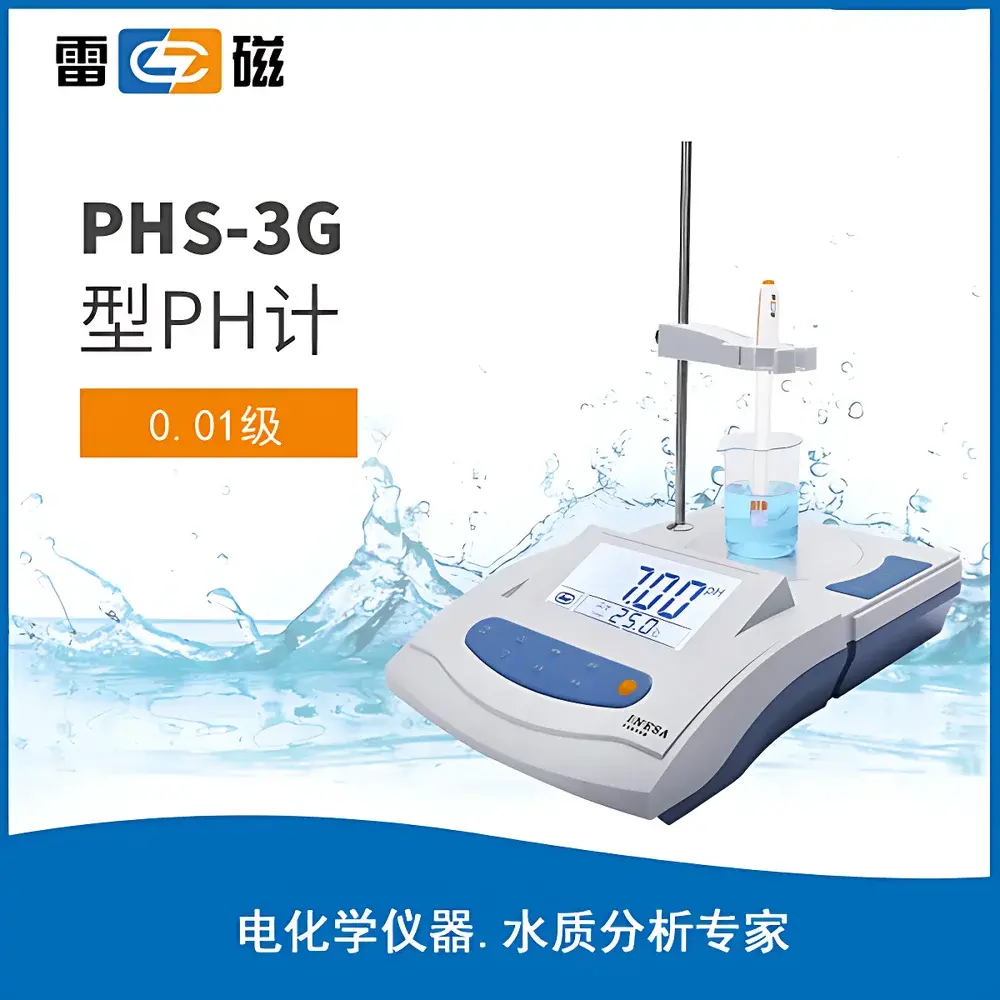
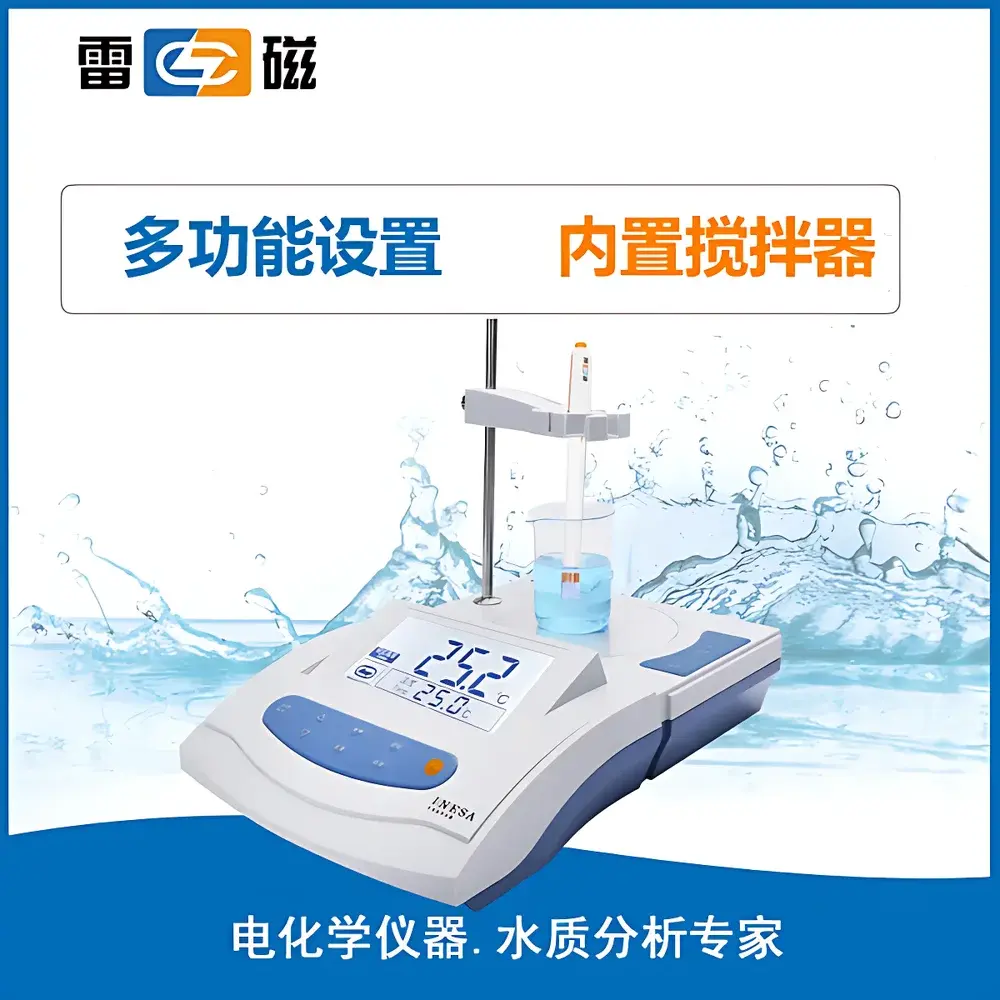
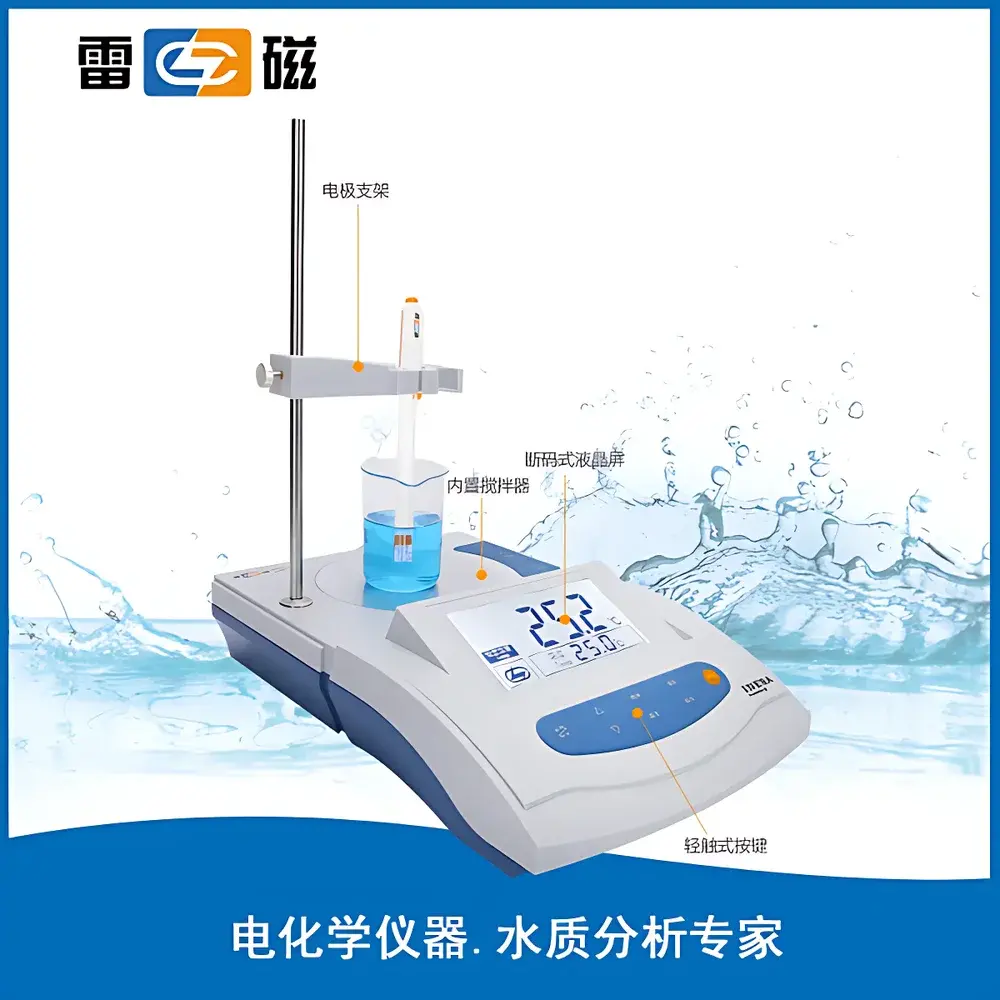
Leici PHS-3G Benchtop pH Meter with Integrated Magnetic Stirrer
| Brand | Leici |
|---|---|
| Origin | Shanghai, China |
| Model | PHS-3G |
| Instrument Type | Benchtop |
| Measurement Parameters | pH and mV (ORP) |
| pH Range | –2.00 to 19.99 pH |
| pH Resolution | 0.01 pH |
| pH Accuracy | ±0.01 pH ± 1 digit |
| mV Range | –1999 to +1999 mV |
| mV Resolution | 1 mV |
| mV Accuracy | ±0.1% FS |
| Stability | ≤ ±0.01 pH ± 1 digit / 3 h |
| Temperature Compensation | Manual, 0.0–60.0 °C |
| Display | Backlit segment LCD |
| Calibration | Auto-buffer recognition for pH 4.00, 6.86, and 9.18 |
| Power Supply | AC 220 V ± 10%, 50 Hz ± 1 Hz |
| Dimensions (W×D×H) | 210 × 310 × 95 mm |
| Weight | 2 kg |
Overview
The Leici PHS-3G is a benchtop electrochemical instrument engineered for precise, routine pH and redox potential (mV/ORP) measurements in academic laboratories, quality control environments, and industrial process support settings. It operates on the fundamental principle of potentiometric measurement: the voltage difference between a pH-sensitive glass electrode and a stable reference electrode is converted into a pH value using the Nernst equation. Designed to meet ISO 8655 and IUPAC guidelines for pH metrology, the PHS-3G delivers traceable, reproducible results within its specified accuracy envelope. Its integrated magnetic stirrer enables homogeneous sample mixing during measurement—critical for viscous, heterogeneous, or low-conductivity solutions where diffusion-limited equilibration may otherwise compromise reading stability. Unlike portable or simplified meters, the PHS-3G maintains Class 0.01 pH meter specifications per Chinese national standard JJG 119–2018 (equivalent to ISO/IEC 17025-compliant performance expectations for routine lab use), making it suitable for GLP-aligned workflows where documentation and repeatability are required.
Key Features
- Benchtop architecture with robust ABS housing and ESD-safe design for long-term stability in shared laboratory environments
- Backlit segment-type LCD display offering high contrast, wide viewing angle, and immunity to pixel decay under continuous operation
- Auto-buffer recognition for three primary NIST-traceable calibration standards (pH 4.00, 6.86, and 9.18 at 25 °C), reducing manual entry errors and accelerating setup
- Integrated magnetic stirrer with adjustable speed control—enabling real-time mixing without external hardware or mechanical coupling complications
- Manual temperature compensation (0.0–60.0 °C) aligned with standard pH electrode response curves; supports common glass electrode types (e.g., Ag/AgCl double-junction)
- Dual-parameter capability: simultaneous readout of pH and mV, facilitating titration endpoint detection, redox monitoring, and electrode diagnostics
- Stability specification of ≤ ±0.01 pH ± 1 digit over 3 hours—validated under controlled ambient conditions per manufacturer test protocol
Sample Compatibility & Compliance
The PHS-3G accommodates standard BNC-input pH electrodes and ORP probes compliant with DIN 19262 and ASTM D1293. It supports aqueous samples across a broad conductivity range (≥50 µS/cm recommended), including buffered solutions, dilute acids/bases, pharmaceutical formulations, food extracts, and environmental water specimens. While not certified for hazardous area use (e.g., ATEX or IECEx), the instrument meets GB/T 18268.1–2010 (IEC 61326-1) for electromagnetic compatibility in laboratory environments. It does not incorporate FDA 21 CFR Part 11–compliant audit trails or electronic signatures; however, its manual calibration logs and stable output support paper-based GLP documentation practices when used with calibrated reference electrodes and documented SOPs.
Software & Data Management
The PHS-3G operates as a standalone instrument with no embedded data logging or USB/Bluetooth connectivity. All measurements are displayed in real time and must be manually recorded. This architecture eliminates firmware dependencies, cybersecurity risks, and software validation overhead—making it suitable for regulated labs where instrument qualification focuses solely on electrical performance, electrode interface integrity, and environmental stability. Users are advised to pair the unit with validated pH electrodes (e.g., Leici E-201-C or equivalent), perform daily calibration checks against certified buffers, and maintain logbooks per ISO/IEC 17025 clause 7.7 requirements for equipment records.
Applications
- Routine QC testing of raw materials and final products in chemical manufacturing and cosmetics production
- pH monitoring during buffer preparation and standard solution verification in analytical method development
- Environmental water analysis—including surface water, wastewater effluent, and leachate—per EPA Method 150.1 and ISO 10523
- Educational laboratory instruction for electrochemistry fundamentals, calibration theory, and electrode kinetics
- Supporting acid-base titrations where continuous stirring ensures rapid equilibrium and minimizes junction potential drift
- Verification of sterilization media pH prior to autoclaving in microbiology workflows
FAQ
Does the PHS-3G support automatic temperature compensation (ATC)?
No—it provides manual temperature input only. Users must measure sample temperature separately and enter the value via front-panel keys.
Can the built-in stirrer be disabled during measurement?
Yes. The stirrer function is independently controlled via dedicated toggle switch and speed dial; it may be turned off at any time without affecting pH/mV circuitry.
Is the instrument compatible with non-Leici electrodes?
Yes, provided the electrode uses a standard BNC connector and complies with typical output impedance (< 100 MΩ) and asymmetry potential limits (< ±30 mV) specified in ISE/PH electrode standards.
What is the recommended calibration frequency?
Daily calibration is advised for critical applications; for general use, calibration before each measurement session is sufficient—especially when switching between acidic and alkaline ranges.
Does the PHS-3G meet international metrological standards?
It conforms to JJG 119–2018 (China’s national verification regulation for pH meters), which references ISO 3696 and IUPAC technical reports on pH measurement uncertainty and traceability.




