
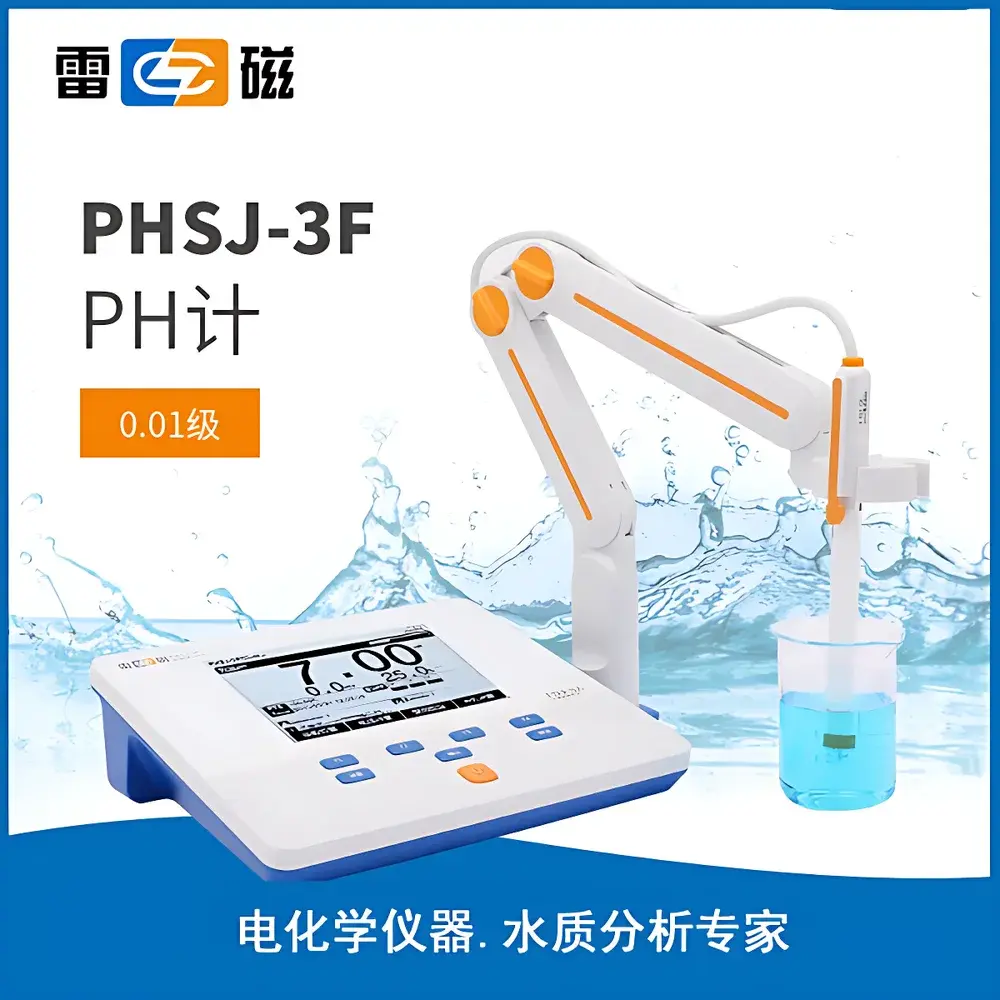
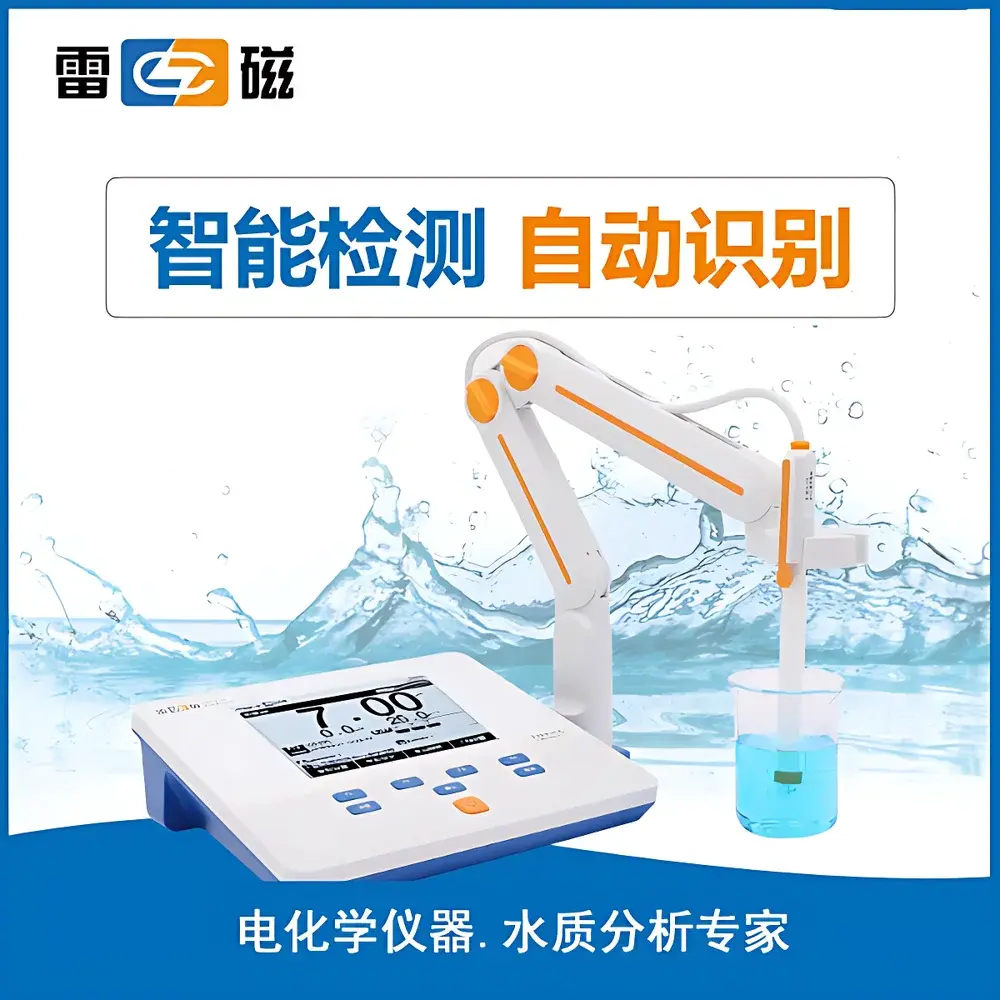
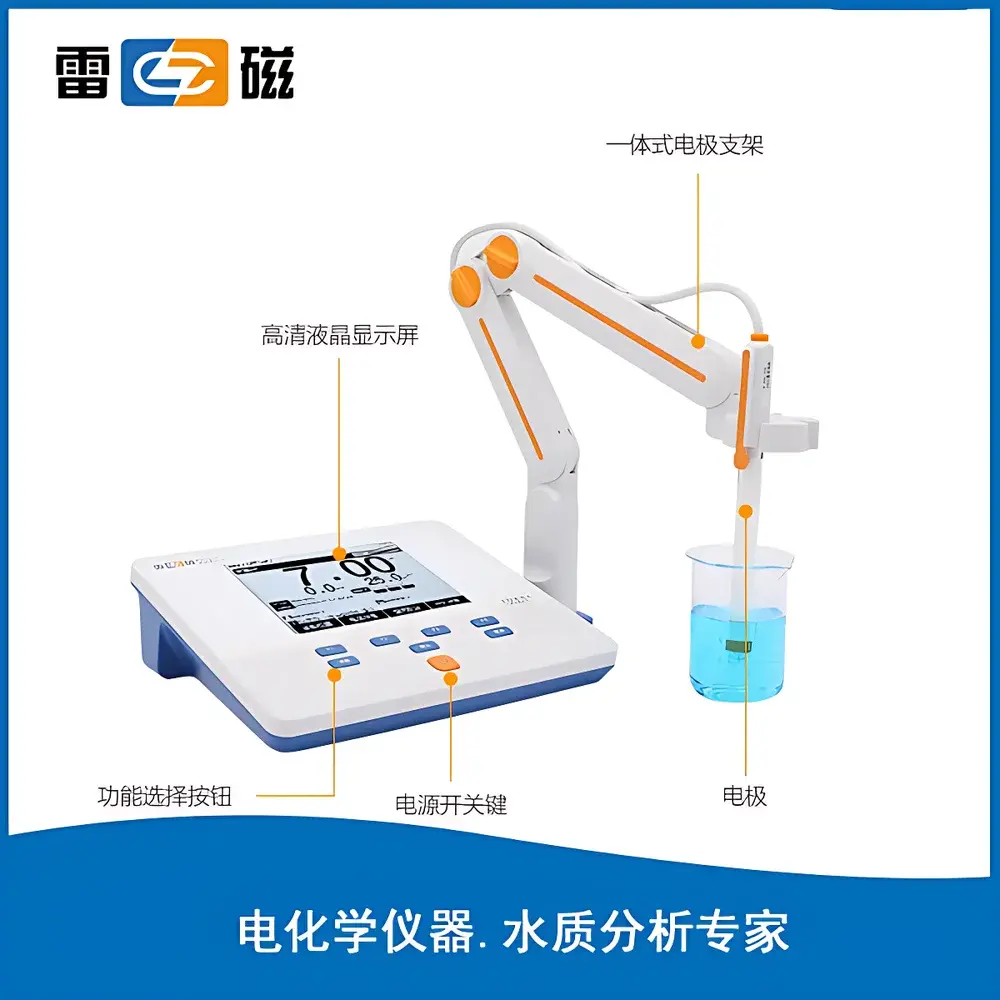
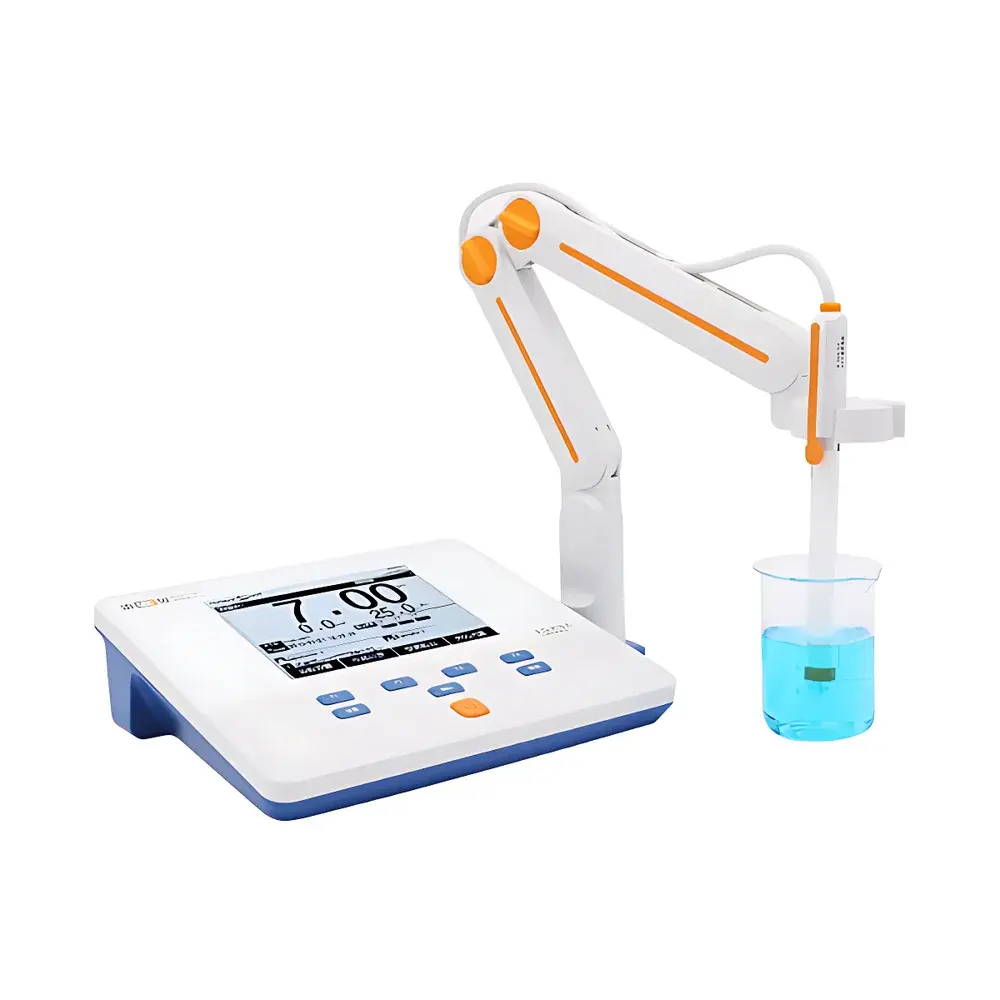
Leici PHSJ-3F Benchtop pH Meter
| Brand | Leici |
|---|---|
| Origin | Shanghai, China |
| Instrument Type | Benchtop |
| Parameter Types | pH / mV (ORP) / Temperature |
| Measurement Accuracy | ±0.01 pH ± 1 digit |
| pH Range | –2.00 to 20.00 |
| pH Resolution | 0.01 pH |
| Temperature Range | –5.0 to 135.0 °C |
| Temperature Resolution | 0.1 °C |
| mV Range | –1999 to +1999 mV |
| mV Resolution | 1 mV |
| Stability | (±0.01 pH ± 1 digit) / 3 h |
| Input Power | 9 V DC, 800 mA (center-positive) |
| Dimensions | 280 × 215 × 92 mm |
| Weight | 1 kg |
| Calibration | 1–3 point, auto-recognizes 5 standard buffer solutions (pH 4.01, 6.86, 7.00, 9.18, 10.01) |
| Data Storage | 500 measurement sets with GLP-compliant timestamping |
| Connectivity | USB interface for PC communication and serial printer output |
| Auto-Temperature Compensation (ATC) | Yes |
| Operating Modes | Smart-Read (auto-endpoint detection), Timed-Read (programmable interval storage), Cont-Read (continuous monitoring) |
| Electrode Status Monitoring | Yes |
| Firmware Upgrade Support | Yes |
| Power Protection | Non-volatile memory retains data during power loss |
Overview
The Leici PHSJ-3F is a high-precision benchtop pH meter engineered for routine and advanced laboratory applications in quality control, environmental testing, pharmaceutical manufacturing, and academic research. Based on potentiometric measurement principles, it determines hydrogen ion activity via a glass pH electrode and reference electrode pair, delivering stable, reproducible readings across an extended pH range from –2.00 to 20.00 — suitable for highly acidic, neutral, and strongly alkaline samples including concentrated caustic solutions and low-ionic-strength buffers. The instrument complies with IUPAC-recommended pH measurement methodology and supports traceable calibration against NIST-traceable buffer standards. Its robust architecture integrates a precision analog front-end with digital signal processing, minimizing drift and ensuring long-term stability per ISO 5725 (accuracy and precision of measurement methods).
Key Features
- Triple-parameter measurement capability: simultaneous real-time display of pH, mV (ORP), and temperature — essential for redox titrations and process validation.
- Intelligent endpoint recognition (Smart-Read mode) dynamically evaluates electrode response kinetics to determine measurement stability, reducing operator dependency and improving inter-user reproducibility.
- Programmable Timed-Read mode enables automated data capture at user-defined intervals (e.g., 15 s, 30 s, 1 min), supporting kinetic studies and batch stability monitoring under GLP/GMP conditions.
- Dedicated Cont-Read mode provides continuous streaming output for integration with external DAQ systems or SCADA interfaces via USB virtual COM port.
- Auto-buffer recognition logic identifies five common calibration standards (pH 4.01, 6.86, 7.00, 9.18, 10.01) without manual selection, minimizing setup errors and accelerating daily calibration workflows.
- Electrode health diagnostics monitor slope deviation and asymmetry potential, issuing alerts when performance falls outside ±5% slope tolerance or exceeds 30 mV zero-point offset — aligning with ASTM D1293 and USP electrode qualification criteria.
- Non-volatile flash memory preserves all 500 stored datasets (including date/time stamp, calibration history, electrode ID, and ambient temperature) even after unexpected power interruption.
Sample Compatibility & Compliance
The PHSJ-3F accommodates standard BNC-input combination electrodes and separate half-cells, enabling compatibility with specialized probes for non-aqueous solvents, high-viscosity gels, food matrices, and sterilized bioprocess streams. It meets the electrical safety requirements of IEC 61010-1:2010 (Class II, Pollution Degree 2) and electromagnetic compatibility per EN 61326-1:2013. Data storage adheres to GLP audit-trail requirements: each record includes operator ID (user-configurable), calibration verification status, electrode serial number (manually entered), and system timestamp. While not FDA 21 CFR Part 11–certified out-of-the-box, its secure USB export protocol and immutable log structure support validation under internal SOPs for regulated environments.
Software & Data Management
Measurement data exports as CSV files via USB connection to Windows/Linux/macOS hosts. The native file format includes column headers compliant with LIMS ingestion protocols (e.g., “Sample_ID”, “pH_Value”, “mV_Reading”, “Temp_C”, “Calibration_Date”, “Operator_Name”). No proprietary software installation is required; exported logs integrate directly with Excel, MATLAB, or enterprise analytics platforms. Print output supports ESC/POS command set for direct thermal or dot-matrix serial printers, producing hard-copy reports with header metadata (instrument ID, firmware version, calibration certificate reference). Firmware updates are delivered as signed binary packages via Leici’s authorized distributor portal, requiring physical USB key authentication to prevent unauthorized modification.
Applications
- Pharmaceutical QC: Dissolution testing per USP , buffer preparation verification, and cleaning validation rinse water analysis.
- Environmental labs: Surface water, wastewater, and soil leachate pH profiling per EPA Method 9040C and ISO 10523.
- Food & beverage: Fermentation monitoring (yogurt, beer, wine), acidulant titration endpoints, and shelf-life stability testing.
- Academic teaching: Electrochemistry labs covering Nernst equation derivation, liquid junction potential correction, and temperature coefficient analysis.
- Industrial process support: Boiler feedwater alkalinity control, electroplating bath management, and semiconductor wafer rinse monitoring.
FAQ
Does the PHSJ-3F support automatic temperature compensation (ATC)?
Yes — it accepts input from integrated or external Pt1000 RTD sensors and applies Nernstian temperature correction in real time using the built-in thermistor algorithm per ISO 3696.
Can I use non-Leici electrodes with this meter?
Yes — any BNC-compatible pH or ORP electrode meeting IEC 60746-1 impedance specifications (< 1 GΩ at 25°C) is fully functional.
Is calibration verification traceable to national standards?
Calibration is traceable when performed with NIST-certified buffer solutions; the instrument logs buffer lot numbers and expiration dates manually entered by the user.
What happens if power fails during measurement?
All active and historical data remain intact due to EEPROM-based memory architecture; no recalibration is required upon restart.
How frequently should I recalibrate the instrument?
Per ISO/IEC 17025:2017, recalibration is recommended before each analytical session or every 2 hours of continuous use — configurable alert thresholds are available in the maintenance menu.
Related Products






