
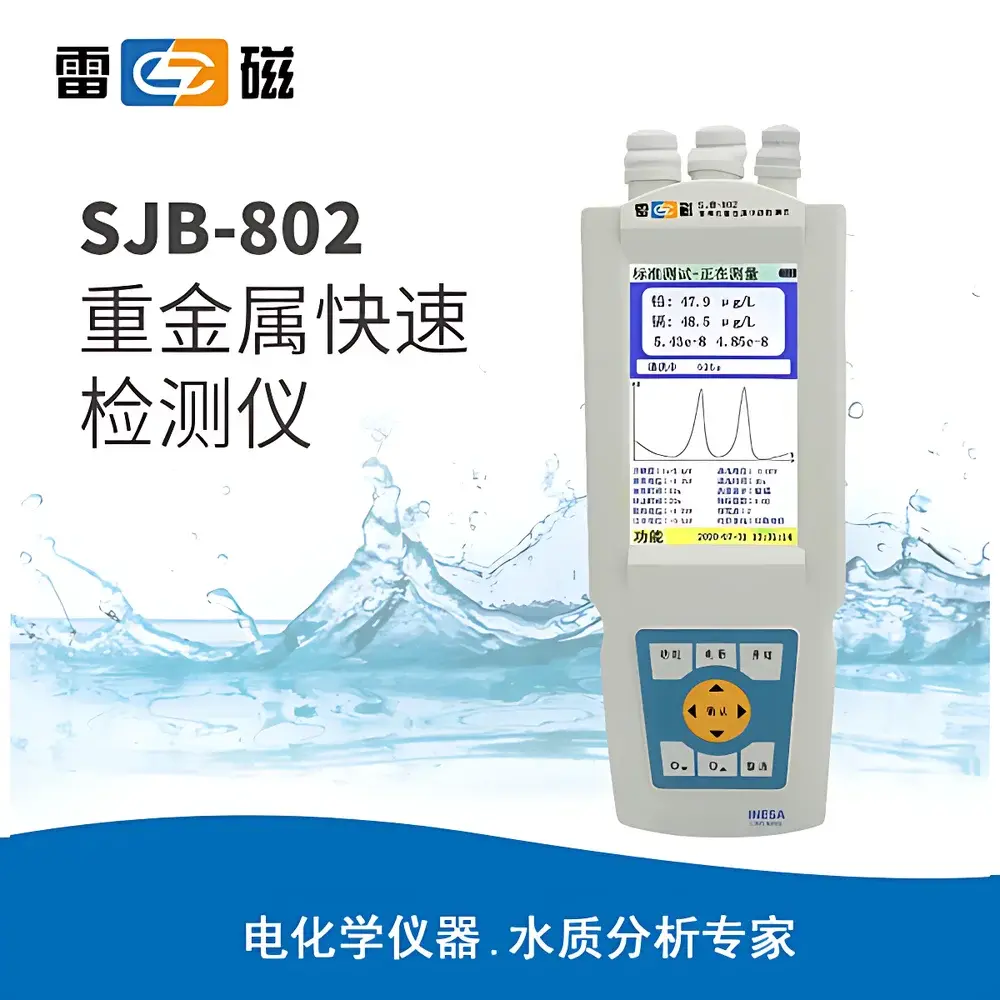
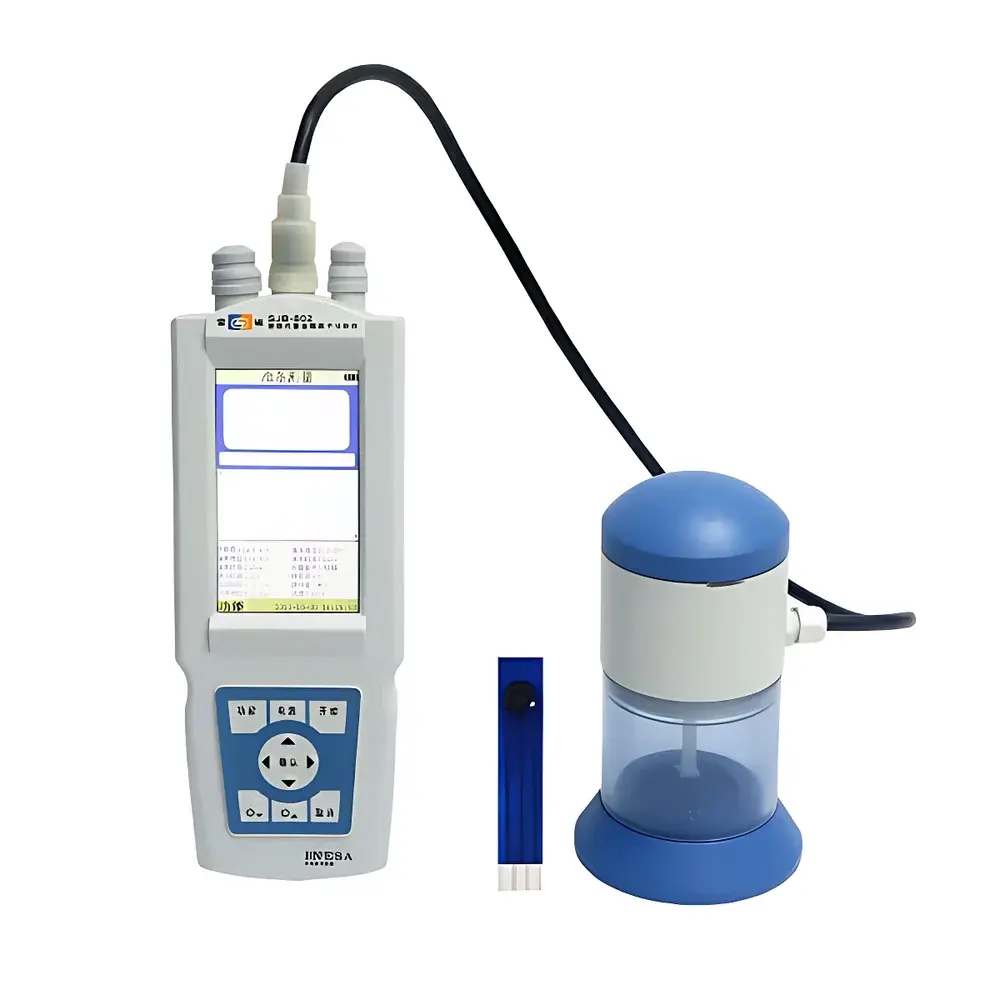
Leici SJB-802 Portable Heavy Metals Analyzer
| Brand | Leici |
|---|---|
| Origin | Shanghai, China |
| Model | SJB-802 |
| Instrument Type | Portable |
| Detection Principle | Anodic Stripping Voltammetry (ASV) |
| Detectable Metals | Pb, Cd, Cu, As, Hg, Zn, Se, Mn, Ni, Cr (dual/multi-parameter) |
| Accuracy | ≤ ±5% or ±3.0 µg/L (for Hg) |
| Detection Limit | Pb, Cd, As, Cu ≤ 0.5 µg/L |
| Electrode Systems | Triple-electrode configuration & disposable screen-printed electrodes (SPEs) |
| Measurement Time | <5 minutes per analysis |
| Data Storage | Up to 2000 records with GLP-compliant audit trail |
| Environmental Rating | IP65 |
| Power Supply | Rechargeable Ni-MH batteries (4×AA), USB power, AC adapter, or portable power bank |
| Compliance | Designed for field-deployable water quality testing in accordance with EPA Method 7000B, ISO 11929, and ASTM D3559/D5673 principles |
Overview
The Leici SJB-802 Portable Heavy Metals Analyzer is a field-deployable electrochemical instrument engineered for rapid, on-site quantification of toxic heavy metal ions in aqueous environmental samples. It operates on the principle of anodic stripping voltammetry (ASV), a well-established electroanalytical technique that combines pre-concentration of target metal ions onto a working electrode surface under controlled negative potential, followed by oxidative stripping and current measurement during a linear potential scan. This method delivers laboratory-grade sensitivity—sub-ppb detection limits—with the operational flexibility of handheld instrumentation. The SJB-802 supports dual electrode architectures: a robust three-electrode system (working, reference, counter) for high-precision lab- or field-based measurements, and a disposable screen-printed electrode (SPE) module optimized for rapid screening, low-cost operation, and minimal maintenance. Its compact form factor (≤1.2 kg), IP65-rated enclosure, and multi-mode power compatibility make it suitable for routine monitoring in rivers, lakes, drinking water distribution systems, wastewater effluents, and emergency response scenarios.
Key Features
- 4.3-inch high-brightness color LCD with intuitive menu-driven interface—no specialized training required
- Real-time visualization of assay progression: automatic calibration, electrode cleaning cycles, and ASV scan curves displayed dynamically during analysis
- Intelligent parameter guidance: on-screen alerts when selected sensitivity settings fall outside optimal range for sample matrix
- Dual electrode support: interchangeable triple-electrode cell for trace-level accuracy and SPE cartridges for high-throughput field screening
- Integrated magnetic stirring ensures uniform mass transport and reproducible deposition kinetics
- Preloaded analytical methods for 10 regulated metals: Pb, Cd, Cu, As, Hg, Zn, Se, Mn, Ni, Cr—compliant with WHO, EU Drinking Water Directive, and China’s GB 5749–2022
- Three standardized measurement modes: Quick Test (3-step workflow), Standard ASV, and Standard Addition—enabling matrix-matched quantification in complex waters
- GLP-compliant data handling: time-stamped records with operator ID, electrode lot tracking, and full audit trail; up to 2000 results stored internally + exportable via SD card or USB
- Multi-source power architecture: operates on 4×AA Ni-MH rechargeables, USB 5 V input (including smartphone chargers), 12 V DC vehicle adapters, or universal AC adapters
Sample Compatibility & Compliance
The SJB-802 is validated for direct analysis of untreated or filtered natural waters, tap water, groundwater, and treated wastewater (TDS ≤ 1000 mg/L, turbidity ≤ 10 NTU, pH 3–9). Sample pretreatment is limited to optional acidification (1% v/v HNO₃) for preservation. Its ASV methodology aligns with the fundamental electrochemical principles underpinning EPA Method 7000B (anodic stripping voltammetry for metals) and ISO 11929 (evaluation of detection capability in analytical chemistry). While not certified as a Class I medical device or FDA 510(k)-cleared instrument, its performance specifications meet the minimum requirements for regulatory screening under national environmental monitoring programs—including China’s “Environmental Monitoring Technical Specifications for Surface Water and Wastewater” (HJ/T 91–2002) and the European Union’s Water Framework Directive (2000/60/EC) Annex X priority substances list. All firmware and data management routines support ALCOA+ principles (Attributable, Legible, Contemporaneous, Original, Accurate, Complete, Consistent, Enduring, Available) for audit readiness.
Software & Data Management
Data acquisition and reporting are managed through REX Data Collection Software (Windows-compatible), which provides secure USB communication, batch report generation (PDF/CSV), and method validation templates. Internal firmware implements electronic signatures, user access levels (admin/operator), and immutable event logs—including electrode initialization, calibration history, and measurement metadata. Raw voltammograms and processed peak current/area values are retained alongside concentration results. Exported datasets include ISO/IEC 17025-aligned uncertainty estimates derived from repeatability studies and standard deviation of calibration slopes. No cloud connectivity or remote telemetry is embedded—ensuring data sovereignty and compliance with institutional IT security policies.
Applications
- Field-based surveillance of lead and copper in municipal drinking water systems (e.g., post-flushing compliance checks)
- Rapid assessment of arsenic contamination in shallow aquifers across rural and peri-urban regions
- On-site verification of wastewater treatment plant effluent for Cd, Ni, and Cr(VI) prior to discharge
- Emergency response screening following industrial spills or mining tailings breaches
- Academic research in environmental electrochemistry, including speciation studies using ligand-modified SPEs
- Regulatory monitoring programs requiring portable, GLP-aligned instrumentation without laboratory infrastructure
FAQ
What electrode configurations does the SJB-802 support?
It accepts both reusable three-electrode cells (glassy carbon working electrode, Ag/AgCl reference, platinum counter) and single-use screen-printed electrodes pre-coated with bismuth or mercury films.
Can the instrument quantify metals in seawater or high-salinity samples?
Direct analysis is not recommended due to chloride interference and elevated background current; dilution or solid-phase extraction pretreatment is required for salinities >5 ppt.
Is method validation documentation available for regulatory submissions?
Yes—Leici provides a comprehensive Performance Verification Report (PVR) including limit of detection (LOD), limit of quantitation (LOQ), linearity (R² ≥ 0.995), repeatability (RSD ≤ 3%), and spike recovery (85–115%) across all 10 preloaded analytes.
How often must the triple-electrode system be polished or reconditioned?
Glassy carbon electrodes require mechanical polishing with 0.05 µm alumina slurry every 20–30 measurements; SPEs are discarded after single use—eliminating maintenance entirely.
Does the instrument comply with FDA 21 CFR Part 11 requirements?
While it supports electronic signatures and audit trails, full Part 11 compliance requires institutional validation protocols; the system is designed to be 21 CFR Part 11-ready upon customer implementation of procedural controls.
Related Products







