
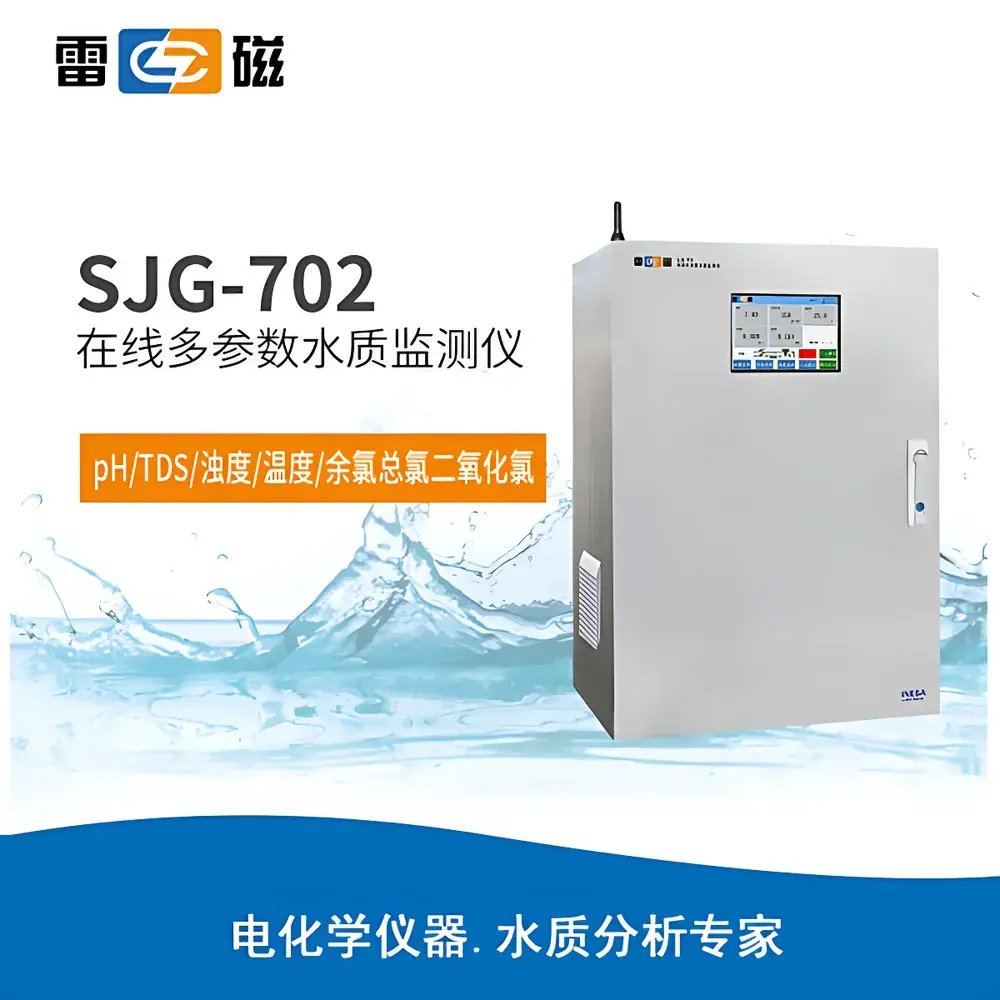
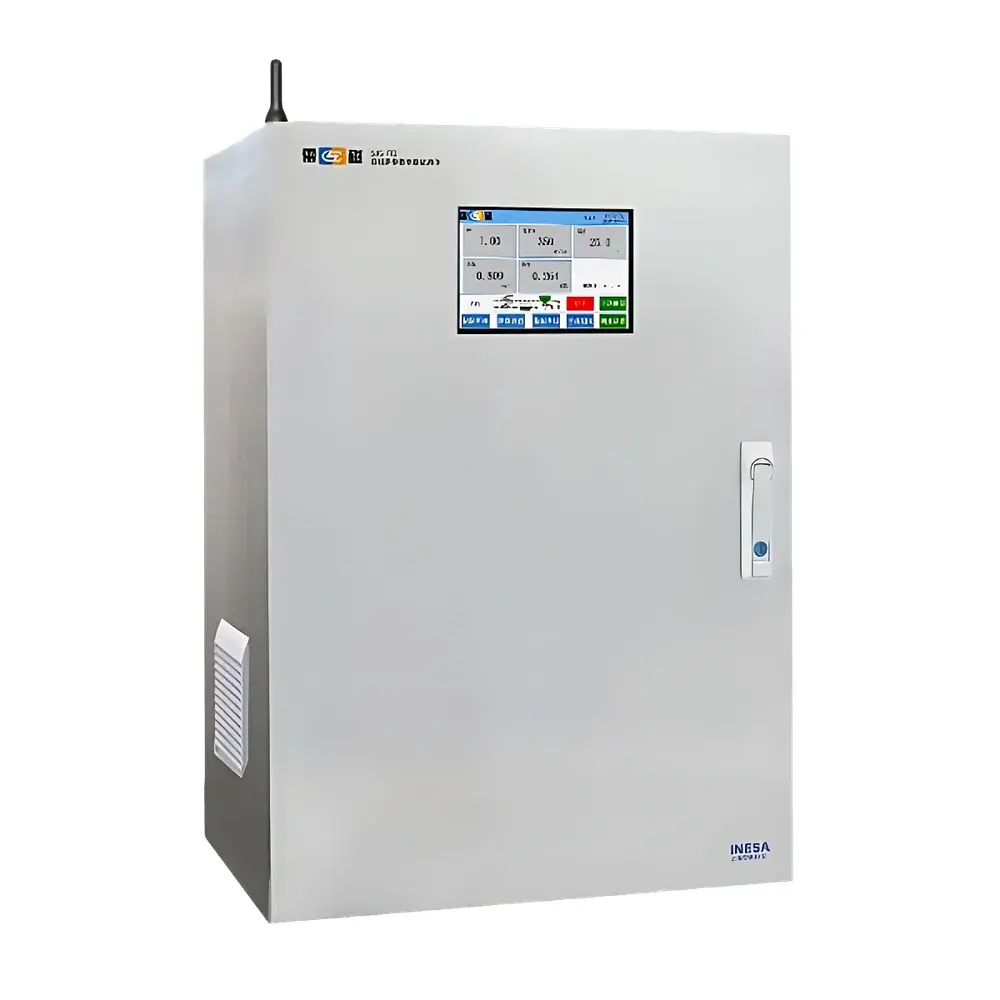
Leici SJG-702 Online Multi-Parameter Water Quality Monitor
| Brand | Leici |
|---|---|
| Origin | Shanghai, China |
| Model | SJG-702 |
| Measurement Principles | pH & conductivity & TDS (electrode method), turbidity (90° light scattering), free/total chlorine & chlorine dioxide (amperometric membrane electrode) |
| Measurement Ranges | pH 0.00–14.00 (±0.05 pH) |
| Compliance | CE, RoHS |
| Power Supply | AC 220 V ±10%, 50 Hz (solar option available) |
| Dimensions | 730 × 520 × 330 mm |
| Weight | 20 kg |
| Communication | RS-232 / RS-485 |
Overview
The Leici SJG-702 Online Multi-Parameter Water Quality Monitor is an industrial-grade, continuously operating analytical platform engineered for real-time, unattended monitoring of critical water quality parameters in municipal and commercial water distribution systems. It operates on well-established electrochemical and optical measurement principles: pH, conductivity, TDS, and temperature are measured via calibrated ion-selective and conductometric electrodes; turbidity is determined using standardized 90° nephelometric light scattering (in accordance with ISO 7027 and EPA Method 180.1); and residual disinfectants—including free chlorine, total chlorine, and chlorine dioxide—are quantified using amperometric membrane electrodes with gas-permeable hydrophobic membranes. This architecture eliminates pH-dependent interference in chlorine measurements, enabling stable, drift-resistant performance across variable source water chemistries. Designed for deployment in drinking water treatment plants, secondary distribution networks, potable water storage tanks, swimming pool circulation systems, and direct-consumption water dispensers, the SJG-702 meets functional requirements aligned with ISO 5667-2, ASTM D1293 (pH), ASTM D512 (chlorine), and WHO Guidelines for Drinking-water Quality.
Key Features
- Modular sensor architecture: Independent, hot-swappable probe modules for pH, conductivity/TDS, turbidity, and disinfectant species—enabling flexible configuration and field-replaceable maintenance without system shutdown.
- Intelligent turbidity measurement cell: Integrated anti-bubble chamber, self-cleaning rotating brush mechanism, and automated sediment purge cycle to prevent fouling and ensure long-term optical path integrity.
- Four operational measurement modes: Continuous real-time acquisition, programmable interval sampling, time-triggered scheduled measurement, and manual on-demand analysis—supporting adaptive monitoring strategies per application requirement.
- Full-featured 7-inch color TFT touchscreen interface: Graphical real-time trend display, intuitive parameter navigation, embedded calibration wizards, and multilingual UI support (English, Spanish, French).
- Comprehensive environmental resilience: IP65-rated enclosure; operating ambient range 0–40 °C, ≤90% RH non-condensing; integrated pressure regulation for inlet water lines (0.1–0.6 MPa); dual-power capability (AC 220 V or solar + battery backup).
- Robust data integrity safeguards: Automatic upper/lower alarm thresholds with relay output activation; timestamped event logging; power-fail recovery with non-volatile memory retention; configurable auto-zero and span calibration routines.
Sample Compatibility & Compliance
The SJG-702 is validated for use with potable water matrices meeting national and international regulatory definitions of drinking water (e.g., GB 5749–2022, EU Directive 98/83/EC, US EPA Safe Drinking Water Act). Its sensor suite is chemically compatible with chlorinated, chloraminated, and chlorine-dioxide-treated waters, as well as low-conductivity purified water streams (≥0.1 µS/cm). All electrochemical sensors utilize solid-state reference systems and selective membranes compliant with ISE and amperometric sensor standards (ISO 11277, EN 27888). The instrument carries CE marking under the EU Electromagnetic Compatibility Directive 2014/30/EU and RoHS 2011/65/EU. While not certified to FDA 21 CFR Part 11 out-of-the-box, its audit trail functionality—including user login timestamps, calibration history, and alarm event logs—supports GLP/GMP-aligned validation protocols when deployed in regulated QA/QC environments.
Software & Data Management
Data acquisition and remote supervision are supported through dual communication pathways: standard RS-232/RS-485 serial interfaces (Modbus RTU protocol) for integration into SCADA or PLC-based infrastructure, and optional LTE/WiFi-enabled wireless telemetry for cloud-based platform synchronization. Raw and processed values—including raw mV signals, compensated readings, and diagnostic flags—are transmitted at user-defined intervals (1 sec to 24 h). Local storage retains ≥30 days of minute-interval data (14,400 records) with cyclic overwrite. Remote firmware updates, configuration cloning, and multi-device fleet management are facilitated via Leici’s WebConfigurator utility—a browser-based tool requiring no client installation. All exported CSV or JSON datasets include ISO 8601 timestamps, sensor ID tags, and measurement uncertainty metadata, facilitating traceability in ISO/IEC 17025-accredited laboratories.
Applications
- Real-time compliance verification at point-of-entry (POE) and point-of-use (POU) locations in municipal water supply networks.
- Automated surveillance of secondary water tanks and rooftop reservoirs to detect stagnation-induced microbiological risk indicators (e.g., chlorine decay, turbidity spikes).
- Continuous disinfectant residual control in swimming pool recirculation loops, ensuring adherence to CDC Model Aquatic Health Code (MAHC) thresholds.
- Performance validation of UV, ozone, or membrane filtration units via upstream/downstream paired monitoring of turbidity and oxidant demand.
- Field-deployable water safety plan (WSP) monitoring for WHO-endorsed Water Safety Plans in healthcare facilities and schools.
FAQ
Does the SJG-702 require pH compensation for chlorine measurements?
No. Its amperometric chlorine and chlorine dioxide sensors incorporate hydrophobic gas-permeable membranes that selectively transmit dissolved molecular species only, rendering measurements independent of sample pH variations. No software or manual pH correction is needed.
Can the turbidity module operate reliably in high-sediment environments?
Yes. The dedicated measurement cell includes a vortex-assisted bubble removal chamber, motor-driven cleaning brush, and timed automatic drain valve actuation—reducing maintenance frequency to ≤1x per month under typical urban water conditions.
Is Modbus TCP supported for Ethernet integration?
The base unit supports Modbus RTU over RS-485. Modbus TCP requires the optional Ethernet-to-RS-485 gateway module (Leici EGM-100), sold separately.
What is the minimum detectable turbidity level, and how is it verified?
The instrument achieves 0.01 NTU resolution per ISO 7027 Annex B. Factory calibration uses NIST-traceable Formazin standards (0.02, 1.0, 20.0, 100.0 NTU); users may perform two-point verification with supplied calibration kits.
How is data security handled during wireless transmission?
LTE/WiFi transmissions employ TLS 1.2 encryption with device-authenticated MQTT sessions. Credentials are stored in hardware-secured EEPROM; no plaintext credentials reside in firmware or configuration files.







