
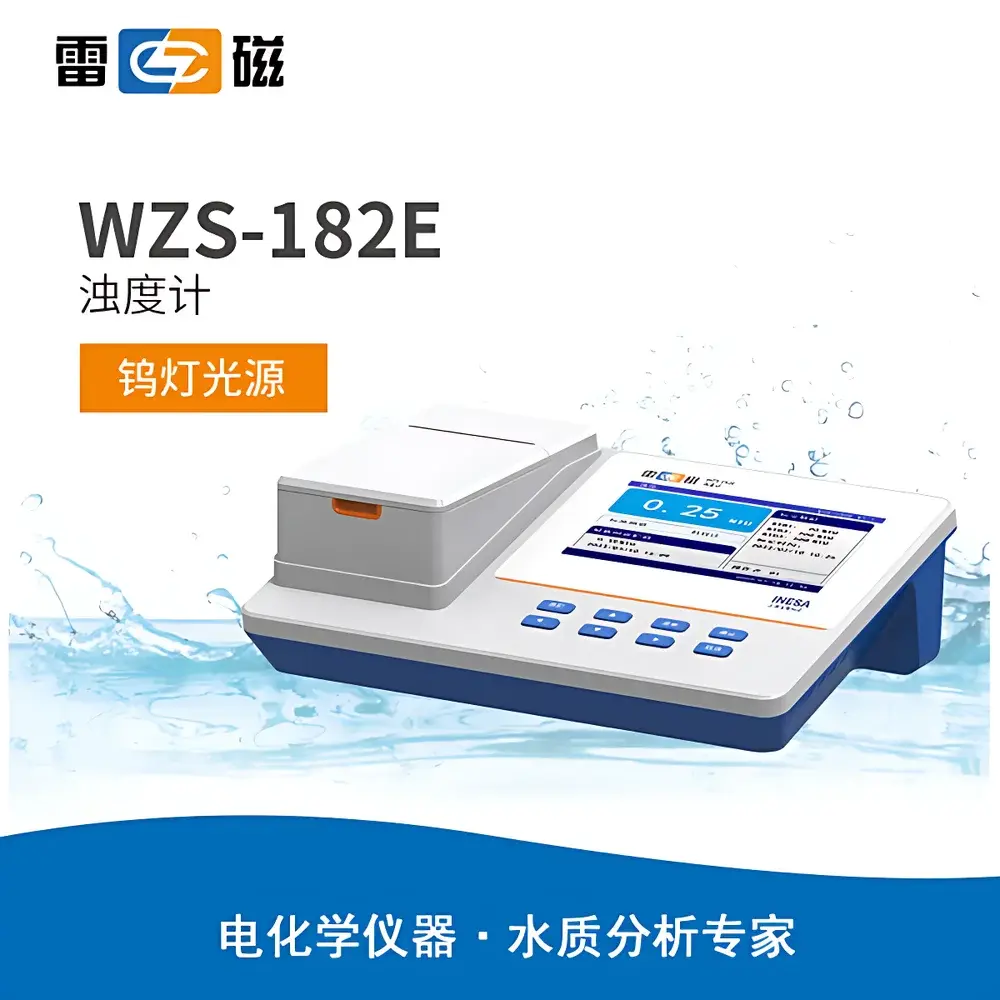
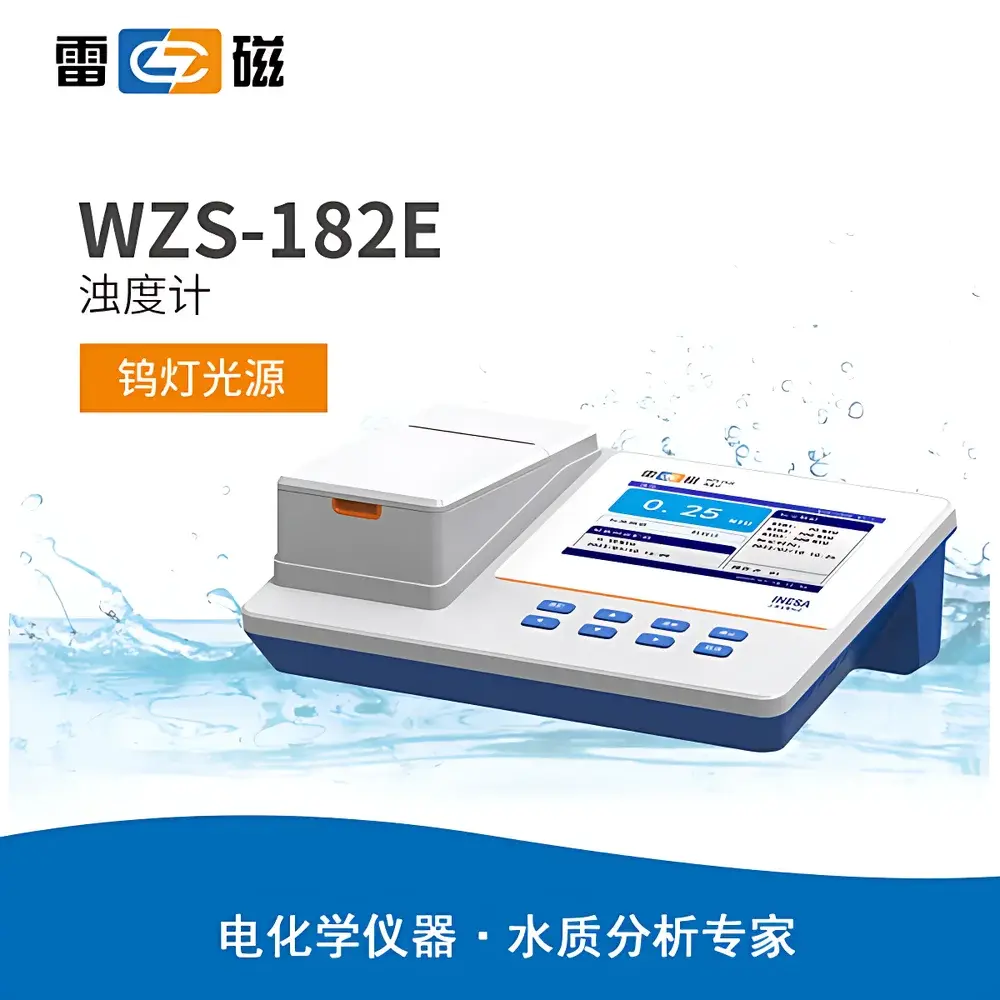
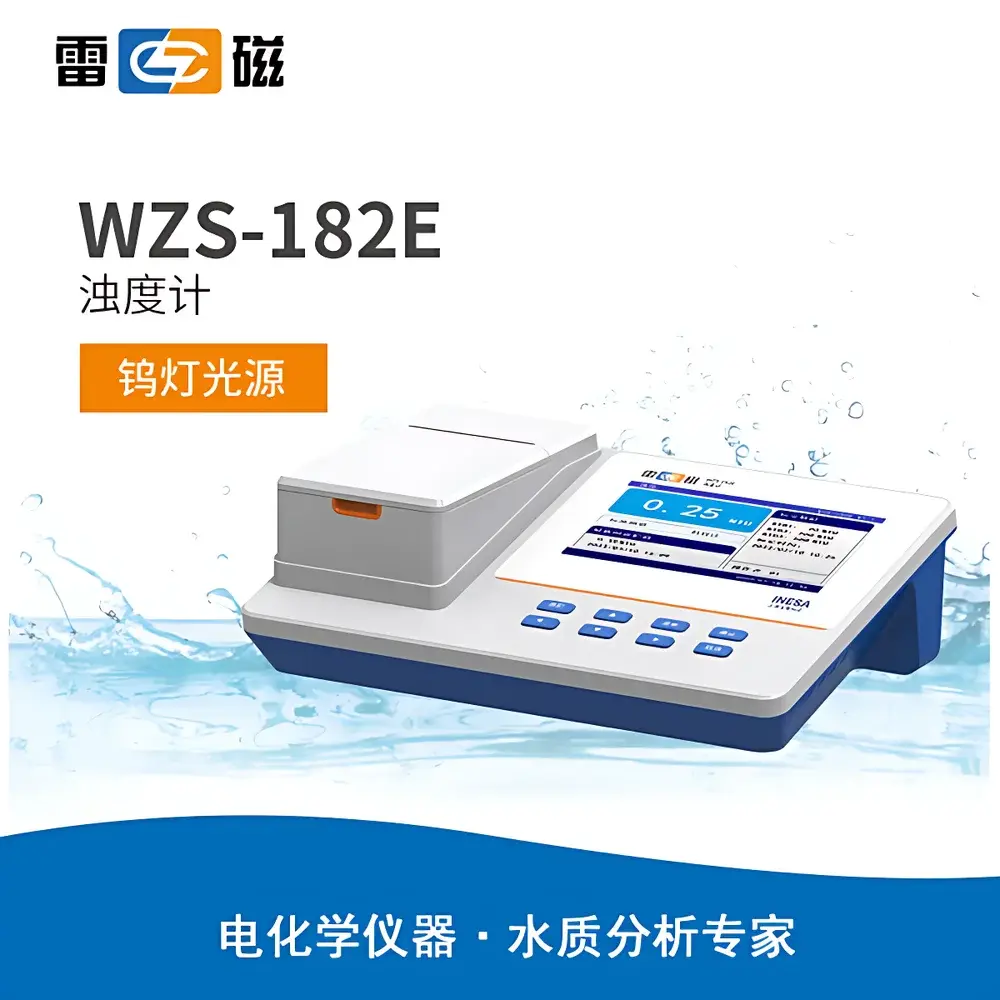
Leici WZS-182E Benchtop Turbidimeter
| Brand | Leici |
|---|---|
| Origin | Shanghai, China |
| Manufacturer Type | Authorized Distributor |
| Product Origin | Domestic (China) |
| Model | WZS-182E |
| Price | USD 980 (FOB Shanghai) |
| Form Factor | Benchtop / Laboratory |
| Measurement Range | 0.00–9.99 NTU |
| Resolution | 0.01 / 0.1 / 1 NTU (auto-ranging) |
| Operating Temperature | 5–35 °C |
| Accuracy | ±6% of reading |
| Light Source | Tungsten-halogen lamp |
| Measurement Principle | Nephelometric (90° scatter) and Ratio nephelometric-scatter/transmission |
| Compliance | USEPA Method 180.1, HJ 1075–2019, JJG 880–2006 |
| Display | 5.7-inch color LCD with tactile keypad |
| Protection Rating | IP54 |
| Calibration Standards Included | Long-life turbidity standards at 20, 200, and 500 NTU |
| Data Storage | 1000 measurement records |
| Interface | RS-232 (for thermal printer), USB-B (for PC communication) |
| Software Support | Dedicated Leici turbidity data management software (Windows-compatible) |
| GLP Features | Audit-trail enabled timestamped records, user ID logging, calibration history, factory reset with zero & calibration value recovery |
Overview
The Leici WZS-182E is a benchtop nephelometric turbidimeter engineered for precise, repeatable turbidity quantification in environmental monitoring, municipal water quality control, and laboratory-based drinking water compliance testing. It operates on the fundamental principle of nephelometry—measuring the intensity of light scattered at a 90° angle by suspended particles in an aqueous sample—as defined in USEPA Method 180.1 and codified in Chinese national standard HJ 1075–2019. To enhance robustness across variable sample matrices, the instrument also supports ratio-mode measurement, which simultaneously detects both scattered and transmitted light intensities to compensate for color interference, high absorbance, or particulate settling effects. This dual-optical-path architecture ensures improved accuracy for low-to-moderate turbidity samples (0.00–9.99 NTU), particularly in applications where sample clarity, chromaticity, or particle size distribution may introduce systematic bias in single-angle detection.
Key Features
- 5.7-inch high-contrast color LCD display with intuitive tactile keypad navigation—optimized for glove-compatible operation in wet-lab environments
- Tungsten-halogen light source delivering stable spectral output in the visible range (400–600 nm), compliant with photometric requirements of ISO 7027 and USEPA 180.1
- Auto-ranging resolution switching (0.01 NTU in 0–0.99 NTU range; 0.1 NTU in 1.0–9.9 NTU range; 1 NTU above 10 NTU—though instrument upper limit remains 9.99 NTU)
- Three standardized turbidity units selectable per measurement: NTU (Nephelometric Turbidity Units), FNU (Formazin Nephelometric Units per ISO 7027), and EBC (European Brewery Convention units)
- Three measurement modes: Standard (single-point reading), Average (up to 10 consecutive readings, mean + SD reported), and Equilibrium (continuous monitoring until signal stabilizes within ±0.02 NTU over 10 s)
- Integrated zero-point calibration and multi-point (1–3 point) turbidity calibration using supplied long-term stability standards (20/200/500 NTU)
- IP54-rated enclosure providing protection against dust ingress and water splashes—suitable for shared analytical workspaces and field-deployable lab carts
Sample Compatibility & Compliance
The WZS-182E is validated for use with clear to moderately turbid aqueous samples including raw surface water, filtered potable water, wastewater effluents, and process streams in food & beverage production. Its optical design accommodates standard 25-mm round glass cuvettes (included), with strict adherence to pathlength and surface quality specifications outlined in JJG 880–2006. The instrument meets regulatory data integrity requirements under Good Laboratory Practice (GLP): each stored record contains embedded metadata—date/time stamp, operator ID (configurable), measurement mode, unit, calibration status, and ambient temperature. Full traceability is maintained through non-volatile memory retention during power loss (built-in capacitor-backed RAM). All firmware and calibration logic are designed to support audit readiness for ISO/IEC 17025-accredited laboratories and routine EPA or MEE (Ministry of Ecology and Environment, P.R.C.) inspections.
Software & Data Management
Data handling is implemented via two parallel pathways: direct RS-232 output to certified thermal printers (e.g., Epson TM-T20II) for immediate hardcopy reporting, and USB-B connection to Windows PCs running Leici’s proprietary TurbiLink™ software. TurbiLink™ enables batch export to CSV or PDF, graphical trend visualization (time-series or calibration curves), automated report generation with institutional headers, and secure archiving compliant with 21 CFR Part 11 principles—including electronic signature prompts, user-level access controls, and immutable audit logs. All measurement files retain embedded calibration history and system diagnostic flags, ensuring full forensic traceability from acquisition to archival.
Applications
- Drinking water quality verification per GB 5749–2022 (Sanitary Standard for Drinking Water)
- Effluent monitoring in municipal wastewater treatment plants (WWTPs) aligned with HJ 91.1–2019
- Process control in bottled water and soft drink manufacturing lines
- Educational laboratory instruction in environmental chemistry and instrumental analysis courses
- Calibration verification and performance qualification of inline turbidity sensors
- Field-deployable reference measurements during portable sensor validation campaigns
FAQ
Does the WZS-182E comply with ISO 7027 for formazin-based calibration?
Yes—the instrument’s optical geometry, detector spectral response, and calibration protocol are fully aligned with ISO 7027:2016 requirements for formazin-equivalent turbidity measurement.
Can it measure samples with significant coloration, such as humic-rich groundwater?
Yes—ratio-mode (scatter/transmission) measurement minimizes interference from sample absorbance, enabling more reliable results in yellow-to-brown colored waters.
Is the 200 NTU and 500 NTU standard suitable for daily verification beyond initial calibration?
These long-life standards are certified for ≥12 months when stored in amber glass vials at 4–25 °C and protected from UV exposure; they are intended for periodic performance verification and recalibration as required by internal QA protocols.
What happens to stored data during unexpected power interruption?
All 1000 measurement records, along with calibration parameters and user settings, are preserved in non-volatile memory; no data loss occurs due to transient power loss.
Is firmware upgrade supported, and how is it performed?
Firmware updates are distributed quarterly via Leici’s secure customer portal and installed via USB drive using guided on-instrument prompts—no third-party tools or service engineer required.



