
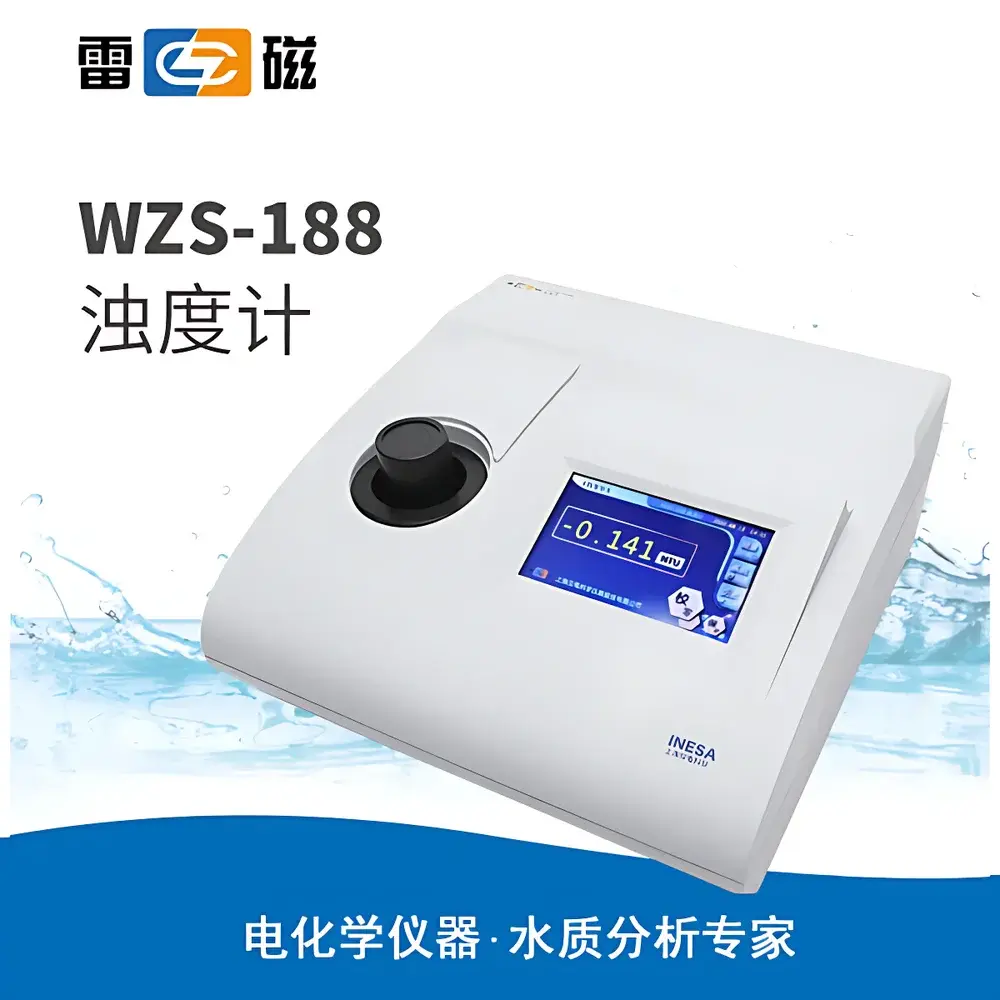
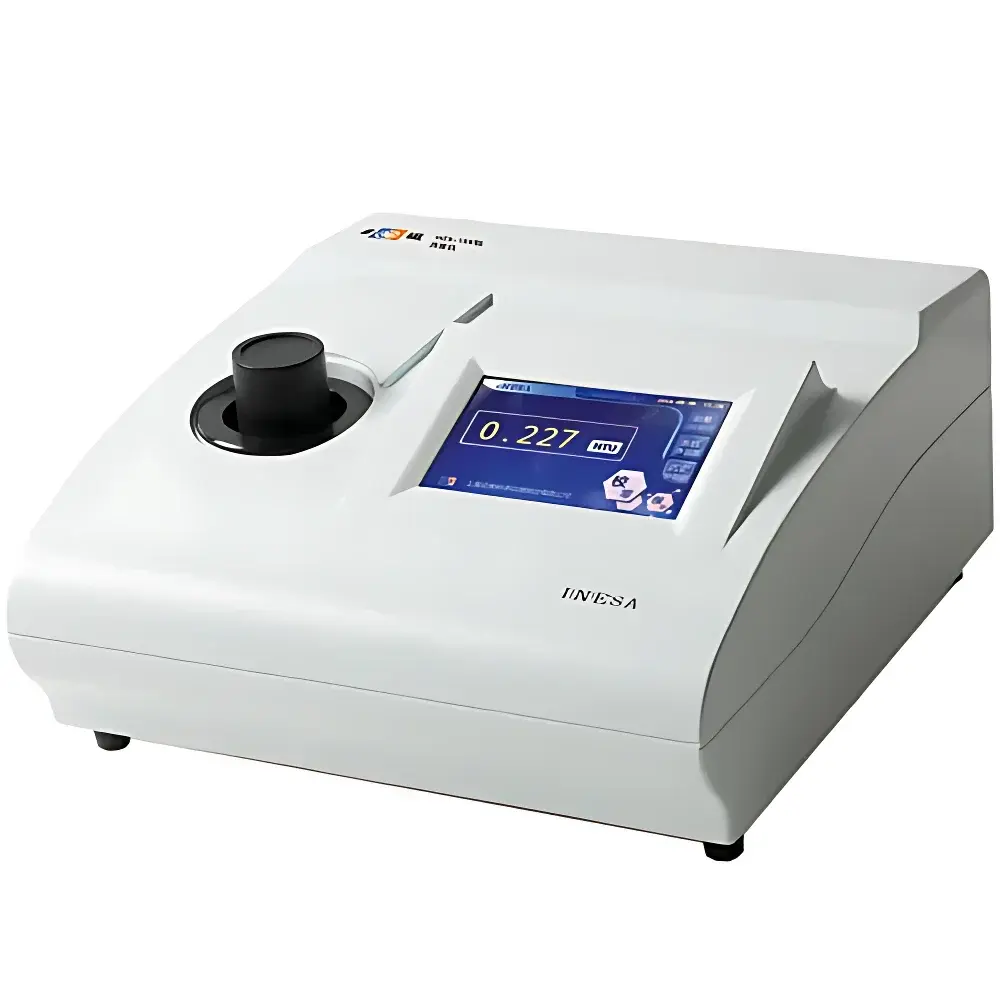
Leici WZS-188 Benchtop Turbidimeter
| Brand | Leici |
|---|---|
| Origin | Shanghai, China |
| Manufacturer Type | Authorized Distributor |
| Origin Category | Domestic (China) |
| Model | WZS-188 |
| Price | USD 1,160 (approx.) |
| Form Factor | Benchtop / Laboratory |
| Measurement Range | 0.000–4000 NTU |
| Accuracy | ≤ ±6 % |
| Repeatability | ≤ 0.5 % |
| Stability | ≤ ±0.5 % FS |
| Zero Drift | ≤ ±0.5 % FS |
| Dimensions | 358 × 323 × 160 mm |
| Weight | 3 kg |
| Light Source | Tungsten Halogen Lamp |
| Compliance | EPA Method 180.1 |
| Calibration | Up to 7-point user calibration with factory restore function |
| Data Storage | 1000 measurement records |
| Interfaces | USB + RS-232 |
| GLP Support | Yes, with audit-ready timestamped data logging |
Overview
The Leici WZS-188 Benchtop Turbidimeter is a precision optical instrument engineered for quantitative determination of turbidity in aqueous and transparent liquid samples via nephelometric measurement — the detection of scattered light at a 90° angle relative to the incident beam. Operating in strict accordance with U.S. Environmental Protection Agency (EPA) Method 180.1, the instrument employs a stable tungsten-halogen lamp as its broadband visible-light source, ensuring spectral consistency across repeated measurements and compatibility with standardized calibration protocols. Designed for routine quality control and regulatory compliance testing, the WZS-188 delivers traceable, reproducible turbidity values in Nephelometric Turbidity Units (NTU), supporting applications ranging from drinking water validation to pharmaceutical process stream monitoring. Its four auto-ranging measurement segments (0.000–20.00 NTU, 20.01–200.0 NTU, 200.1–2000 NTU, and 2001–4000 NTU) eliminate manual range selection while preserving resolution across low- and high-turbidity regimes.
Key Features
- Nephelometric detection geometry compliant with EPA Method 180.1 and ISO 7027 principles, optimized for sensitivity in the 0.000–4000 NTU range
- Four-step automatic range switching with seamless transition between sub-ranges to maintain optimal signal-to-noise ratio
- Up to seven-point user-defined calibration using certified formazin or polymer standards; factory calibration data can be restored at any time
- Average measurement mode (2–10 cycles) mitigates transient fluctuations caused by particle settling, Brownian motion, or flow-induced turbulence
- Full GLP (Good Laboratory Practice) functionality: each stored record includes sample ID, operator ID, date/time stamp, calibration status, and measurement mode
- Dual communication interfaces — isolated RS-232 and standard USB-B — enabling direct connection to laboratory PCs, LIMS systems, or thermal printers for hard-copy reporting
- Robust benchtop architecture with EMI-shielded optical chamber, temperature-stabilized detector electronics, and anti-vibration base design
Sample Compatibility & Compliance
The WZS-188 accepts standard 25-mm round glass cuvettes (10-mm pathlength) and supports both clear and highly scattering samples without dilution in the 0.000–20.00 NTU range. For samples exceeding 2000 NTU, optional dilution modules or pre-filtration workflows are recommended to maintain linearity and avoid multiple scattering artifacts. The instrument meets fundamental requirements of ISO 7027:2016 (optical design), ASTM D6508-21 (turbidity measurement in industrial waters), and USP (turbidity assessment in purified water and water for injection). While not inherently 21 CFR Part 11–compliant, its audit-trail-capable data storage and immutable timestamping support GxP-aligned documentation when integrated with validated PC software.
Software & Data Management
Internal memory retains up to 1000 fully timestamped measurement records, each containing raw signal intensity, calculated NTU value, calibration reference, and environmental metadata (e.g., ambient temperature if external probe is connected). Data export is performed via ASCII-formatted CSV files through USB mass-storage emulation or real-time streaming via RS-232 (ASCII protocol, 9600 baud, no parity). Optional Leici LabLink™ PC software (v3.2+) provides advanced features including calibration curve visualization, statistical trend analysis (RSD, min/max/mean), automated report generation (PDF/Excel), and secure user access control with role-based permissions — facilitating compliance with internal QA procedures and external audits.
Applications
- Drinking water treatment: verification of coagulation/flocculation efficiency and final filter effluent clarity per WHO and EPA guidelines
- Pharmaceutical manufacturing: monitoring of purified water (PW) and water for injection (WFI) systems in accordance with USP and EU Annex 1
- Food & beverage QC: assessment of juice clarification, beer haze stability, and dairy processing rinse water cleanliness
- Power plant chemistry: boiler feedwater turbidity surveillance to prevent turbine deposition and corrosion initiation
- Environmental labs: field-deployable lab verification of surface water, wastewater influent/effluent, and sediment-laden runoff samples
- Academic research: kinetic studies of particle aggregation, flocculant dosing optimization, and membrane fouling characterization
FAQ
Does the WZS-188 comply with ISO 7027:2016?
Yes — its 90° nephelometric optical configuration, tungsten-halogen spectral output, and calibrated response curve align with the performance criteria defined in ISO 7027:2016 for laboratory turbidimeters.
Can I use non-formazin standards for calibration?
Yes; the instrument supports user-defined calibration with traceable polymer standards (e.g., AMCO Clear, Stabical) provided their NTU equivalence is documented and entered during setup.
Is the USB interface compatible with modern Windows/macOS systems?
Yes — the device appears as a standard USB mass-storage device; no driver installation is required for file transfer. Real-time RS-232 streaming requires terminal emulation or Leici LabLink™ software.
What maintenance is required to ensure long-term accuracy?
Quarterly cleaning of the cuvette compartment and optical windows with lens-grade tissue and isopropanol; annual verification against primary standard (e.g., NIST-traceable formazin) is recommended for regulated environments.
Does the instrument support password-protected user accounts?
No — user-level security is implemented exclusively in the optional LabLink™ PC software; the standalone unit supports operator ID entry but no access control.





