
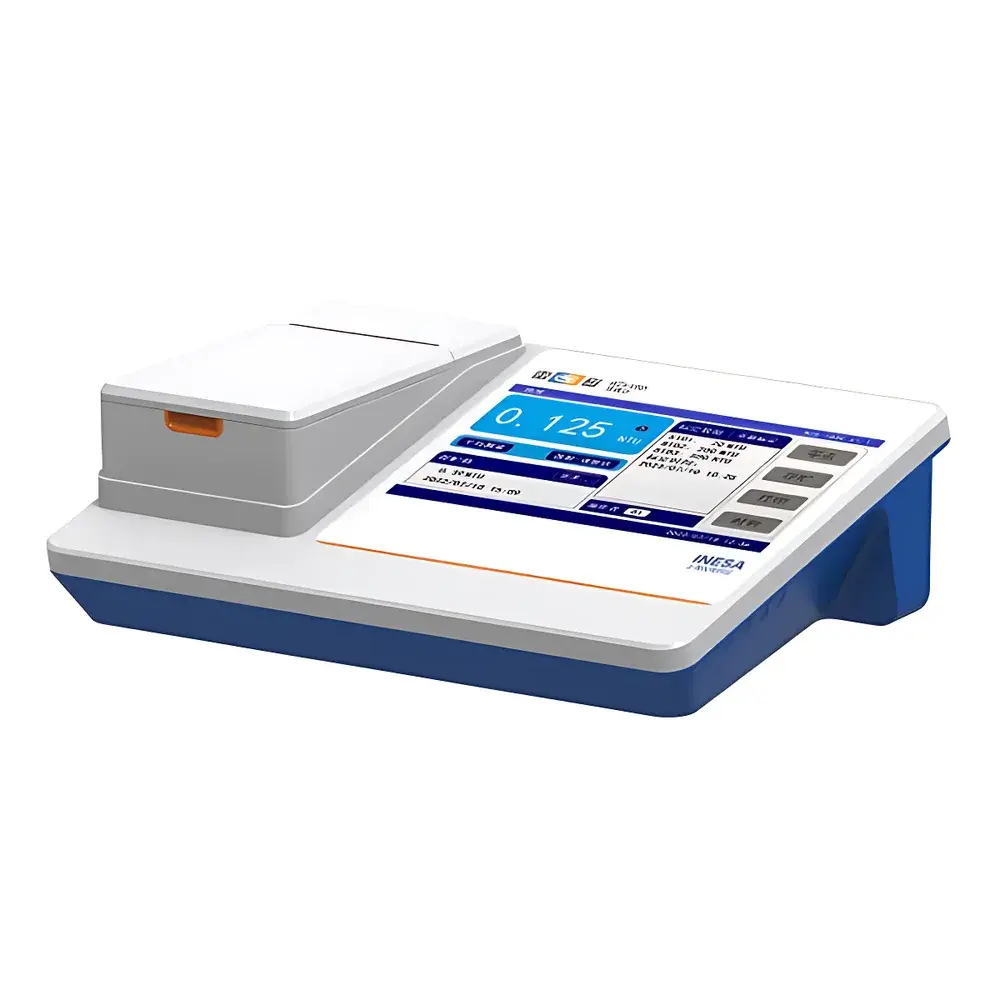
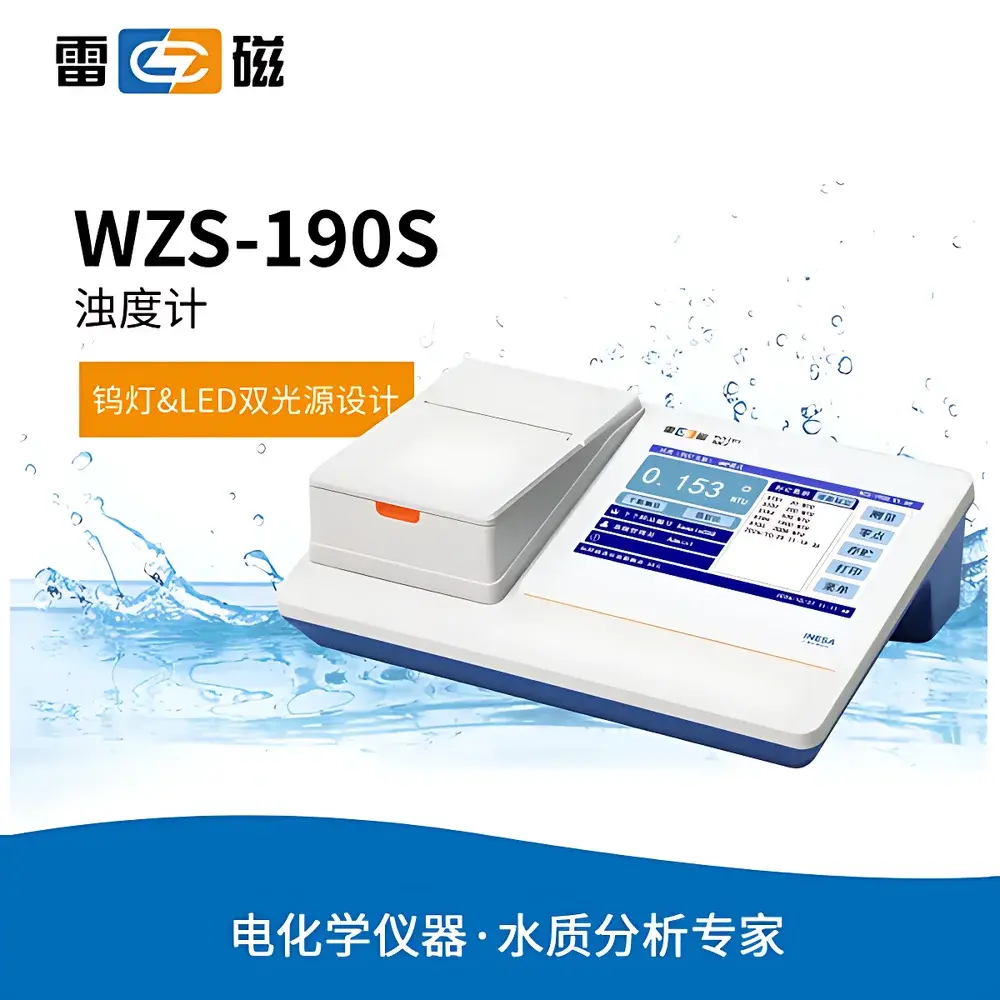
Leici WZS-190S Benchtop Turbidimeter
| Brand | Leici |
|---|---|
| Origin | Shanghai, China |
| Manufacturer Type | Direct Manufacturer |
| Regional Category | Domestic (China) |
| Model | WZS-190S |
| Price Range | USD 1,400–2,100 |
| Instrument Type | Benchtop / Laboratory |
| Measurement Range | 0–4000 NTU (tungsten lamp), 0–2000 NTU (860 nm LED) |
| Resolution | 0.001 NTU (lowest range) |
| Accuracy | ±6% FS |
| Repeatability | ≤0.5% |
| Zero Drift | ±0.5% FS / 30 min |
| Stability | ±0.5% FS / 30 min |
| Light Sources | Dual-source — Tungsten lamp (400–600 nm, compliant with US EPA Method 180.1 & HJ 1075-2019), 860 nm LED (compliant with ISO 7027 & HJ 1075-2019) |
| Calibration Points | Up to 8-point (tungsten), up to 7-point (LED) |
| Data Storage Capacity | 2000 turbidity measurements per light source + 2000 verification records + 500 system logs + 4000 operation logs |
| Environmental Operating Conditions | 5–35 °C, ≤85% RH |
| Power Supply | AC 100–240 V input, DC 20 V output |
| Dimensions & Weight | 300 × 200 × 88 mm, ~1.5 kg |
| Protection Rating | IP54 |
| Compliance Standards | JJG 880–2006, HJ 1075–2019, ISO 7027:2016, US EPA Method 180.1 |
Overview
The Leici WZS-190S Benchtop Turbidimeter is an advanced optical measurement instrument engineered for high-reproducibility turbidity quantification in environmental monitoring, municipal water treatment, pharmaceutical manufacturing, and academic research laboratories. It operates on the principle of nephelometry—measuring the intensity of light scattered at 90° by suspended particles in aqueous samples—and supports dual-mode detection: standard 90° scatter (per US EPA Method 180.1 and HJ 1075–2019) and combined scatter-transmission (for improved linearity across extended ranges). Its dual-light-source architecture—featuring a broadband tungsten lamp (400–600 nm) and a narrowband 860 nm LED—ensures method-specific compliance and eliminates spectral interference from colored or absorbing samples. The instrument adheres strictly to metrological traceability requirements defined in JJG 880–2006 and supports full auditability under GLP and GMP frameworks.
Key Features
- 7-inch high-resolution color TFT touchscreen interface with intuitive icon-based navigation and real-time graphical feedback
- Dual independent light sources: tungsten lamp (EPA/HJ-compliant) and 860 nm LED (ISO 7027-compliant), each with dedicated optical path and calibration routines
- Auto-ranging capability across four decades: 0.000–9.999 NTU, 10.00–99.99 NTU, 100.0–999.9 NTU, and 1000–4000 NTU (tungsten); 1000–2000 NTU (LED)
- Multi-method support: selectable 90° scatter, scatter-transmission ratio, and absorbance-corrected modes
- Triple measurement modes: Standard (single-shot), Average (user-defined N=2–10), and Equilibrium (dynamic stabilization detection)
- Unit flexibility: seamless switching between NTU, FNU, and EBC units without recalibration
- IP54-rated enclosure for dust and splash resistance in shared lab environments
- Robust data integrity architecture: password-protected three-tier user access (Operator, Supervisor, Administrator), automatic timestamping, and immutable operation logging
Sample Compatibility & Compliance
The WZS-190S accommodates standard 25-mm round glass cuvettes (supplied) and is compatible with ASTM D6506-20 reference standards. It meets the optical geometry and stray-light rejection requirements of ISO 7027:2016 (for formazin-equivalent calibration) and US EPA Method 180.1 (for drinking water and wastewater applications). Its 860 nm LED source minimizes interference from sample coloration, enabling reliable measurements in yellow-to-brown natural waters per HJ 1075–2019. The instrument satisfies Chinese national verification regulation JJG 880–2006 and includes built-in validation protocols for zero-point stability, multi-point linearity verification, and drift assessment over 30-minute intervals. All calibration and verification events are time-stamped, user-identified, and stored with cryptographic integrity for regulatory review.
Software & Data Management
- Onboard storage: 2000 turbidity results per light source, 2000 calibration verification records, 500 system logs (firmware updates, configuration changes), and 4000 operation logs (key presses, mode switches, error events)
- Export options: USB mass-storage mode for direct transfer of CSV-formatted datasets (including raw signal values, timestamps, operator IDs, and method parameters) to external drives
- PC connectivity: RS-232 serial port for connection to thermal printers (ESC/P-compatible); micro-USB port for bidirectional communication via Leici’s certified PC software (supports FDA 21 CFR Part 11-compliant electronic signatures and audit trail generation)
- Data security: Full GMP traceability—each measurement links to its associated calibration history, operator credentials, environmental conditions, and instrument status flags
- Backup & archiving: U disk-based scheduled backup; auto-deletion policies configurable by retention period (30/90/365 days)
Applications
The WZS-190S serves as a primary turbidity analyzer in regulated water quality testing labs (e.g., municipal utilities verifying compliance with WHO Guidelines and China’s GB 5749–2022), pharmaceutical cleanroom water systems (PW/WFI per USP and EU Annex 1), and university environmental science departments conducting sediment transport or algal bloom studies. Its dual-source design allows comparative analysis of same-sample turbidity under EPA and ISO methodologies—critical for cross-border reporting. In R&D settings, its high-resolution 0.001 NTU capability enables detection of early-stage coagulation kinetics during flocculant optimization. The integrated GMP module supports routine instrument qualification (IQ/OQ/PQ), change control documentation, and annual performance verification per laboratory SOPs.
FAQ
Does the WZS-190S support 21 CFR Part 11 compliance?
Yes—when used with Leici’s validated PC software, it provides electronic signatures, role-based access control, and tamper-evident audit trails meeting FDA requirements for regulated environments.
Can calibration curves be imported from external laboratories?
No—calibration must be performed in situ using supplied Formazin or StablCal standards; however, up to eight user-defined points may be saved per light source.
Is the instrument suitable for field deployment?
It is designed exclusively for benchtop use in climate-controlled laboratories (5–35 °C, ≤85% RH); no battery option or ruggedized housing is available.
What is the maximum allowable sample absorbance before correction is required?
For tungsten-lamp measurements above 0.5 AU at 450 nm, scatter-transmission mode is recommended to mitigate attenuation effects.
How frequently should zero-point verification be performed?
Per GLP practice, verify zero before each analytical batch and after every 10 samples—or immediately following ambient temperature shifts exceeding ±2 °C.




