
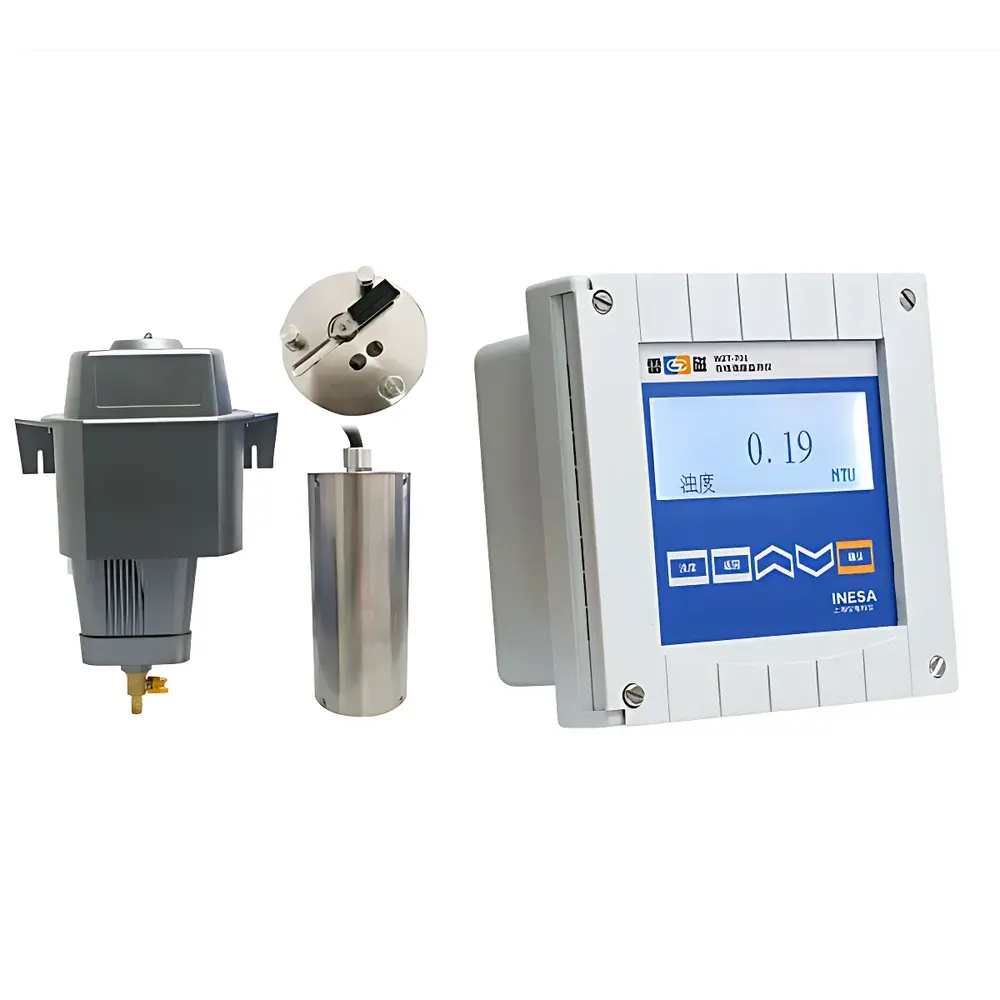
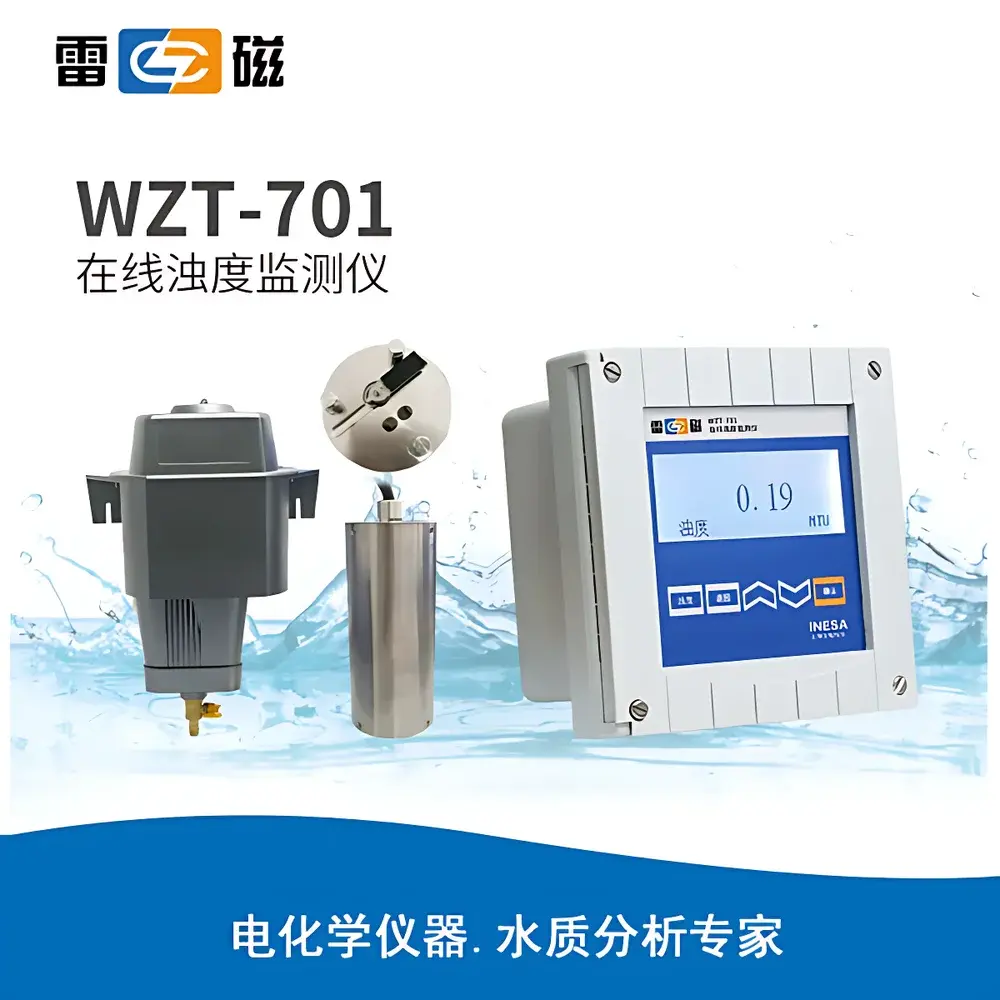
Leici WZT-701 Online Turbidimeter
| Brand | Leici |
|---|---|
| Origin | Shanghai, China |
| Manufacturer Type | Original Equipment Manufacturer (OEM) |
| Regional Classification | Domestic (PRC) |
| Model | WZT-701 |
| Price Range | USD 1,400 – 2,800 |
| Configuration | Online Continuous Monitoring |
| Measurement Range | 0.00–500.0 NTU |
| Resolution | 0.01 NTU (≤10 NTU), 0.1 NTU (>10 NTU) |
| Accuracy | ±10% FS |
| Repeatability | ≤2% |
| Zero Drift | ±0.5% FS / 30 min, ±1% FS / 24 h |
| Span Drift | ±5% FS / 24 h |
| MTBF | ≥720 hours |
| Enclosure Rating | IP65 |
| Power Supply | AC 220 V ±10%, 50 Hz ±2% |
| Dimensions (W×H×D) | 160 × 160 × 110 mm |
| Weight | 5.0 kg |
| Output | Isolated 4–20 mA DC (user-configurable span/zero), RS-232 serial interface |
| Calibration | Single-point or two-point standard calibration |
| Alarm Functions | Programmable high/low limit alerts with latching logic |
| Data Retention | Non-volatile memory for settings and calibration history |
| Environmental Operating Range | 0–40 °C, <90% RH non-condensing |
Overview
The Leici WZT-701 Online Turbidimeter is an industrial-grade, continuous-process turbidity monitoring instrument engineered for reliable, long-term deployment in municipal water treatment, drinking water distribution networks, surface water quality surveillance, and process water loops within pharmaceutical, food & beverage, and power generation facilities. It operates on the principle of nephelometric measurement—detecting scattered light intensity at a 90° angle relative to an incident near-infrared (NIR) LED beam—conforming to ISO 7027-1:2016 and EPA Method 180.1 for standardized turbidity quantification in NTU (Nephelometric Turbidity Units). Unlike benchtop or portable units, the WZT-701 integrates directly into pressurized or gravity-fed piping systems via standardized 1/2″ NPT or DIN 11851 sanitary fittings (adapter kits optional), enabling real-time, flow-through analysis without sample diversion or manual intervention.
Key Features
- High-stability NIR light source with temperature-compensated photodetector array ensures consistent signal integrity across ambient fluctuations (0–40 °C operating range).
- Large dot-matrix LCD display simultaneously presents real-time turbidity (NTU) and integrated Pt100 temperature reading—critical for temperature-corrected reporting per ISO 7027 Annex B.
- Dual-resolution mode: 0.01 NTU resolution below 10 NTU (optimized for potable water compliance), switching automatically to 0.1 NTU above 10 NTU for robustness in high-turbidity industrial effluents.
- Configurable 4–20 mA analog output with fully programmable zero/span mapping—supports integration into DCS, SCADA, or PLC systems with HART-compatible signal conditioning.
- RS-232 serial interface enables direct connection to local data loggers or supervisory PCs for periodic configuration updates and historical trend export (ASCII or CSV format).
- IP65-rated aluminum alloy enclosure provides dust-tight and water-jet resistant protection—suitable for installation in pump stations, chlorination rooms, and outdoor kiosks without additional weatherproof housing.
- Non-volatile EEPROM retains calibration coefficients, alarm thresholds, and system parameters through power cycles; automatic power-fail recovery preserves operational continuity.
Sample Compatibility & Compliance
The WZT-701 is validated for use with clear to moderately turbid aqueous matrices including treated drinking water (target range: 0.05–5 NTU), raw surface water (up to 500 NTU), cooling tower make-up, and low-solids process streams. It is not recommended for highly colored, emulsified, or suspended particulate-laden samples (e.g., wastewater influent >1000 NTU, slurry suspensions) without inline filtration or dilution preprocessing. The instrument meets electromagnetic compatibility requirements per IEC 61326-1:2021 (industrial environment class) and electrical safety standards per IEC 61010-1:2010. While not certified to UL/CE for hazardous locations, its design supports integration into water utility infrastructure compliant with ANSI/AWWA B100-22 (turbidity monitoring in distribution systems) and EU Drinking Water Directive (2020/2184) Annex I parameter monitoring protocols.
Software & Data Management
No proprietary PC software is bundled; configuration and diagnostics are performed via terminal emulation (e.g., PuTTY, Tera Term) over RS-232 using documented ASCII command set (AT-style syntax). All critical parameters—including calibration date, reference standard values (e.g., Formazin or AMCO-AE traceable standards), alarm hysteresis, and output scaling—are stored with timestamped audit trails in non-volatile memory. For regulated environments (e.g., FDA-regulated pharmaceutical water systems), users may implement external validation protocols aligned with 21 CFR Part 11 requirements by logging all configuration changes through a validated SCADA historian with electronic signature capability. Firmware updates are performed via serial bootloader and require physical access—no remote update functionality is implemented, minimizing cybersecurity exposure.
Applications
- Real-time monitoring of filter effluent turbidity in conventional and membrane-based drinking water plants (alerting on breakthrough events per AWWA Standard G300).
- Verification of coagulation/flocculation efficiency during pilot-scale optimization studies.
- Continuous surveillance of reservoir intake water quality to trigger early-warning responses to algal blooms or sediment resuspension.
- In-line verification of final rinse water clarity in sterile pharmaceutical component cleaning validation (supporting USP <1231> purified water specifications).
- Process water turbidity trending in semiconductor fab ultrapure water (UPW) sub-loops where particle counts correlate strongly with NTU deviations.
FAQ
Does the WZT-701 support automatic temperature compensation?
Yes—integrated Pt100 sensor enables real-time NTU correction per ISO 7027-1 Annex B algorithms, with user-selectable compensation ON/OFF.
Can it be calibrated with non-Formazin standards such as StablCal or AMCO-AE?
Yes—the two-point calibration routine accepts any traceable NTU standard; users must input certified reference values manually.
Is the 4–20 mA output intrinsically safe?
No—it is isolated but not intrinsically safe; external barriers are required for Zone 1/2 hazardous area installations.
What maintenance intervals are recommended for field operation?
Optical window cleaning every 7–14 days in high-fouling applications; annual verification against certified standards per ISO/IEC 17025 accredited lab procedures.
Does the device store historical turbidity readings internally?
No—internal memory retains only configuration and calibration logs; continuous data logging requires external SCADA or PLC integration.




