
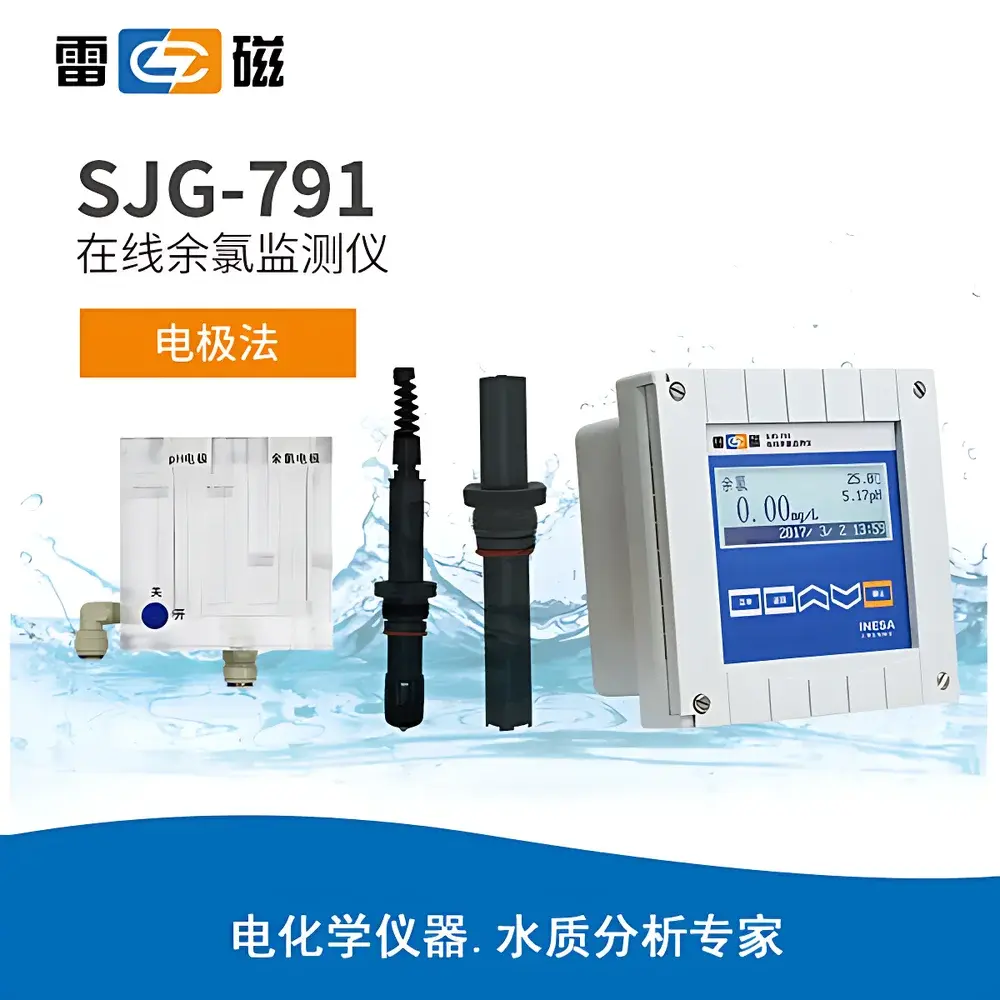
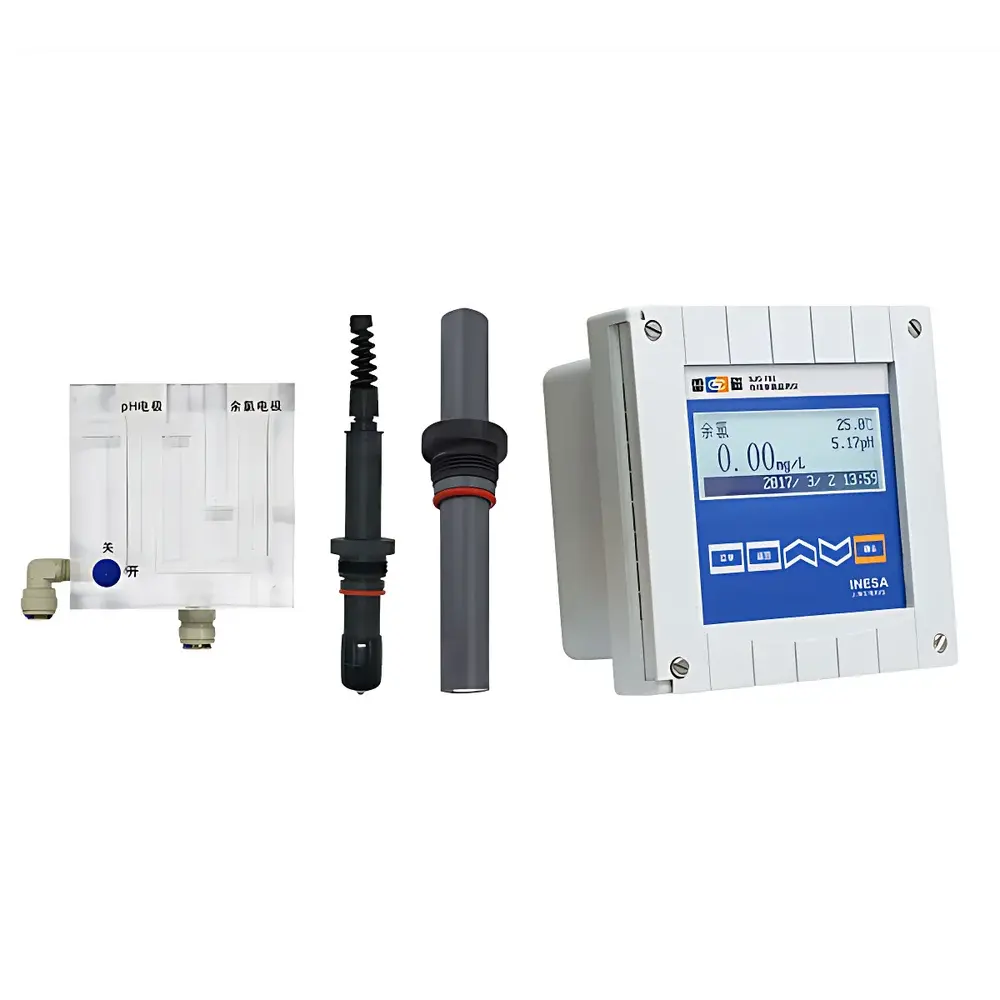
Leici WZT-701 Online Turbidimeter
| Brand | Leici |
|---|---|
| Origin | Shanghai, China |
| Manufacturer Type | Authorized Distributor |
| Country of Origin | China |
| Model | WZT-701 |
| Product Type | Online Turbidimeter |
| Measurement Range | 0.00–500.0 NTU |
| Resolution | 0.01 NTU (≤10 NTU), 0.1 NTU (>10 NTU) |
| Accuracy | ±10% FS |
| Repeatability | ≤2% |
| Zero Drift | ±0.5% FS / 30 min, ±1% FS / 24 h |
| Span Drift | ±5% FS / 24 h |
| MTBF | ≥720 h |
| IP Rating | IP65 |
| Power Supply | AC 220 V ±10%, 50 Hz ±1% |
| Dimensions (W×H×D) | 160 × 160 × 110 mm |
| Weight | 5.0 kg |
| Output | Isolated 4–20 mA DC (configurable upper/lower limits) |
| Digital Interface | RS-232 |
| Calibration | Single-point or two-point standard calibration |
Overview
The Leici WZT-701 Online Turbidimeter is an industrial-grade optical instrument engineered for continuous, real-time turbidity monitoring in water quality management systems. It operates on the principle of nephelometry—measuring the intensity of light scattered at 90° by suspended particles in a liquid sample—conforming to ISO 7027 and EPA Method 180.1 standards for turbidity measurement. Designed specifically for unattended operation in demanding environments, the WZT-701 delivers stable performance across municipal drinking water treatment plants, surface water monitoring stations, industrial process water loops, and pre-filtration control points. Its fixed-path, LED-based optical architecture eliminates moving parts and ensures long-term signal stability without periodic optical alignment. The sensor employs a dual-wavelength (860 nm infrared) light source to minimize color interference and improve accuracy in colored or low-turbidity samples.
Key Features
- High-resolution display: Dot-matrix LCD simultaneously shows turbidity (NTU) and temperature (°C), enabling real-time compensation and diagnostic insight.
- Flexible calibration protocol: Supports both single-point zero calibration and two-point span calibration using certified formazin or AMCO-AE standards—fully traceable to NIST reference materials.
- Robust alarm architecture: Programmable high/low turbidity thresholds with relay outputs for integration into SCADA or PLC-based control systems; includes configurable hysteresis to prevent chattering.
- Industrial signal output: Galvanically isolated 4–20 mA analog output with user-defined scaling (e.g., 0–500 NTU mapped to 4–20 mA); supports HART-compatible configuration via optional handheld communicator.
- Digital communication: RS-232 interface enables direct connection to data loggers, HMIs, or local PCs for firmware updates, parameter backup, and raw data export (ASCII format).
- Environmental resilience: IP65-rated enclosure meets IEC 60529 requirements for dust-tightness and resistance to low-pressure water jets—suitable for wall-mounting in pump rooms, filter galleries, and outdoor kiosks.
Sample Compatibility & Compliance
The WZT-701 is validated for aqueous media with particle concentrations ranging from clear potable water (<0.1 NTU) to moderately turbid process streams (up to 500 NTU). It is compatible with clean-in-place (CIP) protocols using non-abrasive, low-chloride cleaning agents but is not rated for submersion or high-pressure backwash applications. All wetted components—including the quartz optical window and stainless-steel flow cell—are chemically inert to common disinfectants (e.g., chlorine ≤5 mg/L, ozone ≤2 mg/L) and pH 4–10 solutions. The instrument complies with electromagnetic compatibility requirements per EN 61326-1 (industrial environment), and its electrical safety conforms to EN 61010-1. While not FDA 21 CFR Part 11–certified out-of-the-box, audit trails, user access levels, and electronic signature support can be implemented via external supervisory software meeting GLP/GMP data integrity expectations.
Software & Data Management
Configuration and diagnostics are performed locally via the front-panel keypad and LCD or remotely through ASCII command sets over RS-232. Standard commands include READ_TURB, SET_CAL, CONFIG_ALARM, and EXPORT_LOG. Raw measurements are timestamped and stored in volatile memory (circular buffer, 1000 records), with optional external logging via Modbus RTU gateway (requires third-party converter). Firmware version v2.4+ supports configurable sampling intervals (1 s to 60 min) and automatic zero-check cycles during low-flow conditions. Data export files include metadata headers (instrument ID, calibration date, operator code), supporting traceability in ISO/IEC 17025-accredited laboratories.
Applications
- Municipal drinking water distribution: Continuous verification of filtration efficiency and early detection of filter breakthrough events.
- Surface water intake monitoring: Real-time assessment of sediment load fluctuations during storm events or seasonal runoff.
- Industrial cooling tower and boiler feedwater circuits: Trend analysis of particulate accumulation to optimize blowdown frequency and chemical dosing.
- Food & beverage pre-process water: Compliance verification against internal specifications (e.g., ≤0.1 NTU for rinse water prior to CIP).
- Pharmaceutical purified water (PW) loop surveillance: Supplementary monitoring where USP turbidity limits apply—used alongside conductivity and TOC analyzers for holistic water quality assurance.
FAQ
What calibration standards are recommended for the WZT-701?
Formazin suspension (primary standard) or AMCO-AE polymer standard (secondary standard) calibrated against NIST-traceable references. Two-point calibration is advised when operating across >100 NTU range spans.
Can the WZT-701 be integrated into a Modbus-based SCADA system?
Yes—via an RS-232 to Modbus RTU converter (e.g., Moxa NPort series). Native Modbus TCP is not supported.
Is temperature compensation automatic or manual?
Automatic compensation is enabled by default using the built-in Pt1000 sensor; compensation algorithm follows ISO 7027 Annex B guidelines.
What maintenance intervals are recommended for field deployment?
Optical window cleaning every 7–14 days in high-silt environments; full calibration verification every 30 days; annual sensor inspection and gasket replacement.
Does the instrument support digital output redundancy or fail-safe signaling?
The 4–20 mA output includes hardware-level fault detection (e.g., open-circuit, short-circuit, over-range) with configurable fault current (e.g., 3.6 mA or 22 mA) per NAMUR NE43.




