Leiden Scientific LSM-001 High-Throughput Automated Zebrafish Embryo Microinjection System
| Origin | Netherlands |
|---|---|
| Supplier Type | Authorized Distributor |
| Origin Category | Imported Instrument |
| Model | LSM-001 |
| Pricing | Upon Request |
Overview
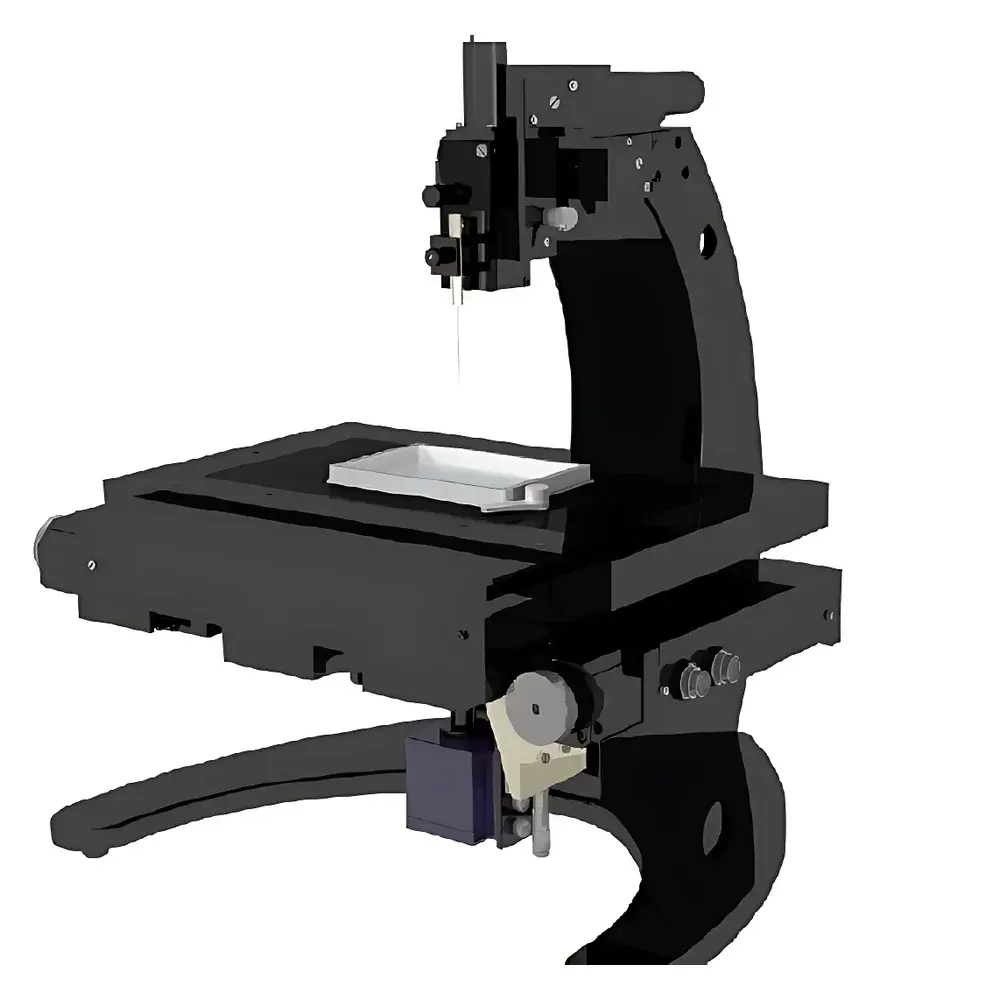
The Leiden Scientific LSM-001 is the world’s first fully automated, high-throughput microinjection platform engineered specifically for zebrafish (Danio rerio) embryos and 3D cellular constructs. Based on precision robotic micromanipulation coupled with real-time stereoscopic imaging and closed-loop feedback positioning, the LSM-001 implements a deterministic injection protocol grounded in calibrated piezoelectric actuation and pressure-controlled nanoliter dispensing. Unlike manual or semi-automated systems reliant on operator-dependent alignment and timing, the LSM-001 executes reproducible intracytoplasmic or perivitelline injections at defined spatial coordinates—within ±5 µm positional accuracy relative to the yolk surface—enabling statistically robust experimental designs in developmental genetics, infectious disease modeling, and tumor microenvironment reconstruction.
Key Features
- Throughput of up to 2,500 zebrafish embryos per hour, with fully autonomous loading, orientation, injection, and post-injection staging
- Integrated agarose mold alignment system supporting standardized grid formats (e.g., 2580-, 1024-, or 9 × 100-well configurations), enabling sub-5-minute embryo loading
- 3D motorized stage with 0.1 µm resolution XYZ translation and automated focus tracking for consistent injection depth control near the blastodisc–yolk interface
- Modular microinjection module compatible with glass capillaries (tip ID: 0.5–2.0 µm) and programmable pressure profiles (0.1–100 kPa range)
- Optical compatibility with confocal, light-sheet, and widefield fluorescence microscopes via standardized mounting interfaces and vibration-damped optical table integration
- Onboard calibration suite for needle tip detection, embryo centroid localization, and injection volume verification using fluorescent tracer co-injection
Sample Compatibility & Compliance
The LSM-001 supports a broad range of biological specimens beyond standard zebrafish embryos, including primary dissociated cells, immortalized cell lines, and hydrogel-embedded spheroids. It accommodates collagen I, Matrigel™, and synthetic PEG-based matrices for 3D culture injection workflows. All hardware components comply with CE marking requirements for laboratory instrumentation (2014/30/EU EMC Directive and 2014/35/EU Low Voltage Directive). The system’s operational protocols align with GLP principles for preclinical assay development, and its audit trail functionality—including timestamped injection logs, operator ID tagging, and parameter versioning—supports compliance with FDA 21 CFR Part 11 when integrated with validated LIMS environments.
Software & Data Management
The LSM Control Suite (v4.2+) provides a graphical workflow editor for defining multi-step injection protocols, including conditional branching based on embryo morphology scoring (e.g., chorion integrity, cleavage stage). Injection metadata—including pressure duration, volume estimate, coordinate map, and image snapshots—is exported in HDF5 format with embedded MIAME-compliant annotation fields. Raw data files are structured for direct ingestion into analysis pipelines compliant with the ZFIN ontology and FAIR data principles. Optional API access enables bidirectional integration with ELN platforms such as LabArchives or Benchling, ensuring traceability from injection event to downstream phenotypic readout.
Applications
- High-throughput genetic screening: CRISPR/Cas9, morpholino, or mRNA delivery into synchronized embryo cohorts for forward/reverse genetic assays
- Infectious disease modeling: Intravenous or hindbrain ventricle injection of Staphylococcus epidermidis, Mycobacterium marinum, or fluorescently labeled immune cells to quantify host-pathogen dynamics
- Tumor microenvironment reconstruction: Co-injection of cancer cell spheroids with stromal or immune populations into pre-formed collagen microgels to model invasion and immunosuppression
- Developmental toxicology: Dose-responsive small-molecule delivery across embryonic stages for teratogenicity assessment under OECD TG 236 guidelines
- 3D functional phenotyping: Spatially resolved injection of biosensors (e.g., Ca2+, ROS, pH) into organoid-like structures for longitudinal live imaging
FAQ
What is the minimum viable embryo age for reliable injection?
Embryos aged 1–4 hours post-fertilization (hpf), at the 1–4 cell stage, demonstrate optimal membrane resilience and yolk adhesion for consistent needle penetration without lysis.
Can the system inject into non-zebrafish models?
Yes—the platform supports Xenopus laevis embryos and mouse oocytes with custom stage adapters and modified pressure calibration; validation data available upon request.
Is sterilization of the injection module supported?
All fluidic pathways are constructed from autoclavable borosilicate glass and PEEK components; full-cycle steam sterilization (121°C, 20 min) is validated per ISO 17665-1.
How does the system handle embryo variability in size or chorion thickness?
Real-time brightfield segmentation algorithms dynamically adjust injection depth and pressure thresholds per embryo using adaptive thresholding and morphological filtering.
Does the LSM-001 support multiplexed reagent delivery?
Yes—dual-channel microfluidic manifolds enable sequential or simultaneous co-injection of up to three distinct agents (e.g., guide RNA + donor template + fluorescent tracer) with independent volumetric control.