
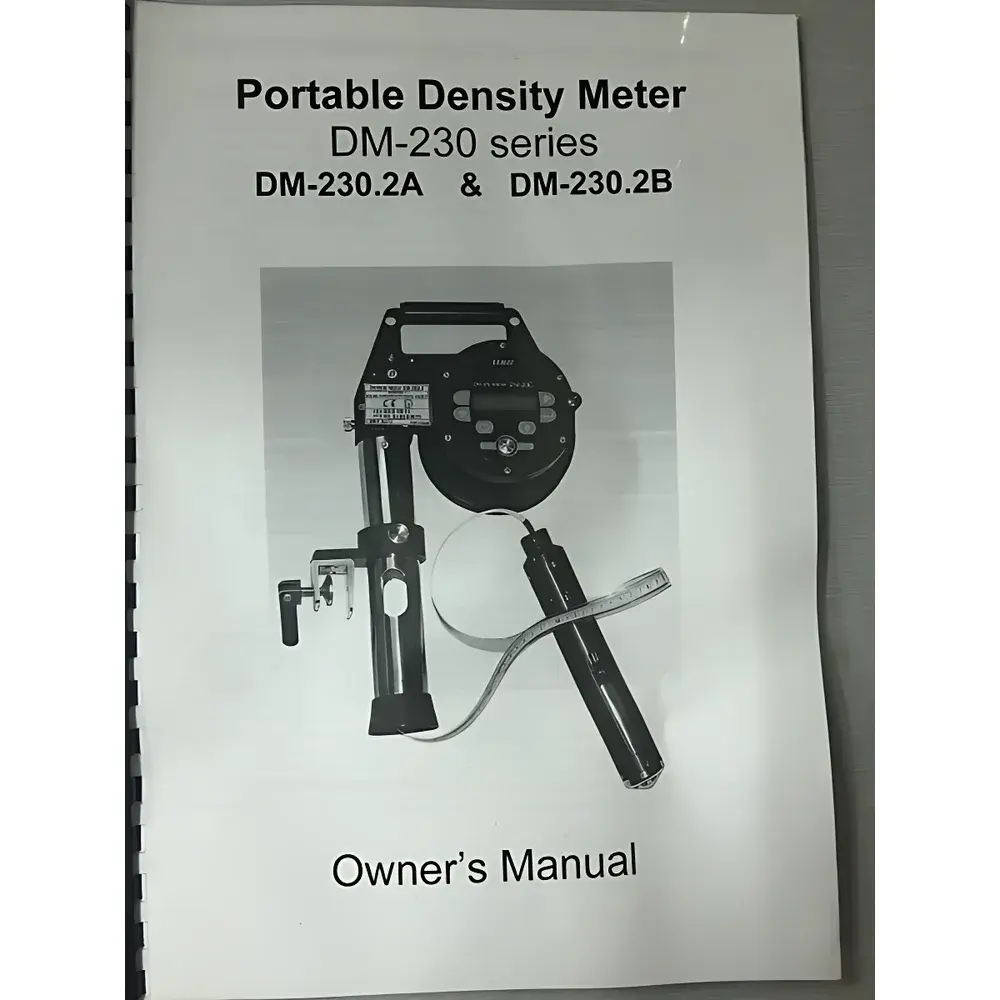
LEMIS DM-230.2A & DM-230.2B Oscillating U-Tube Digital Densimeter
| Origin | Imported |
|---|---|
| Manufacturer Type | Authorized Distributor |
| Instrument Type | Oscillating U-Tube Densimeter |
| Portability | Portable |
| Sample Phase | Liquid |
| Application Focus | Petroleum Products Density Measurement |
| Density Range | 0.6–2.2 g/cm³ |
| Density Resolution | 0.0001 g/cm³ |
| Temperature Control Range | 15–40 °C (Peltier-regulated) |
| Temperature Accuracy | ±0.03 °C |
| Minimum Sample Volume | 1.5 mL |
| Compliance | ASTM D4052, ISO 12185, IP 365, GB/T 1884 |
Overview
The LEMIS DM-230.2A and DM-230.2B are high-precision, portable oscillating U-tube densimeters engineered for rapid, traceable density determination of liquid petroleum products and related hydrocarbon-based fluids. Operating on the fundamental principle of resonant frequency measurement—where the natural oscillation period of a precisely machined, evacuated U-shaped glass tube filled with sample is inversely proportional to its mass—and calibrated against certified reference standards, these instruments deliver laboratory-grade accuracy in field or mobile laboratory environments. Unlike hydrometer- or pycnometer-based methods, the oscillating tube technique eliminates operator subjectivity, requires no buoyancy corrections, and is inherently insensitive to sample viscosity within specified ranges. The DM-230.2 series is specifically configured for compliance with internationally recognized test methods including ASTM D4052 (Standard Test Method for Density, Relative Density, and API Gravity of Crude Petroleum and Liquid Petroleum Products by Digital Density Meter), ISO 12185 (Crude Petroleum and Liquid Petroleum Products — Determination of Density — Digital Density Meters), and IP 365 (Determination of Density of Petroleum Products — Digital Density Meter Method).
Key Features
- Integrated Peltier temperature control system maintaining ±0.03 °C stability across the 15–40 °C operating range—critical for accurate API gravity and density reporting per ASTM D1250 and ISO 91-1.
- Dual-model configuration: DM-230.2A optimized for routine refinery QC with preloaded petroleum-specific calibration curves; DM-230.2B includes extended firmware for customizable multi-point calibration, density/temperature coefficient (α) calculation, and real-time API gravity conversion.
- Compact, battery-operated design (optional external power supply) with IP54-rated enclosure—enabling deployment at tank farms, loading racks, marine terminals, or mobile quality control vans without AC infrastructure.
- Self-diagnostic quartz sensor module with automatic bubble detection and purge cycle initiation—minimizing measurement artifacts from entrained air or incomplete filling.
- Robust architecture featuring corrosion-resistant fluid path materials (borosilicate glass, PTFE, and Hastelloy C-276 wetted parts) compatible with gasoline, diesel, jet fuel, lubricants, biodiesel blends (B5–B20), and light crudes.
Sample Compatibility & Compliance
The DM-230.2A/B supports direct analysis of transparent to moderately hazy liquids with kinematic viscosity ≤ 20 mm²/s at measurement temperature. Samples containing suspended solids, excessive water emulsions, or highly volatile components (e.g., unstabilized naphtha) require prior filtration or stabilization per ASTM D4177. All measurements adhere to GLP data integrity requirements: instrument identification, operator ID, timestamp, temperature, raw oscillation period, and calibration history are embedded in each result. Audit trails comply with FDA 21 CFR Part 11 when paired with validated LEMIS Densidata Manager software (v3.2+), supporting electronic signatures and role-based access control.
Software & Data Management
The included Densidata Manager PC software enables method setup, calibration management (single- or multi-point using NIST-traceable standards), report generation (PDF/CSV/XLSX), and secure data archiving. It supports automated pass/fail evaluation against specification limits (e.g., ASTM D975 for diesel density), batch summary statistics, and export to LIMS via ASTM E1384-compliant structured data files. Firmware updates and calibration certificate import are performed through encrypted USB interface—no internet connection required during operation.
Applications
- Real-time density verification during crude oil custody transfer and blending operations.
- In-process monitoring of distillation fractions (naphtha, kerosene, gasoil) in continuous reformer or hydrotreater units.
- Quality release testing of finished fuels at terminal storage—aligned with ISO 4259 precision limits.
- API gravity calculation for fiscal metering and tariff classification per U.S. Customs regulations.
- Supporting ASTM D7153 (low-viscosity biofuels) and EN 16943 (biodiesel density specifications) compliance workflows.
FAQ
What calibration standards are required for daily verification?
NIST-traceable water and dry air (or certified hydrocarbon standards such as iso-octane and tetrabromomethane) are recommended for two-point verification before each analytical session.
Can the instrument measure ethanol–gasoline blends (E10–E85)?
Yes—provided the blend is homogeneous and free of phase separation; temperature must be stabilized within ±0.1 °C during measurement due to ethanol’s high thermal expansion coefficient.
Is cleaning validation documented in the software?
Each cleaning cycle (solvent flush + air purge) is timestamped and logged alongside subsequent measurement records; optional cleaning SOP templates are available in Densidata Manager.
Does the device meet explosion-proof requirements for Zone 1 environments?
No—the DM-230.2 series is rated for general-purpose use only; intrinsic safety certification (e.g., ATEX II 2G Ex ib IIB T4) requires third-party enclosure integration.
How is temperature uniformity ensured across the oscillating tube?
A dual-sensor Peltier system actively monitors both tube wall and ambient chamber temperatures, applying dynamic feedback to maintain axial thermal homogeneity within 0.02 °C over the full 15–40 °C range.
Related Products



