
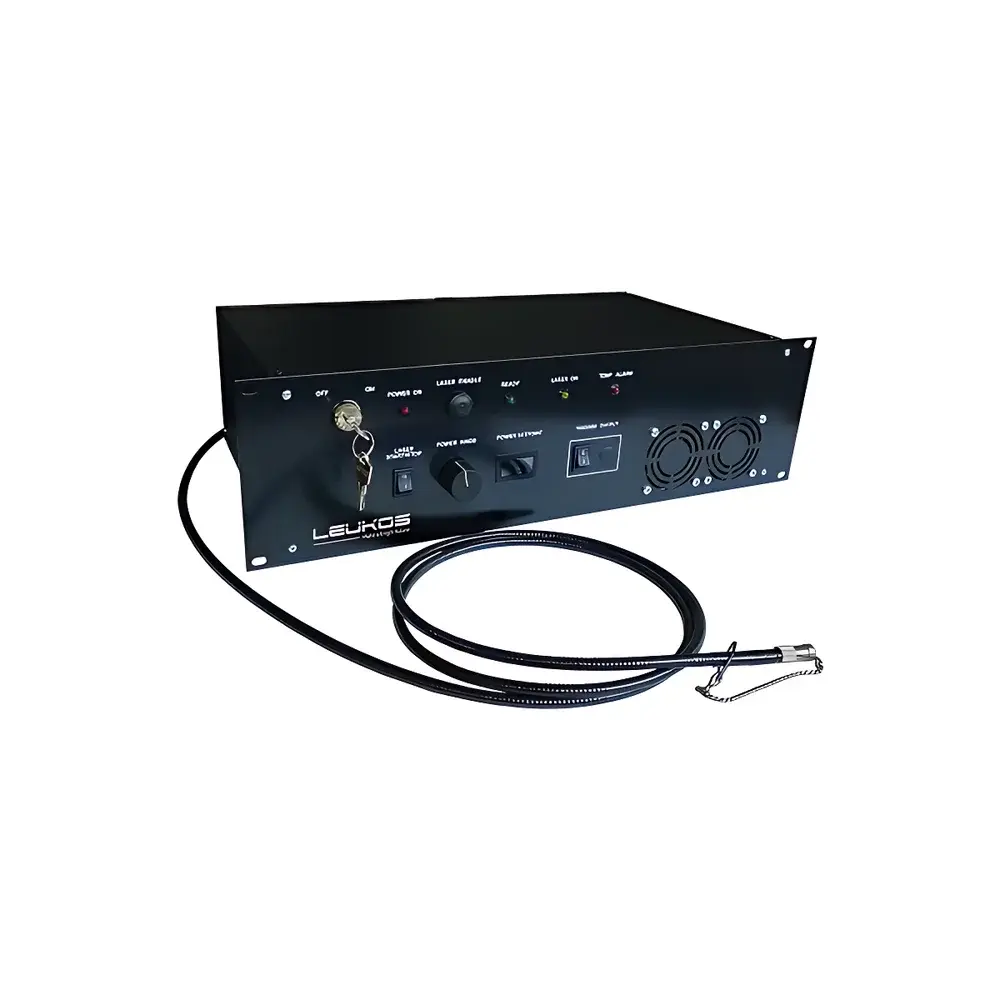
LEUKOS DISCO Ultrafast Supercontinuum Laser Source
| Brand | LEUKOS |
|---|---|
| Model | DISCO |
| Type | Fiber-Pumped, Solid-State Hybrid Supercontinuum Source |
| Spectral Range | UV–NIR (350–2400 nm) |
| Repetition Rate | 2 kHz (externally triggered) |
| Timing Jitter | < 10 ns (RMS, at 2 kHz) |
| Pulse Energy | > 3 µJ per pulse |
| Beam Quality | Spatially Single-Mode (M² < 1.1) |
| Output Format | Free-space collimated beam (standard), optional fiber coupling (FC/APC or SMA) |
| Compliance | CE-marked, RoHS-compliant, Class 4 Laser Product (IEC 60825-1) |
Overview
The LEUKOS DISCO Ultrafast Supercontinuum Laser Source is a high-stability, externally triggerable broadband light source engineered for time-resolved optical measurements requiring precise synchronization and broad spectral coverage. Based on nonlinear spectral broadening in photonic crystal fiber (PCF), the DISCO leverages femtosecond-pumped solid-state architecture to generate a smooth, high-brightness supercontinuum spanning from the ultraviolet (350 nm) through the visible and near-infrared (up to 2400 nm). Its core design integrates a mode-locked Yb-fiber oscillator and a high-gain amplification stage, followed by dispersion-engineered nonlinear conversion—ensuring exceptional spectral flatness and shot-to-shot reproducibility. Unlike conventional lamp-based or LED white-light sources, the DISCO delivers coherent, pulsed output with deterministic temporal structure, making it fundamentally suited for pump–probe spectroscopy, time-of-flight metrology, and asynchronous optical sampling (ASOPS) applications where sub-10 ns timing fidelity is critical.
Key Features
- Ultra-low timing jitter: < 10 ns RMS at 2 kHz repetition rate under external triggering—enabling reliable synchronization with ultrafast lasers, streak cameras, or time-correlated single-photon counting (TCSPC) systems.
- Broadband UV–NIR output: Continuously covered spectrum from 350 nm to 2400 nm with < ±1.5 dB spectral flatness across key OCT and spectroscopic windows (e.g., 800–900 nm, 1250–1350 nm, 1600–1700 nm).
- High pulse energy: > 3 µJ per pulse ensures sufficient signal-to-noise ratio (SNR) for low-light detection schemes including fluorescence lifetime imaging (FLIM) and multi-photon absorption experiments.
- Spatially single-mode output: M² < 1.1 guarantees diffraction-limited focusing and efficient coupling into single-mode fibers or scanning optics—critical for confocal microscopy and OCT interferometry.
- Robust hybrid architecture: Combines diode-pumped solid-state gain stages with polarization-maintaining fiber delivery, minimizing alignment sensitivity and thermal drift over extended operation.
- Flexible integration options: Standard free-space collimated output; optional accessories include broadband achromatic collimators, FC/APC or SMA fiber coupling modules, and motorized bandpass filter wheels for spectral gating.
Sample Compatibility & Compliance
The DISCO is designed for use with standard optical tables, breadboard-mounted spectrometers, delay stages, and ultrafast detectors. Its output is compatible with common UV–NIR photodetectors (Si, InGaAs, extended-InGaAs), monochromators, and array-based spectrometers (e.g., CCD/CMOS with UV-enhanced coatings). The system meets IEC 60825-1:2014 Class 4 laser safety requirements and carries CE marking for EMC and LVD compliance. It operates within ambient temperature ranges of 15–30 °C and relative humidity ≤ 70% non-condensing. While not inherently GMP/GLP-certified, its deterministic triggering, audit-ready internal log buffer (via USB-C serial interface), and traceable firmware versioning support integration into regulated environments compliant with ISO/IEC 17025 or FDA 21 CFR Part 11 when paired with validated acquisition software.
Software & Data Management
The DISCO is controlled via a native Windows/Linux-compatible GUI (DISCO Control Suite v3.x), offering real-time monitoring of pulse energy stability, internal temperature sensors, and trigger latency diagnostics. All operational parameters—including trigger delay offset, inter-pulse interval verification, and spectral power distribution snapshots—are logged with UTC timestamps and exportable in CSV or HDF5 format. Remote control is supported via SCPI-over-USB or TCP/IP protocols, enabling seamless integration with LabVIEW, MATLAB, or Python-based automation frameworks (e.g., PyVISA). Firmware updates preserve calibration constants and maintain backward compatibility with legacy experiment scripts. Optional SDKs provide low-level access to jitter-compensation algorithms and hardware-level trigger arbitration logic.
Applications
- Pump–Probe Spectroscopy: Serves as a broadband probe source synchronized to amplified Ti:sapphire or Yb-based pump lasers for transient absorption, photoelectron, and terahertz generation studies.
- Optical Coherence Tomography (OCT): Delivers high axial resolution (< 2 µm in tissue) in swept-source and full-field OCT configurations, especially in ophthalmic and dermatological imaging.
- Flow Cytometry: Enables multi-parameter spectral phenotyping using hyperspectral detection across UV-excitable fluorophores (e.g., DAPI, Hoechst) and NIR dyes (e.g., IRDye 800CW).
- Confocal & Multiphoton Microscopy: Provides tunable excitation bands without mechanical filter changes—ideal for label-free imaging (SHG, THG, CARS) and spectral unmixing.
- Optical Component Testing: Used for wavelength-dependent loss (WDL), polarization-dependent loss (PDL), and group delay dispersion (GDD) characterization of filters, waveguides, and AR coatings.
FAQ
Is the DISCO fully turnkey, or does it require external pump laser integration?
The DISCO is a self-contained, integrated supercontinuum source—no external pump laser is required. Its internal Yb-fiber oscillator and amplifier are factory-aligned and sealed.
Can the timing jitter be further reduced below 10 ns with custom triggering electronics?
The specified < 10 ns jitter is measured with standard TTL-triggered operation. Sub-5 ns performance may be achievable using LVDS or differential clock inputs, subject to user-provided low-jitter master oscillator validation.
What is the typical spectral power density across the UV–NIR range?
Average spectral power density exceeds 0.1 mW/nm from 400–1000 nm and remains > 0.02 mW/nm up to 2200 nm, normalized to 2 kHz repetition rate and >3 µJ pulse energy.
Does LEUKOS provide NIST-traceable spectral calibration data?
Yes—each unit ships with a factory-measured spectral radiance certificate, calibrated against NIST-traceable reference lamps and calibrated spectrometers (Ocean Insight QE Pro, calibrated to NIST SRM 2031).
Is remote firmware update supported over network connection?
Firmware updates require local USB-C connection for security and integrity verification; however, configuration files and log exports support secure FTP/SFTP transfer for centralized lab management.




