
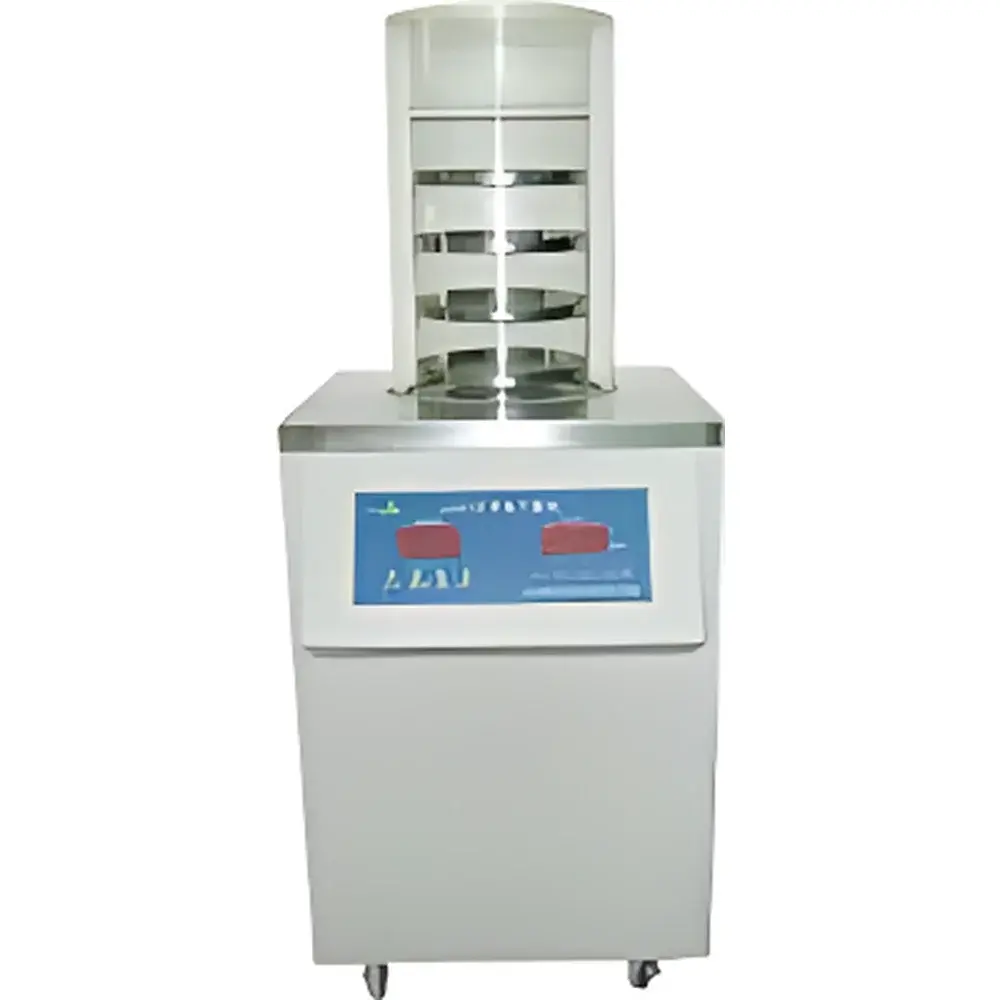
LGJ-12 Benchtop Vertical Freeze Dryer
| Origin | Beijing, China |
|---|---|
| Manufacturer Type | Authorized Distributor |
| Origin Category | Domestic (PRC) |
| Model | LGJ-12 |
| Quotation | Upon Request |
| Cold Trap Temperature | < −50 °C (standard), optional −80 °C |
| Ultimate Vacuum | < 15 Pa |
| Lyophilization Area | 0.09–0.18 m² |
| Water Capture Capacity | 3 kg/24 h |
| Overall Dimensions (W×D×H) | 560 × 460 × (720 + 450) mm |
| Shelf Configuration | 4 stainless steel trays (Ø200 mm, 70 mm spacing) for bulk loading |
| Optional Configurations | 6-tray (Ø200 mm, 50 mm spacing) or 3-tray (Ø180 mm) for vial drying with manual stoppering kit |
| Tray Material | Electropolished 304 stainless steel |
| Typical Drying Cycle | ~24 h for samples ≤10 mm thickness |
Overview
The LGJ-12 Benchtop Vertical Freeze Dryer is a compact, vertically oriented lyophilization system engineered for laboratory-scale freeze-drying of biological, pharmaceutical, and research-grade samples. It operates on the fundamental principles of sublimation under deep vacuum and cryogenic condensation: frozen water in the sample transitions directly from solid to vapor phase under controlled low-pressure conditions, while non-volatile solutes remain structurally intact. The vapor is captured as ice on a high-efficiency cold trap, enabling solvent removal without thermal degradation. Designed for flexibility and operational simplicity, the LGJ-12 supports both bulk drying (e.g., gels, suspensions, tissue homogenates) and vial-based processing—making it suitable for method development, stability studies, small-batch formulation work, and preclinical sample preparation. Its vertical architecture minimizes footprint, aligning with space-constrained academic labs, QC facilities, and early-stage biotech environments.
Key Features
- High-performance imported hermetic refrigeration unit delivering stable cold trap temperatures down to −50 °C (standard) or −80 °C (optional upgrade), ensuring rapid freezing and efficient vapor capture.
- Large-diameter stainless steel cold trap chamber with no internal coil obstructions—facilitating easy cleaning, uniform frost distribution, and corrosion resistance per ISO 8573-1 Class 4 air purity requirements for lab equipment surfaces.
- Optically transparent acrylic bell jar (dome-type drying chamber) providing full visual monitoring of sublimation progress and ice buildup without compromising vacuum integrity.
- Modular stainless steel shelf assembly with adjustable inter-tray spacing (70 mm standard for bulk; 50 mm for high-density loading; 3-tier Ø180 mm configuration available for vials).
- Electropolished 304 stainless steel sample trays (Ø200 mm) supporting up to 1500 mL total loading volume at 10 mm depth—optimized for reproducible heat transfer and minimal edge effects.
- Integrated pre-freezing capability within the cold trap chamber, eliminating need for external ultra-low temperature freezers during initial solidification step.
Sample Compatibility & Compliance
The LGJ-12 accommodates aqueous and mildly organic solutions, protein formulations, microbial cultures, plant extracts, and diagnostic reagents. It supports common lyophilization containers including open petri dishes, glass crystallizing dishes, and standard 10–20 mL serum vials (with optional manual stoppering kit). While not certified for GMP production, its construction and operational parameters conform to foundational principles outlined in USP , ISO 22057 (lyophilization terminology), and ASTM F2375 (freeze-dryer performance verification guidelines). All wetted surfaces meet FDA-compliant material standards (3-A Sanitary Standards SR-1 for stainless steel finish), and vacuum system components are rated for continuous operation under ≤15 Pa absolute pressure per IEC 61000-6-3 EMC emission limits.
Software & Data Management
The LGJ-12 operates via an integrated digital controller with real-time display of cold trap temperature, chamber pressure, and elapsed time. Although it does not include PC-based software or data logging as standard, analog output signals (0–10 V or 4–20 mA) are available upon request for integration into third-party SCADA or LIMS platforms. For laboratories requiring audit-ready records, external USB data loggers compatible with NIST-traceable thermocouples and capacitance manometers may be deployed to satisfy GLP documentation expectations—including timestamped pressure/temperature profiles and cycle start/stop metadata.
Applications
- Stabilization of heat-labile enzymes, monoclonal antibodies, and mRNA intermediates prior to analytical characterization.
- Preparation of calibration standards and reference materials for HPLC, LC-MS, and ELISA assays.
- Drying of microbial pellets for long-term storage and strain archiving.
- Processing of botanical extracts and nutraceutical concentrates where volatile compound retention is critical.
- Method scouting for scalable lyophilization cycles—data generated on the LGJ-12 informs shelf temperature ramping, primary drying duration, and annealing protocols used in pilot-scale systems.
FAQ
What is the maximum sample volume capacity per cycle?
Up to 1500 mL when loaded uniformly across four Ø200 mm trays at 10 mm depth—equivalent to ~1.2 kg wet weight for typical aqueous biological samples.
Can the LGJ-12 be used for sterile processing?
No. It lacks HEPA filtration, steam sterilization capability, or ISO Class 5 chamber certification. Sterile vial handling requires aseptic transfer before loading.
Is vacuum pump included?
No. A two-stage oil-sealed rotary vane pump (minimum 4 m³/h pumping speed, ultimate vacuum ≤5 Pa) must be selected separately and connected via DN25 KF flange.
Does the system support programmable freeze-drying cycles?
Not natively. Cycle control is manual: users set cold trap temperature and monitor pressure manually; ramping or hold steps require external intervention.
What maintenance intervals are recommended?
Refrigeration oil and filter replacement every 2,000 operating hours; cold trap de-icing after each batch; vacuum pump oil change every 500 hours or per pump manufacturer specifications.



