
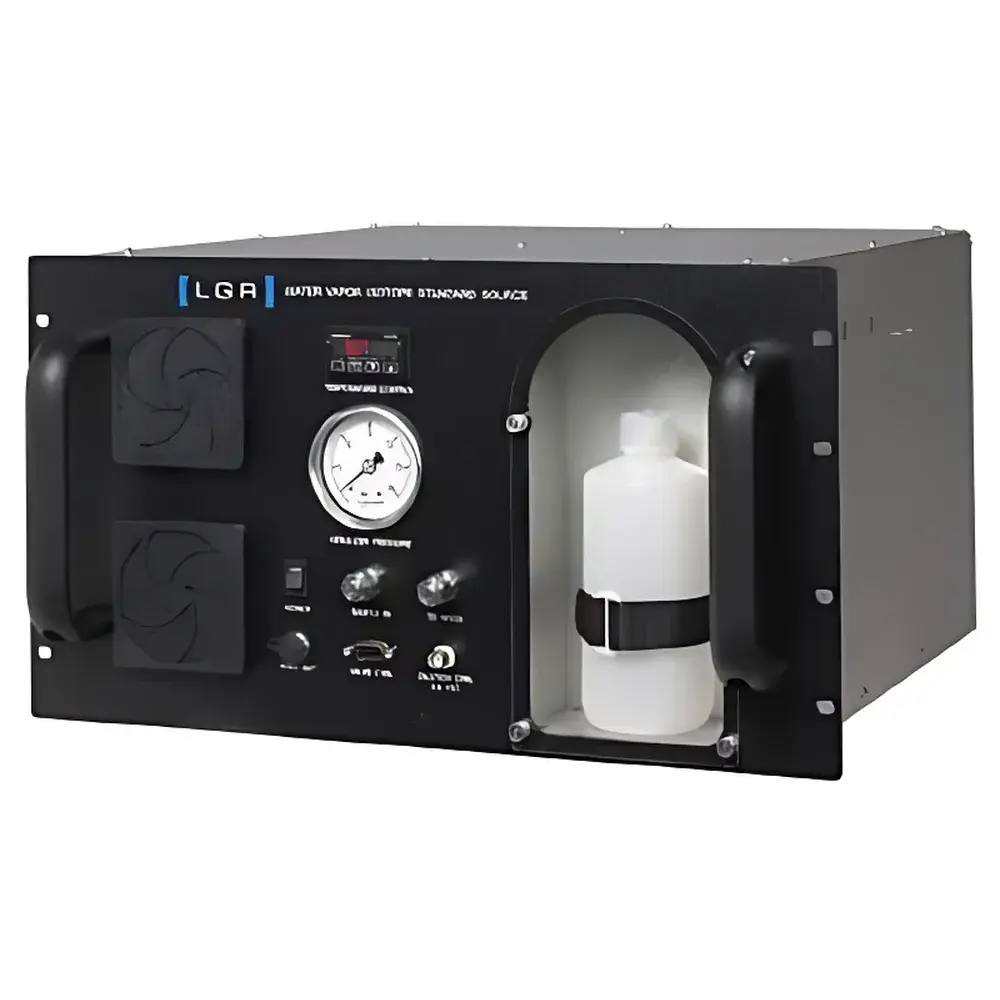
LGR WVISS Water Vapor Isotope Standard Source
| Origin | USA |
|---|---|
| Manufacturer | Los Gatos Research |
| Type | Imported |
| Model | 908-0004-9002 (Standard Range), 908-0004-9003 (Extended Range) |
| Power Supply | 115/230 VAC, 50/60 Hz |
| Average Power Consumption | 30 W |
| Standby Power | 10 W |
| Max Power | 300 W |
| Dimensions (Std) | 26.7 cm H × 48.3 cm W × 43.2 cm D |
| Weight (Std) | 27 kg |
| Dimensions (Ext) | 26.7 cm H × 48.3 cm W × 58.4 cm D |
| Weight (Ext) | 29 kg |
| H₂O Vapor Range (Std) | 3000–30,000 ppm |
| H₂O Vapor Range (Ext) | 500–30,000 ppm |
Overview
The LGR WVISS (Water Vapor Isotope Standard Source) is an engineered calibration and reference generation system designed for high-precision, long-term isotopic monitoring of water vapor δ²H, δ¹⁷O, and δ¹⁸O ratios. It operates on the principle of dynamic vapor-phase mixing and temperature-controlled equilibrium evaporation, enabling real-time synthesis of water vapor with traceable, user-defined isotopic compositions and precisely adjustable concentration levels. Unlike static permeation or cryogenic standard delivery methods, the WVISS delivers continuous, stable, and dynamically programmable isotopic standards directly into the sample stream of cavity ring-down spectroscopy (CRDS) or isotope ratio mass spectrometry (IRMS) systems—most commonly integrated with Los Gatos Research’s WVIA (Water Vapor Isotope Analyzer). This architecture eliminates manual calibration drift, reduces operator intervention, and supports unattended operation over multi-week campaigns under field or laboratory conditions.
Key Features
- Real-time generation of water vapor standards with certified δ²H, δ¹⁷O, and δ¹⁸O values traceable to VSMOW-SLAP scale
- Two configurable operating ranges: standard (3000–30,000 ppm) and extended (500–30,000 ppm) H₂O concentration
- Full bidirectional digital integration with LGR WVIA via Ethernet or RS-232 for automated scheduling, trigger-based output, and closed-loop feedback control
- Onboard temperature-stabilized evaporation chambers and precision mass flow controllers ensure <±0.5% repeatability in concentration output and <±0.2‰ reproducibility in isotopic ratio delivery
- Low-power architecture optimized for remote deployment: average consumption of 30 W; compatible with solar-battery hybrid power systems
- Ruggedized benchtop chassis with EMI-shielded electronics and thermal management for stable operation across ambient temperatures from 5 °C to 35 °C
Sample Compatibility & Compliance
The WVISS is validated for direct interfacing with CRDS-based analyzers (e.g., LGR WVIA, Picarro G2131-i) and IRMS inlet systems equipped with cryo-focused water trapping or direct vapor introduction modules. It supports both gaseous-phase calibration and liquid-water equilibration workflows: when paired with LGR’s Liquid Water Isotope Analyzer (LWIA) interface module, the WVISS enables automated, sequential injection of calibrated vapor into headspace equilibration vessels for high-throughput δ²H/δ¹⁸O analysis of liquid samples. All firmware and hardware design comply with IEC 61326-1 (EMC for laboratory equipment) and meet essential requirements of ISO/IEC 17025 for reference material generation. Traceability documentation—including uncertainty budgets per NIST SP 800-90B and calibration certificates aligned with ISO/IEC 17025-accredited laboratories—is provided with each unit shipment.
Software & Data Management
Control and configuration are executed through LGR’s proprietary WVISS Manager software (v3.2+), which runs on Windows-based host PCs and communicates via TCP/IP. The software provides a GUI for defining multi-step calibration sequences (e.g., “baseline → low-concentration standard → high-concentration standard → blank”), setting dwell times (1 s to 24 h), and exporting timestamped metadata logs (CSV/JSON) containing setpoints, actual delivered concentrations, internal sensor readings (T, P, RH), and synchronization pulses. Audit trails are maintained in accordance with FDA 21 CFR Part 11 requirements when configured with electronic signatures and role-based access controls. Raw log files integrate natively with LIMS platforms via OPC UA or RESTful API endpoints.
Applications
- Long-term atmospheric water vapor isotope monitoring in eddy covariance towers and boundary layer profiling stations
- Calibration validation and drift correction of CRDS and IRMS instruments in environmental isotope laboratories
- Method development for dual-isotope (δ²H–δ¹⁸O) meteoric water line characterization and evaporation enrichment studies
- Quality assurance in paleoclimate proxy calibration using ice core or speleothem water extracts
- Supporting GLP-compliant isotope analysis for regulatory submissions in hydrological tracing and groundwater recharge studies
FAQ
Can the WVISS be used independently of an LGR analyzer?
Yes—it can operate in standalone mode via front-panel controls or serial commands, though full automation and isotopic feedback require integration with a compatible analyzer.
What is the typical uncertainty in delivered δ-values?
When operated within its specified range and calibrated against primary reference waters (VSMOW, SLAP, GISP), expanded uncertainty (k=2) is ≤ ±0.4‰ for δ²H and ≤ ±0.15‰ for δ¹⁸O.
Is the WVISS compatible with non-LGR IRMS systems?
Yes—via analog voltage outputs (0–10 V) for concentration and TTL triggers for timing synchronization; custom interface modules are available upon request.
How often does the WVISS require recalibration?
Annual verification against certified reference waters is recommended; internal diagnostics monitor evaporator performance and flag deviations exceeding ±1.5% of setpoint.
Does the system support GLP/GMP audit readiness?
Yes—full electronic records, user authentication, change logging, and 21 CFR Part 11-compliant signature options are enabled by default in enterprise software configurations.





