
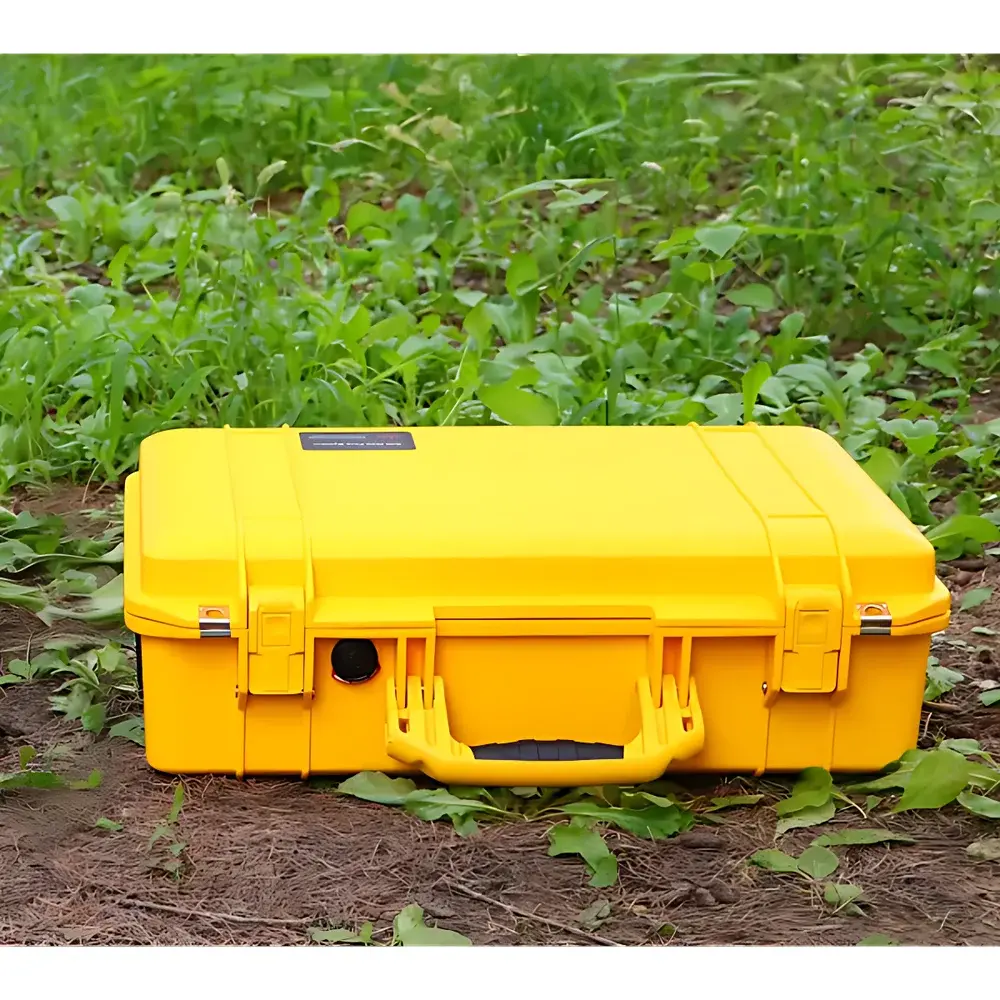
LICA LI-G3001 CH4/CO2/H2O High-Precision Greenhouse Gas Analyzer
| Brand | LICA |
|---|---|
| Model | LI-G3001 |
| Measurement Targets | CH₄, CO₂, H₂O |
| Precision (1σ, 1 s / 10 s) | CH₄ < 2 ppb / < 1 ppb |
| Measurement Ranges | CH₄ 1–200 ppm |
| Operating Temperature | 0–45 °C |
| Operating Humidity | 0–95 %RH (non-condensing) |
| Data Acquisition Rate | ≥1 Hz (1/e response time) |
| Sample Flow Rate | 350 sccm |
| Power Consumption | < 30 W |
| Connectivity | Wi-Fi |
| Onboard Storage | 30 GB |
| Dimensions | 56 × 36 × 19 cm |
| Weight | 8 kg |
Overview
The LICA LI-G3001 CH₄/CO₂/H₂O High-Precision Greenhouse Gas Analyzer is an integrated, field-deployable optical gas analyzer engineered for continuous, simultaneous quantification of methane (CH₄), carbon dioxide (CO₂), and water vapor (H₂O) in ambient air and soil flux chambers. It employs tunable diode laser absorption spectroscopy (TDLAS) with wavelength modulation—operating in the near-infrared spectral region—to achieve high selectivity, minimal cross-sensitivity, and exceptional long-term stability. Designed specifically for eddy covariance systems, static chamber deployments, and mobile survey platforms, the LI-G3001 delivers trace-level detection limits and sub-second temporal resolution required for rigorous greenhouse gas (GHG) flux studies. Its compact architecture and low power draw support unattended operation in remote terrestrial ecosystems—including forests, wetlands, tundra, and agricultural soils—where accurate, real-time GHG data underpin climate modeling, biogeochemical cycling analysis, and national inventory reporting aligned with IPCC Tier 2/3 methodologies.
Key Features
- Simultaneous, real-time measurement of CH₄, CO₂, and H₂O with independent calibration paths and zero-point referencing
- Sub-ppb CH₄ detection sensitivity (1σ, 10 s averaging) and ppm-level CO₂ precision optimized for atmospheric background and flux-gradient applications
- Robust thermal and pressure compensation algorithms ensuring metrological consistency across variable environmental conditions (0–45 °C, 0–95 %RH non-condensing)
- Integrated sample handling system with mass flow-controlled inlet (350 sccm), heated sample line (optional), and particulate filtration to prevent optical window contamination
- Onboard 30 GB flash memory with timestamped, high-resolution data logging (≥1 Hz native output), supporting gap-free acquisition over extended campaigns
- Wi-Fi-enabled remote configuration, firmware updates, and data retrieval—compatible with common telemetry protocols including MQTT and NMEA 0183 for integration into automated monitoring networks
- Low-power design (<30 W typical) enabling solar-battery operation in off-grid locations; CE-marked and RoHS-compliant construction
Sample Compatibility & Compliance
The LI-G3001 is validated for direct analysis of ambient air, headspace gas from static soil chambers, and vented emissions from controlled enclosures. Its optical path length and spectral fitting routines are optimized for dry-air-equivalent concentration reporting, with built-in H₂O correction applied to CH₄ and CO₂ outputs per ISO 14064-3 and EPA Method TO-15 guidelines. The analyzer meets the performance criteria outlined in the AmeriFlux and ICOS network specifications for GHG flux instrumentation. All firmware and data handling modules comply with GLP principles, including audit-trail enabled configuration logging, user-access controls, and immutable timestamping. While not FDA 21 CFR Part 11 certified out-of-the-box, the system supports export of raw spectra and processed data in ASCII/CSV formats suitable for regulated QA/QC workflows.
Software & Data Management
LICA provides the LI-Studio Control Suite—a cross-platform application for instrument initialization, spectral diagnostics, calibration validation, and real-time visualization. The software implements automatic baseline drift correction, multi-component spectral deconvolution, and configurable averaging windows (1 s to 300 s). Raw absorption spectra and calibrated concentration time series are stored locally and can be exported in CF-compliant NetCDF or standardized HDF5 format for interoperability with FluxNet, ICOS BIFROST, and EDI repositories. Remote access via secure Wi-Fi allows for scheduled data pull, alarm-triggered alerts (e.g., flow deviation, temperature excursion), and over-the-air recalibration parameter uploads—enabling centralized fleet management across distributed monitoring sites.
Applications
- Soil-atmosphere CH₄ and CO₂ flux quantification using closed/open dynamic chamber systems
- Long-term eddy covariance tower integration for ecosystem-scale carbon and methane budgeting
- Verification of carbon sequestration projects under Verra VCS or Gold Standard methodologies
- Urban emission hotspot mapping and landfill gas migration monitoring
- Calibration transfer and intercomparison studies among reference analyzers (e.g., Picarro G2301, Los Gatos RMT-200)
- Field validation of satellite-based GHG retrievals (e.g., OCO-2, TROPOMI, GOSAT)
FAQ
Does the LI-G3001 require external calibration gases during routine operation?
No—zero and span verification can be performed using certified NIST-traceable standards, but the analyzer incorporates internal reference cells and automated baseline tracking to maintain accuracy between scheduled calibrations (recommended every 30–90 days depending on deployment severity).
Can the LI-G3001 operate continuously for more than 30 days without maintenance?
Yes—under stable environmental conditions and with clean inlet air, the unit supports unattended operation exceeding 60 days; filter replacement and optical window inspection are recommended every 2–3 months in high-dust or high-humidity environments.
Is H₂O measurement used solely for correction, or is it reported as a primary output?
H₂O is reported as a fully calibrated, traceable primary output (500–20,000 ppm range), enabling concurrent analysis of evapotranspiration coupling and water vapor interference effects on CH₄/CO₂ signals.
What data security protocols are implemented for Wi-Fi transmission?
All wireless communication uses WPA2-Enterprise authentication with TLS 1.2 encryption; local storage is write-protected by default, and data export requires authenticated session initiation.







