
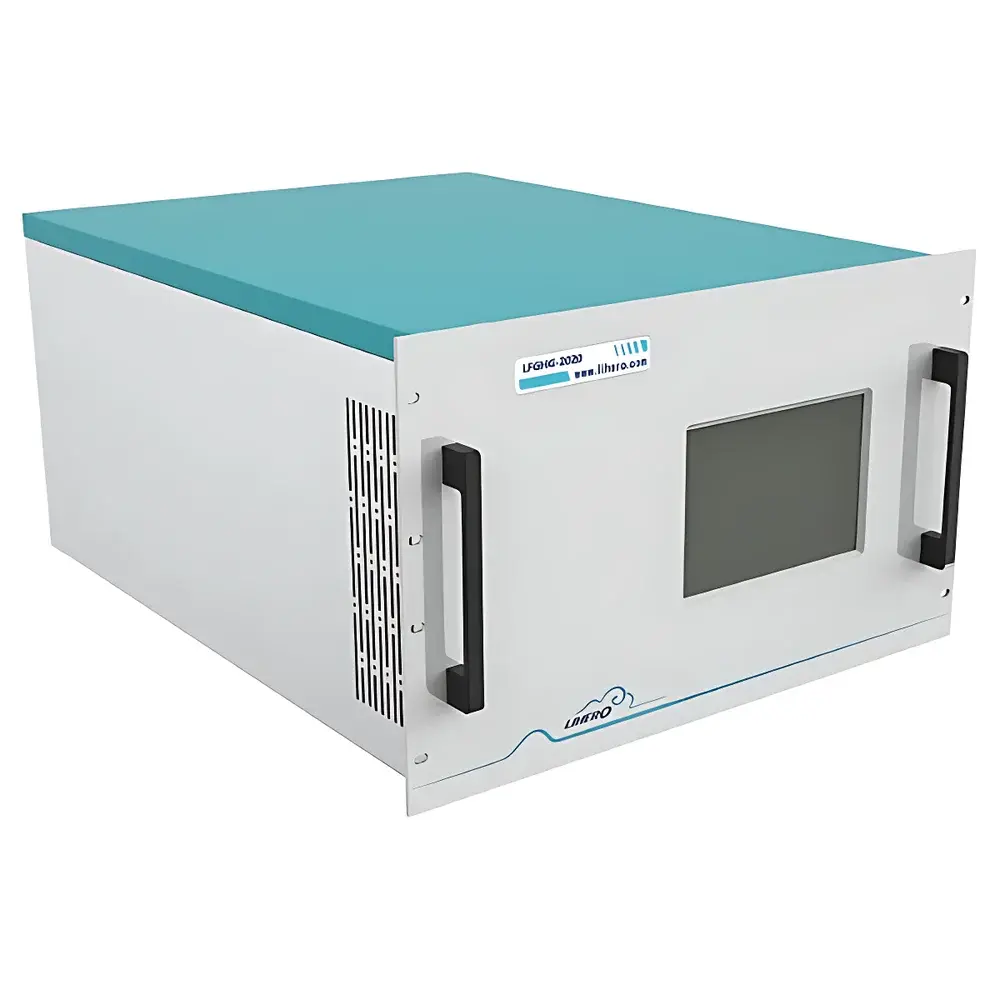
Lihero LFGHG-2020 Multi-Parameter Emission Source Analyzer
| Brand | Lihero |
|---|---|
| Origin | Hunan, China |
| Manufacturer Type | Authorized Distributor |
| Country of Origin | China |
| Model | LFGHG-2020 |
| Pricing | Available Upon Request |
Overview
The Lihero LFGHG-2020 Multi-Parameter Emission Source Analyzer is a tunable diode laser absorption spectroscopy (TDLAS)-based in-situ gas analyzer engineered for continuous, real-time monitoring of multiple gaseous pollutants directly at industrial emission sources—such as stack outlets, flue ducts, and combustion exhaust streams. It operates on the fundamental principle of near-infrared (NIR) or mid-infrared (MIR) laser absorption, where a narrow-linewidth tunable semiconductor laser scans across characteristic rovibrational absorption lines of target gas molecules (e.g., CO, NO, SO₂, NH₃, CH₄, H₂O). By quantifying wavelength-dependent optical attenuation via Beer–Lambert law modeling, the system delivers quantitative concentration data with high spectral resolution and minimal cross-sensitivity. Designed for harsh industrial environments, the LFGHG-2020 integrates robust optical architecture with thermally decoupled measurement cells to ensure metrological stability under fluctuating ambient and process temperatures.
Key Features
- Multi-gas capability: Simultaneous detection of up to six gas species via multi-wavelength laser scanning or time-multiplexed dual-laser configuration, configurable per application requirements.
- Thermally isolated optical path: Critical optical components—including collimators, beam splitters, and photodetectors—are physically separated from the high-temperature gas cell (>200 °C operational range), minimizing thermal drift and preserving long-term alignment integrity.
- Suspended optical mount with anti-vibration damping: The entire optical train is mounted on elastomeric isolators and mechanically tuned to suppress low-frequency mechanical resonance, ensuring immunity to plant-floor vibrations and structural harmonics.
- Zero-gas spectral subtraction: Utilizes a compact, low-volume heated gas cell (<150 mL) enabling rapid zero-air purging (<30 s cycle time) and real-time background spectrum acquisition—effectively suppressing broadband scattering artifacts, etalon fringes, and detector baseline drift.
- In-situ probe design: Integrated heated sampling probe with ceramic filtration, automatic condensate purge, and NIST-traceable calibration port supports direct insertion into hot, humid, particulate-laden exhaust streams without external sample conditioning systems.
Sample Compatibility & Compliance
The LFGHG-2020 is validated for continuous monitoring of gaseous emissions in compliance with national and international regulatory frameworks, including China’s HJ 75–2017 and HJ 76–2017 technical specifications for CEMS, as well as reference methods aligned with EPA Method 3A (for O₂), Method 6C (SO₂), Method 7E (NOₓ), and ISO 14956:2002 (air quality—performance criteria for automated measuring systems). Its optical design eliminates reliance on extractive sampling lines, thereby avoiding adsorption losses, catalytic conversion, or phase separation artifacts common in wet-gas applications. The system meets IP65 ingress protection rating and operates reliably within –20 °C to +60 °C ambient temperature range, with gas cell temperature controllable from 120 °C to 220 °C to prevent condensation and maintain molecular line-shape fidelity.
Software & Data Management
Embedded firmware supports dual-mode operation: standalone local display with touchscreen HMI (including real-time spectra visualization, alarm logging, and trend charts), and networked mode via Modbus TCP, RS-485, or optional 4–20 mA analog outputs. The companion Lihero EmissionSuite™ software provides full remote configuration, spectral library management, multi-point calibration validation, and audit-trail-enabled data export compliant with GLP/GMP documentation standards. All measurement events—including zero/span checks, maintenance logs, and firmware updates—are timestamped and digitally signed. Optional integration with third-party SCADA platforms supports IEC 61850 and OPC UA protocols for enterprise-level environmental data aggregation.
Applications
- Continuous Emission Monitoring Systems (CEMS) for coal-fired power plants, cement kilns, and waste incinerators.
- Process optimization and combustion control in petrochemical refineries and syngas production units.
- Ammonia slip monitoring in SCR (Selective Catalytic Reduction) DeNOₓ systems.
- Leak detection and quantification (LDAR) for fugitive VOC and methane emissions in upstream oil & gas facilities.
- Research-grade emission characterization in engine test beds and pilot-scale biomass combustors.
FAQ
Does the LFGHG-2020 require periodic calibration with certified gas standards?
Yes—initial field calibration and quarterly verification using NIST-traceable span gases are recommended per HJ 76–2017 and EPA PS-18 guidelines. The system supports automated zero/span sequence execution with user-defined schedules.
Can it operate in high-dust or high-humidity exhaust streams without sample conditioning?
Yes—the heated probe and integrated ceramic filter enable direct in-situ measurement in particulate concentrations up to 10 g/m³ and relative humidity up to 100% at probe tip, provided condensate purge cycles are enabled.
Is the firmware upgradeable in the field?
Yes—firmware updates are delivered via secure USB or Ethernet connection and include version rollback capability and cryptographic signature verification.
What data output formats are supported for regulatory reporting?
CSV, XML, and PDF reports compliant with China’s national CEMS data format standard (HJ 212–2017), plus configurable Modbus register mapping for integration with central DCS/SCADA systems.
Does the system support dual-laser configuration for simultaneous NO and NO₂ measurement?
Yes—optional dual-TDL configuration enables independent wavelength tuning for overlapping absorption features, supporting speciated NOₓ analysis without chemical conversion.







