
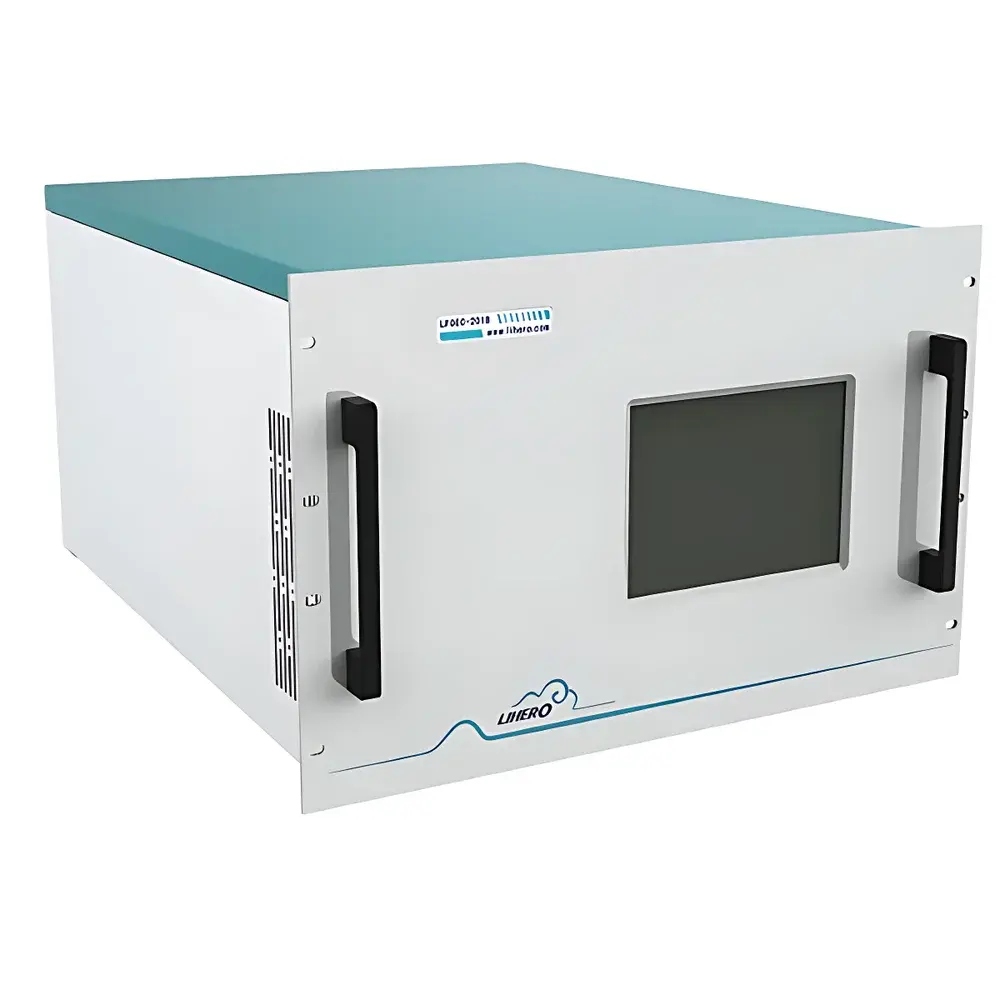
Lihero LFOEC-2018 Online OC/EC Analyzer for Ambient Air Particulate Matter
| Brand | Lihero |
|---|---|
| Model | LFOEC-2018 |
| Measurement Principle | Thermal-Optical Transmittance (TOT) and Thermal-Optical Reflectance (TOR) |
| Compliance | ASTM D7566 Annex C, IMPROVE_A, NIOSH 5040 |
| Detection Range | 0.1–500 µgC/m³ (OC & EC, typical) |
| Sample Medium | Ambient air particulate matter collected on quartz fiber filters |
| Operating Temperature | 10–35 °C |
| Relative Humidity | ≤80% RH (non-condensing) |
| Power Supply | 220 VAC ±10%, 50 Hz |
| Dimensions | 600 × 500 × 700 mm (W×D×H) |
| Weight | ~65 kg |
Overview
The Lihero LFOEC-2018 Online OC/EC Analyzer is a fully automated, laboratory-grade instrument engineered for continuous, real-time quantification of organic carbon (OC) and elemental carbon (EC) in ambient airborne particulate matter (PM2.5 and PM10). It implements the thermal-optical analysis (TOA) principle—specifically compliant with both Thermal-Optical Transmittance (TOT) and Thermal-Optical Reflectance (TOR) protocols—as defined in widely adopted regulatory and research standards including ASTM D7566 Annex C, the IMPROVE_A protocol, and NIOSH Method 5040. The system thermally desorbs OC fractions under inert atmosphere (He), followed by oxidative conversion of pyrolyzed carbon and residual EC under oxidizing atmosphere (He/O2), while simultaneously monitoring optical attenuation or reflectance changes on the quartz filter substrate via a 635 nm laser diode. This dual-mode optical correction compensates for charring artifacts inherent in thermal separation, enabling high-fidelity speciation of carbonaceous aerosols critical for source apportionment, climate modeling, and regulatory PM compliance monitoring.
Key Features
- Dual-protocol capability: Simultaneous TOT and TOR analysis within a single run, supporting method flexibility for regional regulatory alignment (e.g., U.S. EPA, EU EMEP, China HJ 656-2013).
- Integrated thermal reactor design: Short-path furnace architecture minimizes volatile organic compound (VOC) loss during transfer from pyrolysis to oxidation zones, enhancing mass recovery and reducing analytical bias.
- Precision temperature control: High-stability alloy heating elements coupled with PID-based multi-zone thermal profiling ensure reproducible ramp rates (e.g., 1–5 °C/s), dwell accuracy (±0.5 °C), and long-term thermal stability over extended unattended operation.
- Modular optical train: Simplified beam path with removable collimating optics and anti-contamination lens mounts enables rapid field maintenance without recalibration.
- Ergonomic filter handling: Tool-free quartz filter cassette insertion and ejection mechanism reduces operator exposure and ensures consistent positioning for optical baseline consistency.
- Embedded industrial touchscreen interface: Linux-based HMI with intuitive workflow navigation, real-time thermal profile visualization, and configurable alarm thresholds for temperature deviation, gas flow interruption, or optical signal drift.
Sample Compatibility & Compliance
The LFOEC-2018 accepts standard 47 mm quartz fiber filters (e.g., Pallflex QAT-UP, Whatman QMA) pre-loaded via compatible ambient air samplers (e.g., TEOM, Hi-Vol, or sequential dichotomous systems). Filter loading duration is programmable (typically 24–72 h), and sample mass range is optimized for typical urban/rural background concentrations (0.5–200 µg/cm²). All operational parameters—including carrier gas purity (99.999% He, 99.995% O2), flow calibration traceability (NIST-traceable mass flow controllers), and thermal program validation—are documented per GLP requirements. Data output meets audit-ready formatting for integration into environmental data management systems compliant with ISO/IEC 17025 and U.S. EPA QA/G-5 guidance.
Software & Data Management
The analyzer runs proprietary firmware (v3.2+) with embedded data acquisition at 10 Hz temporal resolution. Raw thermal profiles, optical signals, and gas chromatographic-like carbon evolution curves are timestamped and stored locally on a redundant SD card and internal SSD. Export formats include CSV (with header metadata), NetCDF (CF-compliant), and XML (for EPA AQS submission). Remote access is supported via secure TLS-enabled web server (HTTPS), enabling real-time status monitoring, parameter adjustment, and diagnostic log retrieval. Audit trails record all user actions, method changes, and calibration events—fully aligned with FDA 21 CFR Part 11 requirements for electronic records and signatures where applicable.
Applications
- Long-term ambient air quality monitoring networks (e.g., national reference stations, supersites)
- Source contribution analysis using EC/OC ratios and secondary organic aerosol (SOA) proxy metrics
- Validation of satellite-based aerosol optical depth (AOD) retrievals through ground-truth carbon speciation
- Health impact studies correlating carbonaceous PM exposure with respiratory morbidity endpoints
- Industrial emission characterization near combustion facilities, traffic corridors, and biomass burning zones
- Method development and intercomparison studies within international collaborative programs (e.g., ACTRIS, EUSAAR)
FAQ
What carbon fractionation protocols does the LFOEC-2018 support?
It natively executes both TOT and TOR methodologies per IMPROVE_A and NIOSH 5040 specifications, with user-selectable temperature ramps and atmosphere switching logic.
Is the system compatible with existing air sampling infrastructure?
Yes—it interfaces directly with standard filter-based samplers using 47 mm quartz substrates; optional vacuum manifold adapters are available for seamless integration.
How frequently does the optical path require cleaning?
Under typical urban ambient conditions, optical components require inspection every 30 days and cleaning every 90 days—facilitated by the quick-release lens mount design.
Does the analyzer provide traceable calibration documentation?
Each unit ships with factory calibration certificates for thermal sensors (NIST-traceable RTDs), mass flow controllers (ISO/IEC 17025 accredited), and laser power output (calibrated photodiode reference).
Can raw thermal-optical chromatograms be exported for third-party reanalysis?
Yes—full-resolution time-series data (temperature, laser transmittance/reflectance, CO2 signal, gas flows) are exportable in open-format CSV and NetCDF for offline processing using tools such as OC-EC Analysis Toolkit or custom Python/Matlab scripts.
Related Products







