
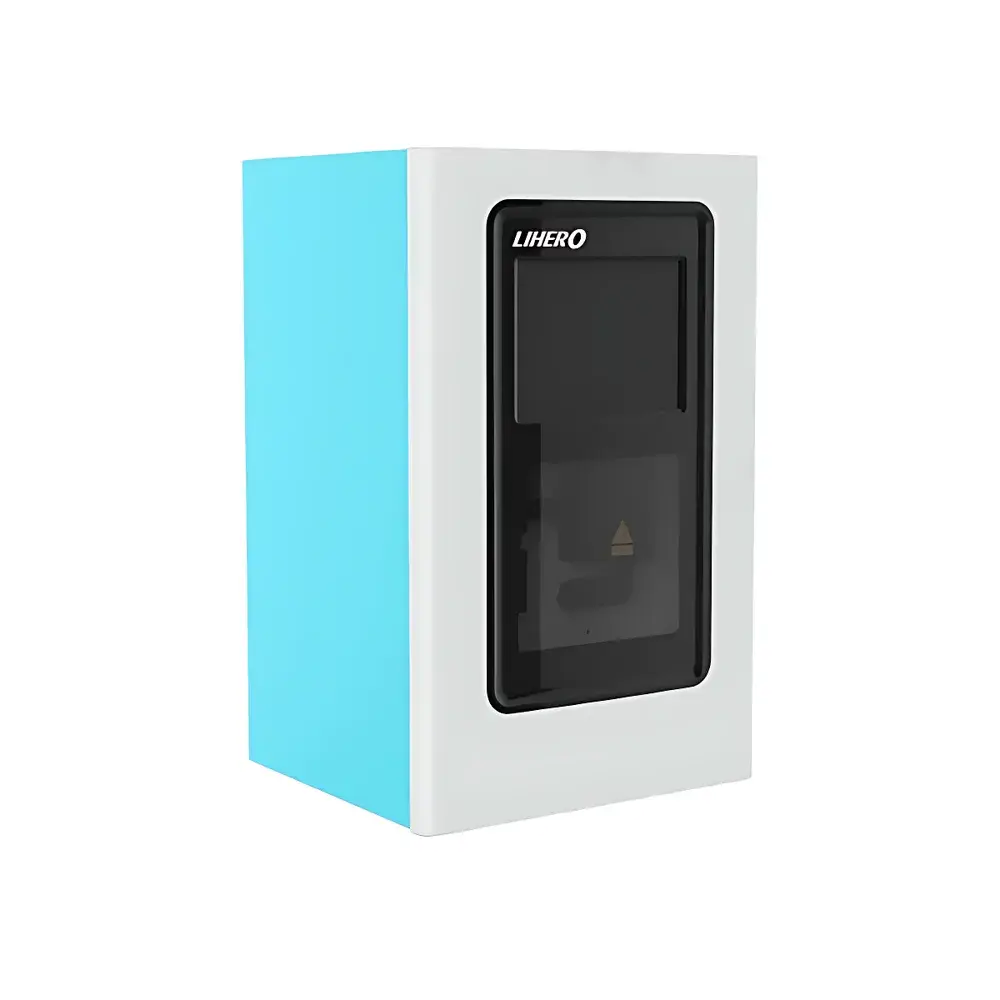
Lihero LFS-2002(TCl) Online Residual Chlorine, Total Chlorine and Chlorine Dioxide Analyzer
| Brand | Lihero |
|---|---|
| Model | LFS-2002(TCl) |
| Type | Online Analyzer |
| Measurement Principle | DPD Colorimetric Spectrophotometry at 520 nm |
| Sample Turnaround Time | ≤20 min per analysis |
| Reagent Switching Capability | Residual Chlorine / Total Chlorine / Chlorine Dioxide |
| Calibration Modes | Zero Check, Span Check, Standard Calibration, Curve Auto-Standardization, Spike Recovery Test |
| Self-Diagnostics | Component Failure, Over-Range, Abnormal Data, Reagent/Water Depletion Alarms |
| Maintenance Functions | Automatic Optical Path Balancing, Scheduled Cleaning, Auto-Calibration, Auto-Range Switching |
| Compliance Support | Designed for ASTM D1253, ISO 7393-2, EPA Method 334.0, and GB/T 5750.11–2023 (China National Standard) |
Overview
The Lihero LFS-2002(TCl) is a fully automated online analyzer engineered for continuous, high-reliability monitoring of residual chlorine, total chlorine, and chlorine dioxide in potable water, wastewater effluent, and distribution system networks. It implements the internationally recognized DPD (N,N-diethyl-p-phenylenediamine) colorimetric method—standardized under ASTM D1253, ISO 7393-2, EPA Method 334.0, and China’s GB/T 5750.11–2023. In this method, free chlorine or total chlorine oxidizes DPD to form a stable magenta-colored quinoneimine dye, with maximum absorbance at 520 nm. The instrument employs a precision dual-beam photometric detection system to quantify absorbance changes with high linearity and low drift, enabling accurate concentration determination across dynamic water matrices.
Key Features
- Sub-20-minute cycle time from sample aspiration to result output—optimized for real-time process feedback without compromising analytical rigor.
- Integrated turbidity compensation algorithm mitigates interference from suspended solids, ensuring robust performance in raw water or secondary effluent applications.
- Modular reagent cartridge design allows seamless switching between residual chlorine, total chlorine, and chlorine dioxide measurement protocols via software-selectable assay configuration.
- Comprehensive calibration and verification suite: zero-point verification, span validation, multi-point standard calibration, full working curve auto-standardization, and automated spike recovery assessment—all executed without manual intervention.
- Self-monitoring architecture includes real-time diagnostics for optical path stability, pump performance, valve actuation, heater status, and reagent/water level thresholds.
- Automated maintenance routines include scheduled decontamination of fluidic pathways, optical cell cleaning, and periodic recalibration—reducing operational overhead and minimizing downtime.
- Dynamic range adaptation enables automatic selection of optimal measurement range based on incoming sample concentration, preserving resolution at both trace (e.g., 0.02–2.0 mg/L Cl₂) and elevated levels (e.g., 0.5–10.0 mg/L Cl₂).
Sample Compatibility & Compliance
The LFS-2002(TCl) accepts untreated or filtered water samples with turbidity up to 50 NTU and total suspended solids (TSS) ≤100 mg/L. It operates reliably across pH 4.0–8.5 and temperatures of 5–40 °C. Its hardware and firmware architecture supports audit-ready data integrity: all calibrations, alarms, maintenance logs, and measurement events are timestamped and stored locally with optional encrypted upload to SCADA or LIMS platforms. The system is configurable to meet GLP-compliant recordkeeping requirements, including electronic signature support and 21 CFR Part 11–ready audit trails when deployed with validated IT infrastructure.
Software & Data Management
Embedded Linux-based firmware provides web-accessible configuration, remote diagnostics, and real-time trend visualization via HTTPS-secured interface. Data export supports CSV, Modbus TCP, and OPC UA protocols for integration into industrial automation ecosystems. All measurement records include metadata: sample ID, operator tag (if enabled), calibration history, alarm flags, and environmental sensor readings (e.g., temperature, pressure). Firmware updates are delivered via signed package files to ensure version control and cybersecurity compliance.
Applications
- Drinking water treatment plants: Continuous monitoring at chlorine contact tanks, clearwells, and distribution system entry points.
- Wastewater disinfection control: Verification of post-secondary or tertiary disinfection efficacy prior to discharge.
- Swimming pool and recreational water management: Regulatory compliance with WHO and national hygiene standards.
- Pharmaceutical facility utilities: Monitoring of purified water and water-for-injection (WFI) loop sanitization cycles.
- Food & beverage processing: Validation of CIP rinse water quality and final product water safety.
FAQ
What regulatory methods does the LFS-2002(TCl) comply with?
It adheres to ASTM D1253 (residual chlorine), ISO 7393-2 (total chlorine), EPA Method 334.0 (chlorine dioxide), and GB/T 5750.11–2023 (Chinese drinking water standard).
Can the analyzer operate unattended for extended periods?
Yes—its self-diagnostic capabilities, automatic cleaning cycles, and reagent-level monitoring support unattended operation for up to 30 days with appropriate reagent volume and maintenance scheduling.
Is remote firmware update supported?
Yes, secure over-the-air (OTA) updates are available through authenticated HTTPS channels with cryptographic signature verification.
How is data integrity ensured during transmission?
All data packets include checksums and TLS 1.2 encryption; local storage uses write-protected flash memory with cyclic redundancy checking (CRC) for long-term reliability.
Does the system support integration with existing SCADA platforms?
Yes—native Modbus TCP and OPC UA server functionality enable plug-and-play connectivity with major industrial control systems without middleware.
Related Products







