
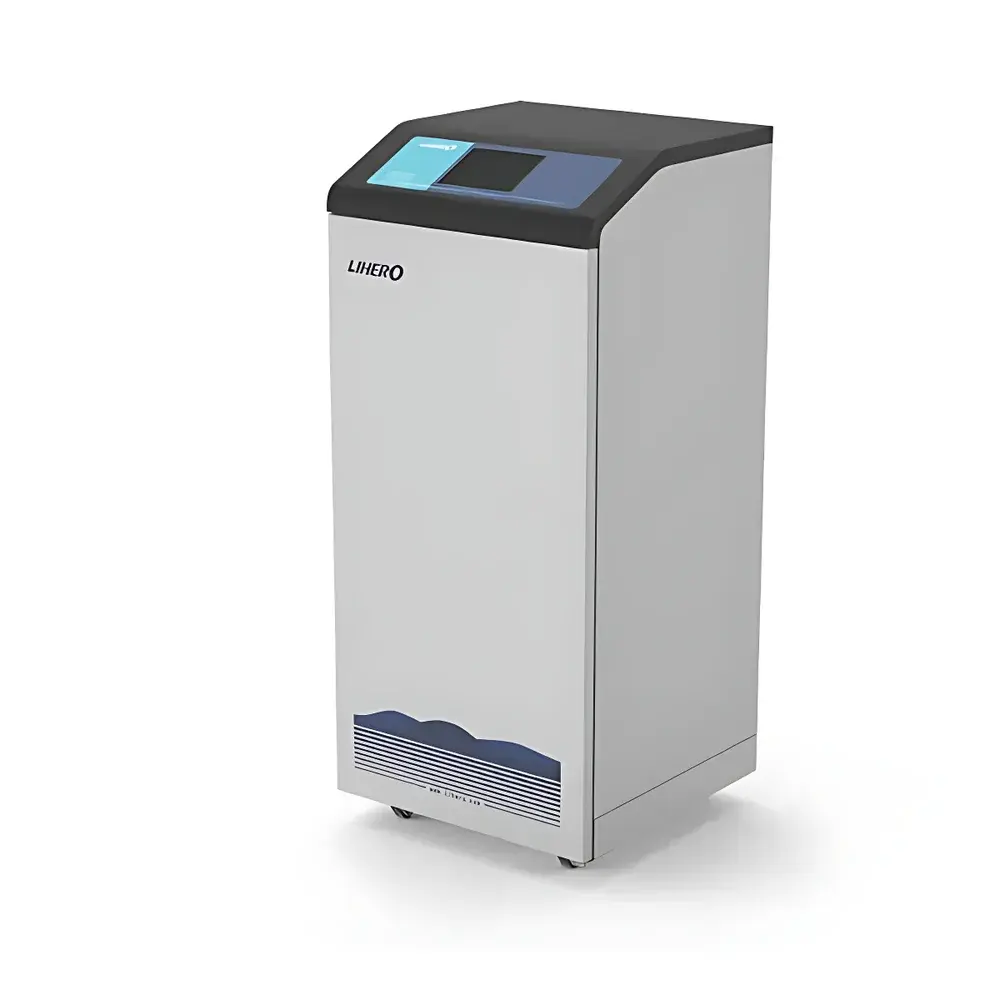
Lihero LHWTE-2014 Waste Liquid Treatment System
| Brand | Lihero |
|---|---|
| Origin | Hunan, China |
| Manufacturer Type | Authorized Distributor |
| Country of Manufacture | China |
| Model | LHWTE-2014 |
| Pricing | Available Upon Request |
| Treatment Capacity | ≥10 L/h |
| pH Adjustment Range | 6–9 |
| Treatment Stages | Neutralization & Sedimentation → Activated Carbon Filtration → Ion Exchange Resin Column |
| Automation Features | Real-time Monitoring with Alarms for Treatment Efficiency, Overflow, and Pipeline Blockage |
Overview
The Lihero LHWTE-2014 Waste Liquid Treatment System is an engineered solution designed for the safe, compliant, and continuous post-analytical management of laboratory-generated aqueous waste streams. It operates on a sequential physicochemical treatment principle: first adjusting effluent pH to a neutral range (6–9) to facilitate metal hydroxide precipitation and organic stabilization; followed by sedimentation to remove suspended solids and precipitated contaminants; then subjecting the clarified supernatant to dual-stage adsorptive purification—first through granular activated carbon (GAC) to eliminate residual organics, chlorine, color, and odor compounds; and finally through a regenerable ion exchange resin column targeting dissolved heavy metals, anions (e.g., nitrate, phosphate), and trace cations. This multi-barrier architecture ensures consistent effluent quality suitable for discharge into municipal sewer systems in accordance with local environmental regulations, while minimizing secondary pollution risks associated with untreated or partially treated lab waste.
Key Features
- Modular, skid-mounted design enabling rapid integration into existing laboratory utility infrastructure without major civil modifications.
- Automated pH control loop with precision dosing pumps and real-time pH sensor feedback, maintaining setpoint stability within ±0.3 units across variable influent loads.
- Dual-stage filtration train: high-capacity GAC column (standard 10×50 mesh coconut shell carbon) paired with a customizable mixed-bed or selective chelating resin configuration, depending on anticipated contaminant profile.
- Integrated level monitoring system with ultrasonic sensors in collection, neutralization, and treated effluent tanks—triggering audible/visual alarms and automatic pump shutdown upon high-level or low-level thresholds.
- Embedded fault-detection logic for flow obstruction: differential pressure transducers across filter columns activate maintenance alerts when ΔP exceeds preset operational limits, indicating carbon exhaustion or resin fouling.
- Low-energy operation: gravity-assisted flow between unit operations where feasible; all pumps are 24 V DC brushless types with variable-frequency drive capability for adaptive flow regulation.
Sample Compatibility & Compliance
The LHWTE-2014 is validated for treating non-hazardous, water-miscible liquid waste generated from routine analytical instrumentation—including HPLC mobile phase waste, GC carrier gas scrubber condensates, spectrophotometer rinse solutions, and general lab sink drainage (excluding halogenated solvents, concentrated acids/bases >6 M, cyanide-containing solutions, or radioactive materials). Its treatment output meets China’s Comprehensive Wastewater Discharge Standard (GB 8978–1996) Class III requirements for pH, turbidity, CODCr, and total heavy metals (Pb, Cd, Cr, Ni, Cu, Zn). While not certified to ISO 14001 or EPA 40 CFR Part 261 out-of-the-box, the system’s modular construction and documented process parameters support third-party validation for GLP-compliant laboratories requiring auditable waste handling protocols.
Software & Data Management
The system includes a local HMI touchscreen interface (7-inch resistive LCD) running embedded Linux firmware. It logs timestamped records of pH values, tank levels, pump runtime, alarm events, and cumulative treated volume—stored internally for up to 90 days. Data export is supported via USB 2.0 port in CSV format for integration into institutional LIMS or environmental compliance reporting workflows. Audit trail functionality complies with basic ALCOA+ principles (Attributable, Legible, Contemporaneous, Original, Accurate), including operator ID tagging for manual override actions. Remote monitoring is available via optional RS-485 Modbus RTU interface for connection to building management systems.
Applications
- Centralized waste treatment for analytical labs operating multiple HPLC, IC, or AAS instruments generating low-to-moderate volume acidic/basic eluents.
- Environmental testing facilities managing standardized leachate or soil extract samples prior to disposal.
- Pharmaceutical QC labs requiring documented, repeatable neutralization and adsorption steps for solvent-free aqueous process rinsates.
- University teaching laboratories seeking a pedagogically transparent system to demonstrate core wastewater treatment unit operations: neutralization kinetics, sedimentation dynamics, adsorption isotherms, and ion exchange equilibria.
- Contract research organizations (CROs) needing scalable, CE-marked (via distributor certification) waste infrastructure aligned with ISO/IEC 17025 clause 4.13 on sample integrity and environmental responsibility.
FAQ
What types of laboratory waste streams are compatible with the LHWTE-2014?
It is intended for non-halogenated, non-viscous, aqueous-based waste with total suspended solids (TSS) < 50 mg/L and organic load (COD) 4 M), alkalis (>2 M), or cytotoxic agents must be segregated and handled separately.
Can the resin column be regenerated on-site?
Yes—the standard configuration uses a regenerable chelating resin (e.g., Amberlite IRC748 or equivalent), with regeneration protocol and chemical consumption data provided in the technical manual. Regeneration frequency depends on influent metal concentration and throughput.
Is remote monitoring or cloud-based data logging supported?
The base unit supports only local HMI and USB export. Optional Ethernet-to-Modbus gateway modules enable integration with SCADA or cloud platforms; custom firmware development for MQTT/HTTPS endpoints is available under OEM agreement.
Does the system require annual calibration or third-party certification?
pH sensors require quarterly verification using NIST-traceable buffer standards; no formal recalibration is needed unless drift exceeds ±0.2 units. Annual preventive maintenance (filter replacement, pump inspection, sensor cleaning) is recommended but not mandated by regulatory bodies for this class of equipment.
How is compliance with local discharge permits verified?
Users must perform periodic grab sampling of treated effluent and submit analyses to accredited labs per their municipal authority’s specified parameters (e.g., pH, conductivity, heavy metals). The LHWTE-2014 provides the engineering controls and documentation framework—but final permit adherence remains the facility’s regulatory responsibility.



