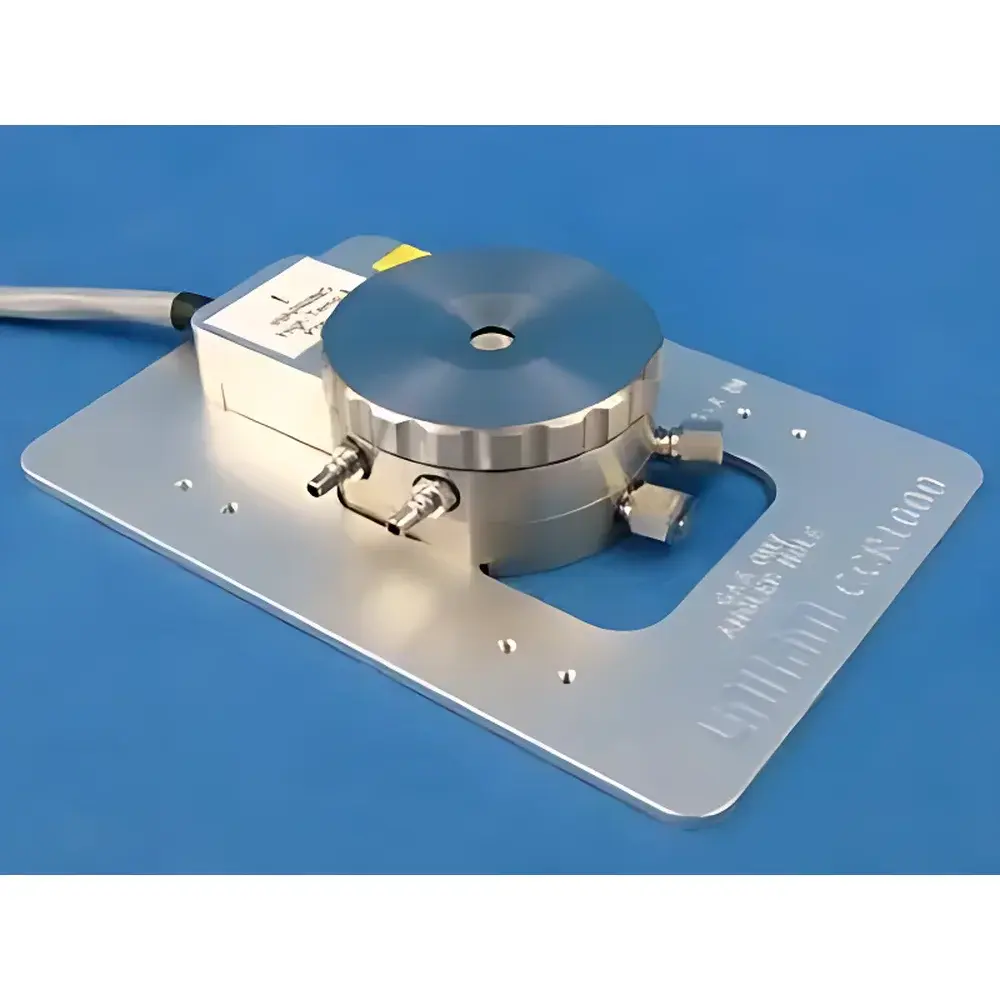
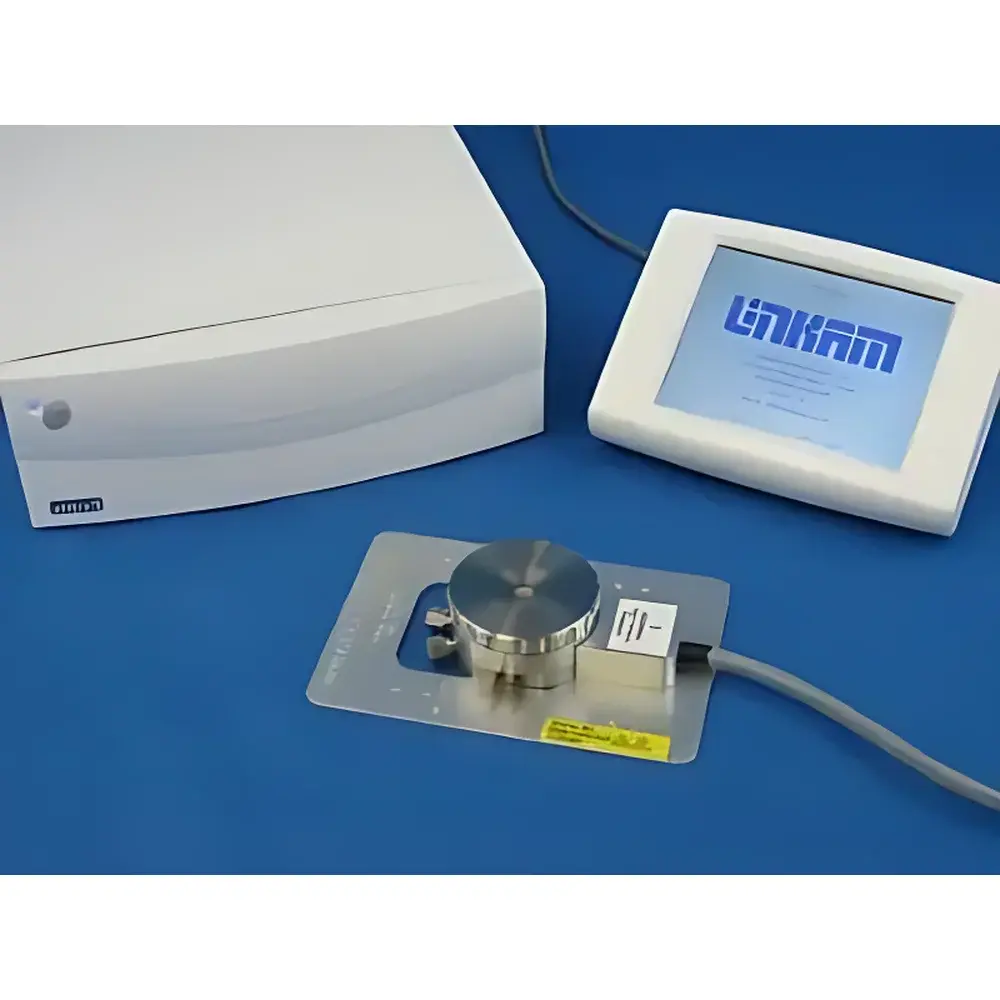
Linkam CCR1000 High-Temperature Catalytic Reaction Stage
| Brand | Linkam |
|---|---|
| Origin | United Kingdom |
| Model | CCR1000 |
| Temperature Range | Ambient to 1000 °C |
| Heating Rate | 1–130 °C/min |
| Temperature Stability | ±1 °C |
| Maximum Pressure | 5 bar (with quartz window) |
| Sample Diameter | 7 mm |
| Sample Mass | 70–100 mg |
| Gas Inlet | 1/16″ stainless steel high-pressure tubing |
| Working Distance for Objective Lens | 6 mm |
| Window Compatibility | Reflectance microscopy, Raman spectroscopy, FTIR |
| Cooling | Integrated water-cooled jacket |
| Construction Materials | Non-reactive ceramics, inert ceramic fiber filter, quartz or sapphire optical windows |
Overview
The Linkam CCR1000 High-Temperature Catalytic Reaction Stage is an engineered solution for in situ and operando characterization of heterogeneous catalytic processes under controlled thermal, pressure, and gaseous environments. Designed explicitly for integration with optical analytical platforms—including reflected-light microscopes, confocal Raman spectrometers, and Fourier-transform infrared (FTIR) systems—the CCR1000 enables real-time observation and spectroscopic interrogation of catalyst morphology, phase transformation, surface adsorption, and reaction intermediates during active operation. Its core architecture employs a resistively heated ceramic tube with embedded heating elements, ensuring uniform radial temperature distribution across the sample zone while minimizing thermal gradients. The stage operates on the principle of direct conductive heating of the catalyst bed supported on a porous, chemically inert ceramic fiber filter—eliminating metal contamination risks and enabling compatibility with aggressive reactive gases (e.g., H₂S, Cl₂, NH₃, HF) without degradation of thermal performance or structural integrity.
Key Features
- Temperature capability from ambient to 1000 °C, with programmable ramp rates from 1 to 130 °C/min and long-term stability within ±1 °C at setpoint.
- Integrated water-cooled outer jacket maintains external housing temperature below 40 °C, ensuring safe handling and compatibility with temperature-sensitive microscope stages and optical mounts.
- Gas delivery system utilizes 1/16″ stainless steel high-pressure tubing; inlet gas is preheated within the reactor body to match the reaction zone temperature—preventing condensation and wall deposition prior to analysis by mass spectrometry, GC-MS, or online IR.
- Narrow-bore ceramic heater geometry minimizes dead volume (< 50 µL), critical for kinetic studies requiring precise residence time control and rapid gas-phase response.
- Modular optical window assembly supports interchangeable quartz (UV–VIS–NIR), sapphire (broadband IR up to ~5.5 µm), or CaF₂ windows—enabling spectral optimization across analytical modalities.
- All wetted and sample-contacting components—including filter support, heater sleeve, and gas path—are fabricated from high-purity alumina ceramics and non-reactive refractory fibers, ensuring chemical inertness under oxidizing, reducing, and corrosive atmospheres.
Sample Compatibility & Compliance
The CCR1000 accommodates solid catalyst samples up to 7 mm in diameter and 70–100 mg in mass, mounted directly onto a low-cost, disposable ceramic fiber filter that permits unrestricted gas permeation while retaining fine particulates. Its design conforms to standard mechanical interfaces for inverted and upright optical microscopes, with a fixed 6 mm objective working distance optimized for high-NA dry and long-working-distance objectives. The stage meets material compatibility requirements outlined in ASTM D7269 (catalyst thermal stability testing) and supports experimental protocols aligned with ISO 18382 (heterogeneous catalysis—activity measurement). When operated with validated gas-handling accessories and calibrated thermocouples traceable to NIST standards, data generated satisfies GLP documentation prerequisites for catalyst screening reports submitted to regulatory dossiers.
Software & Data Management
The CCR1000 is fully compatible with Linkam’s TC125 temperature controller and associated LinkSoftware™ platform (v5.0+), supporting synchronized acquisition of temperature, pressure, and gas flow parameters alongside third-party imaging or spectroscopic data streams via TTL triggering and analog/digital I/O. All temperature programs are timestamped and logged with audit-trail metadata—including operator ID, firmware version, and calibration certificate expiry—ensuring compliance with FDA 21 CFR Part 11 requirements when deployed in GMP-compliant QC laboratories. Export formats include CSV, HDF5, and MATLAB-compatible .mat files for downstream kinetic modeling (e.g., Arrhenius analysis, Langmuir–Hinshelwood fitting) and multivariate spectral deconvolution.
Applications
- In situ monitoring of coke formation, sintering, and redox-induced phase segregation in Ni-, Co-, and Pt-based reforming catalysts.
- Operando Raman identification of surface-bound carbonyls, nitrosyls, and oxygenate intermediates during CO hydrogenation or selective catalytic reduction (SCR).
- Time-resolved FTIR tracking of adsorbed NOₓ species evolution on V₂O₅–WO₃/TiO₂ SCR catalysts under transient lean–rich cycling.
- Hot-stage microscopy of molten salt infiltration dynamics in molten carbonate fuel cell (MCFC) electrode structures.
- Thermal desorption spectroscopy (TDS) coupling with quadrupole mass spectrometry for quantifying binding energies of probe molecules on zeolitic frameworks.
FAQ
Can the CCR1000 be used under vacuum conditions?
Yes—when equipped with appropriate vacuum-rated seals and quartz windows, it supports base pressures down to 10⁻³ mbar; however, maximum operating temperature is reduced to 800 °C to ensure seal integrity.
Is calibration of the integrated thermocouple traceable to national standards?
Each unit ships with a factory calibration certificate referencing ITS-90; optional on-site recalibration services include NIST-traceable reference junction verification and spatial gradient mapping.
What is the maximum recommended gas flow rate for kinetic studies?
For laminar flow regime and minimal axial dispersion, the recommended range is 5–50 mL/min (STP); higher flows require computational fluid dynamics (CFD) validation for residence time distribution modeling.
Does the ceramic fiber filter contribute to background Raman or IR signals?
No—the proprietary aluminosilicate composition exhibits negligible Raman cross-section above 100 cm⁻¹ and no intrinsic absorption bands in the mid-IR fingerprint region (4000–400 cm⁻¹).
Can the CCR1000 be retrofitted to existing Linkam stages?
It is mechanically and electrically independent but shares mounting dimensions with the LTS420 and THMS600 series, allowing straightforward integration into multi-stage optical setups using standard Linkam adapter plates.