
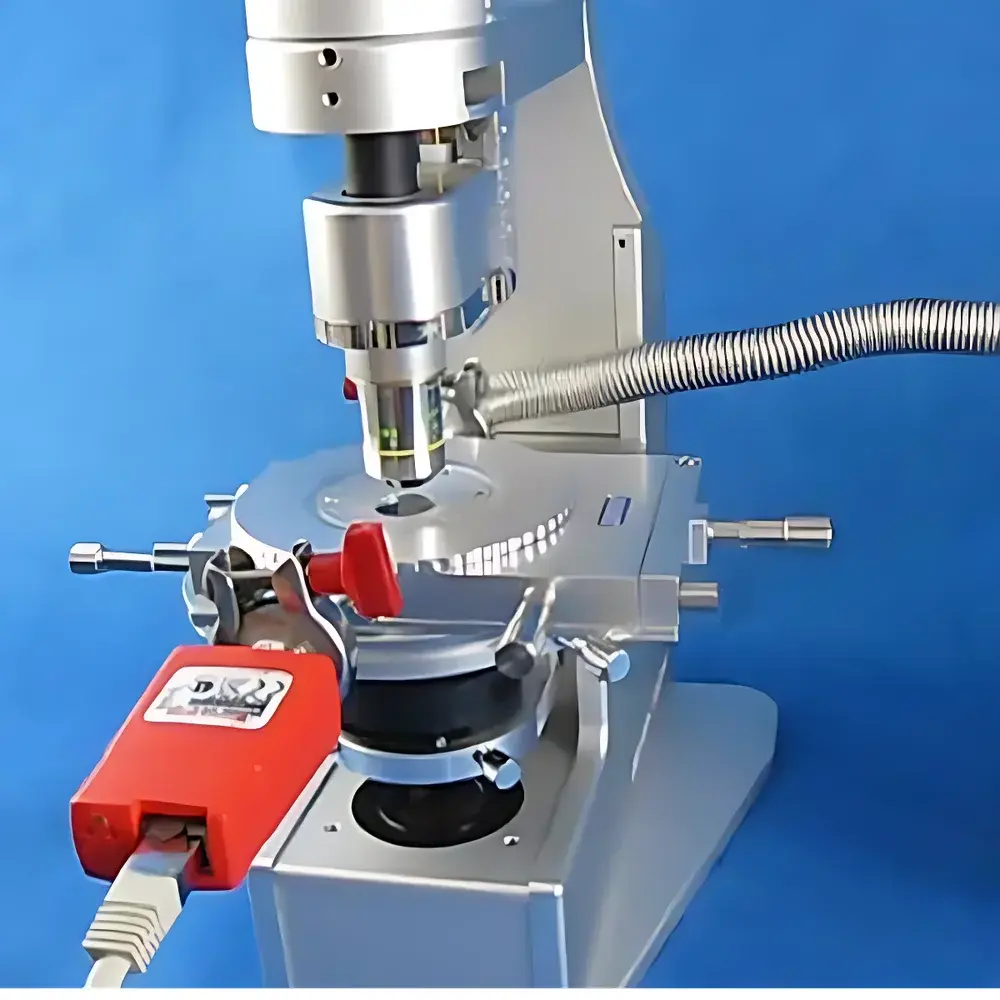
Linkam THMS350V Cryo-Heating Stage for Freeze-Drying Microscopy
| Brand | Linkam |
|---|---|
| Origin | United Kingdom |
| Model | THMS350V |
| Temperature Range | −196 °C to +350 °C (with LN₂ cooling) |
| Vacuum Range | Down to 10⁻³ mbar |
| Heating/Cooling Rate | 0.01–30 °C/min |
| Temperature Stability | < ±0.1 °C |
| Sensor | 100 Ω Pt RTD |
| Sample Area | Ø22 mm |
| XY Translation Range | 16 mm |
| Optical Aperture | Ø1.3 mm |
Overview
The Linkam THMS350V Cryo-Heating Stage is a precision-engineered thermal stage designed specifically for in situ optical microscopy of freeze-drying (lyophilization) processes. It integrates high-fidelity temperature control with active vacuum regulation—enabling real-time observation of phase transitions, collapse behavior, eutectic melting, and pore structure evolution during primary and secondary drying. Based on the proven low-pressure thermal architecture of the FDCS196 Freeze-Drying Control System, the THMS350V extends operational range to −196 °C (using liquid nitrogen cryocooling) and +350 °C, while maintaining sub-millibar vacuum stability (<10⁻³ mbar) with only a standard 2.5 m³/h rotary vane pump. Its design adheres to fundamental principles of heat and mass transfer under reduced pressure, allowing direct correlation between microscopic structural changes and thermodynamic parameters—critical for rational development of lyophilization cycles in pharmaceutical, biologics, and advanced materials research.
Key Features
- Wide operational temperature range: −196 °C to +350 °C, programmable with ramp/soak profiles and derivative-based event detection
- Integrated Pirani vacuum gauge mounted directly on the stage chamber for real-time, spatially uniform pressure monitoring and feedback-controlled regulation via MV196 motorized valve
- Optimized thermal architecture featuring direct cryogen injection into the heating element, enabling rapid cooling without condensation on optical windows or sample surface
- High-precision 100 Ω platinum resistance thermometer (Pt RTD) with <±0.1 °C short-term stability and NIST-traceable calibration support
- Compact 22 mm diameter sample area with 1.3 mm central optical aperture—compatible with high-NA objectives, confocal laser scanning, micro-Raman spectroscopy, synchrotron X-ray imaging, and FTIR transmission setups
- Motorized XY manipulator (16 mm travel) for precise tracking of drying front progression and localized thermal event mapping
- Seamless integration with Linkam’s NEXUS imaging platform for time-lapse acquisition; metadata (temperature, pressure, time stamp, ramp rate) embedded directly into each image header
Sample Compatibility & Compliance
The THMS350V accommodates samples as small as 5 µL—minimizing consumption of high-value biopharmaceutical actives, monoclonal antibodies, or novel excipient formulations. Its inert stainless-steel and ceramic construction ensures compatibility with aqueous, organic, and viscous amorphous systems—including protein solutions, polymer blends, and nanosuspensions. The stage meets ISO 13485-aligned manufacturing controls and supports GLP-compliant documentation workflows when paired with validated NEXUS software. Vacuum and temperature logging comply with FDA 21 CFR Part 11 requirements for electronic records and signatures when configured with audit-trail-enabled firmware and user access controls. It is routinely employed in studies referenced in USP , ICH Q5C, and Ph. Eur. 2.9.40 methodologies for lyophilized product characterization.
Software & Data Management
Control and data acquisition are managed through Linkam’s proprietary TMS94 software, which provides synchronized logging of temperature, pressure, heating/cooling rate, and user-defined events at up to 10 Hz resolution. Experimental protocols can be saved, versioned, and reloaded to ensure method reproducibility across instruments and laboratories. Export formats include CSV, HDF5, and TIFF stacks with embedded EXIF metadata—enabling downstream analysis in MATLAB, Python (NumPy/Pandas), or commercial image analytics platforms. Optional IQ/OQ documentation packages support installation and operational qualification per GMP Annex 15 guidelines. Remote operation via Ethernet or USB-C enables integration into automated lab environments and centralized instrument management systems.
Applications
- Determination of critical temperatures: collapse temperature (Tc), eutectic melting point (Teu), and glass transition (Tg’) via real-time morphological assessment under controlled vacuum
- Structural optimization of lyophilized cakes: quantification of pore size distribution, ice crystal anisotropy, and dried matrix homogeneity using phase contrast and polarized light
- Excipient screening and formulation development: comparative evaluation of bulking agents (e.g., mannitol, trehalose) and stabilizers under identical thermal-vacuum stress conditions
- Process validation support: simulation of industrial shelf-ramp cycles, stoppering dynamics, and residual moisture gradients at microscale
- Low-temperature materials science: crystallization kinetics of metallic glasses, polymer phase separation, and solvent-free cryo-gelation mechanisms
FAQ
What vacuum pump is required to achieve 10⁻³ mbar?
A standard 2.5 m³/h two-stage rotary vane pump is sufficient; no turbomolecular or diffusion pump is needed.
Can the THMS350V be used with inverted microscopes?
Yes—the stage is compatible with both upright and inverted configurations via custom mounting adapters and optional bottom-illumination kits.
Is liquid nitrogen handling automated or manual?
LN₂ delivery is manually initiated but fully regulated by integrated level sensors and solenoid valves; auto-refill modules are available as an option.
How is temperature calibration verified?
Calibration is performed using a NIST-traceable reference thermometer inserted into a dedicated bore adjacent to the sample position; certificate-of-calibration is provided with each unit.
Does the stage support dynamic vacuum modulation during temperature ramps?
Yes—pressure setpoints can be programmed as a function of temperature or time, enabling complex profiles such as constant-rate sublimation or pressure-pulse drying protocols.



